
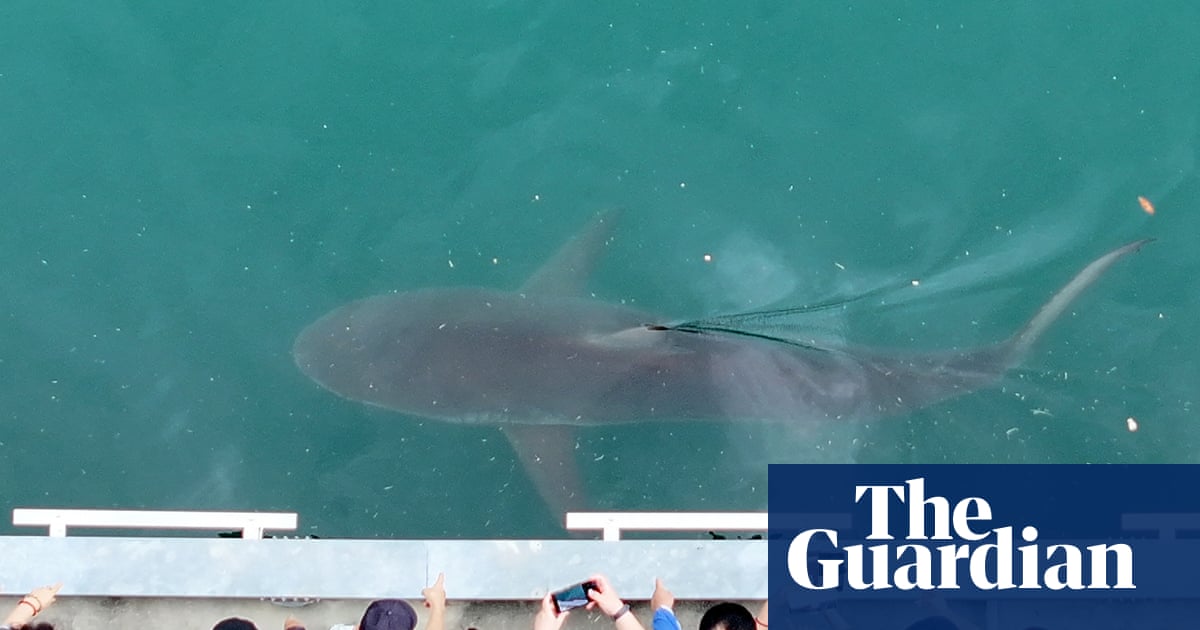
In South Korea, they call them jagyeongdan, a word that sits somewhere between a vigilante group and a neighbourhood watch.
Each night they don hi-vis vests, pick up their selfie sticks, and gather around the harbour in Busan to keep watch over an unlikely charge: a stranded shark affectionately known as Bukang-i.
A month after the shark became trapped in a city canal, the group of self-appointed guardians are taking turns to protect her, patrolling the waterfront at night for visitors who might disturb the animal.
Most are YouTubers who livestream the waterway, from where the shark has become a national celebrity. They stay up through the night, calling out anyone shining torches or lasers into the water. Some of their videos have been watched hundreds of thousands of times.
Visitors watch the shark trapped in a waterway in the south-eastern port city of Busan. Photograph: Jung Yeon-Je/AFP/Getty Images
“They bring fishing lamps, or the kind of lights people use at a campsite,” says Choi Won-jin, one of the shark’s protectors. He arrives as the lights go out along the canal and waits for the offenders Koreans online call “lantern villains”.
The shark has been marooned in the canal since 18 September. Named after Bukhang, the Korean name for the city’s North Port, and about 3 metres long, the female dusky shark is one of a species classed as endangered worldwide. More than 1.6 million visitors have come to see her, the city says, at a park that used to draw about 2,000 people on a busy Saturday.
Authorities have twice tried to guide her back out to sea and a third attempt is due to take place on Wednesday afternoon.
For now though, the shark remains in the canal, drawing crowds by day and leaving a handful of men to keep watch after dark. They patrol the canal’s park to check everything’s in order, eat snacks as the night goes by, and share their grievances on air about the behaviour they witness.
“We’re ordinary members of the public,” says Choi, who has had a YouTube channel for ten years and covers trending issues in South Korea. “So we have no choice but to put it nicely, and get them to understand as best we can.”
“Don’t, please don’t switch the torch on,” says one of them, a YouTuber who lives nearby and goes by the name Na Tae-soo. Most people comply, he says. “The animal thrashes about at night because of the torches, and it’s dangerous.”
Crowds flock to the waterfront park in Busan to see the shark. Photograph: YONHAP/EPA
His footage has captured the shark twisting sharply away from a beam of light at 2am and striking the side of the canal. The national institute of fisheries science later confirmed an abrasion on her snout and said a visitor’s torch likely startled the shark into injury.
Korean media report that 105 officials from seven agencies watch over her, with a team on standby to reach the water within three minutes. Choi disputes this, saying that after dark it is almost up to him and the others.
The waterfront is closed to the public from midnight until five in the morning, a restriction the YouTubers say is impossible to enforce across a park that size. One night, livestreaming from the walkway, Choi filmed a man tipping food waste into the water.
Nobody has seen her feed, though experts say that feeding can happen in an instant and sharks her size need not eat often.
Further attempts to free the shark have been paused on the grounds that more force would distress her.
Cooler water might see her move on. Dusky sharks prefer water between 18C and 26C, the fisheries institute says. Experts put 15C as the point below which her physiological functions would start to decline, and about 11C as the point at which survival becomes precarious. Busan city officials expect the canal to reach that temperature after the middle of November.
This aerial photo taken on 29 September shows the South Korean Coast Guard boats spraying water in an attempt to guide the shark back to the sea. Photograph: YONHAP/AFP/Getty Images
The fisheries institute recorded 46 large sharks off the east coast in the first half of this year, nearly four times as many as a year earlier, which it attributes to warmer seas and more of the fish sharks feed on.
The affection for Bukang-i has meanwhile become an industry, with a commemorative soju, a baseball mascot in a shark cape and an honorary city ambassadorship, and nearby shops reporting a surge in sales. South Korea’s president, Lee Jae Myung, visited the canal in mid-October.
The shark’s guardians thinks she should be forced out. Choi says the city should protect her where she is until she leaves of her own accord.
Kim Jong-hwan, who runs a small business, keeps watch by day as well and has livestreamed her almost every day.
“I went to pass on information [to my followers], and after that I started observing her”, he says. “Watching her over time, with the water pumps being fired and then the nets, I came to find those things being done to her objectionable. So we ended up cheering her on.”
“She’s just an animal, and she came in by her own choice,” Kim says.
“If it gets cold, if there’s no food, if the water doesn’t suit her, she’ll leave by herself. I’d like her to just be left alone, to rest there comfortably until then, and go.”