
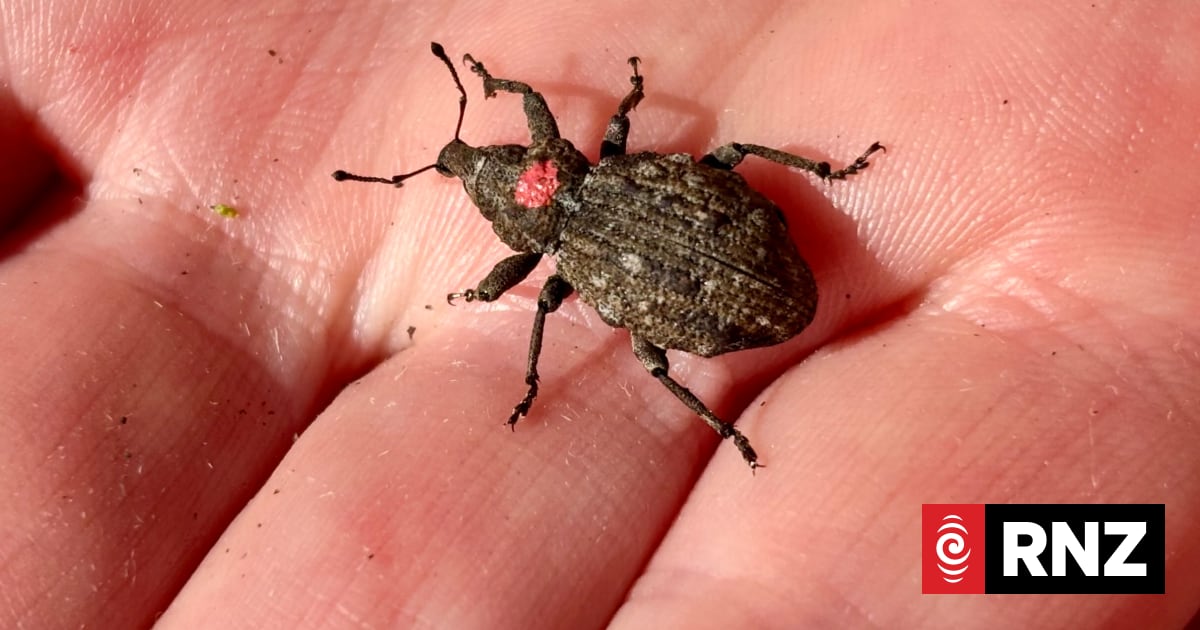
Hundreds of the critically-endangered Canterbury knobbled weevils have been released at a secret location.
The tiny creatures – which are protected under the Wildlife Act – were thought be extinct, but were rediscovered in the early 2000s.
Six of them became 260, after mating in a laboratory in Mosgiel.
Department of Conservation entomologist Tara Murray – who set the weevils free today – told Checkpoint the weevils were “one of the most threatened insects in the country”, but they did not expect them to be quite so easy to rear.
“We didn’t think we’d get so many of them. So we’re pretty chuffed that they’ve produced so many offspring and they’ve survived.”
Murray said the weevils were a native species that would historically have been through a lot of the Canterbury lowlands, and humans had destroyed almost all of their natural habitat, so it was only fair that humans should help them out.
She said today’s release had gone well, with about 215 of the tiny insects placed in special areas.
While she could not reveal where the weevils had been released, Murray said the insects were very particular about what they ate, and the spiky plants they favoured were found in the low foothills of Canterbury.
While owls would have been their main predator in the past, introduced species like hedgehogs and rodents were now the greatest threats to the weevils.
Murray said they had carried out a “soft release” to give the insects their best shot at survival.
“That means we’ve put little cages over the plants that they feed on and then we put the weevils into the middle of the plant and they just hunker down. Straight away they were scurrying right down into the base of the plant, which is exactly what we wanted them to do. And that just gives them the greatest chance of settling in instead of just running away straight away in a panic.
“They settle in, and after a week or two we’ll take cages away and hopefully they’ll stay exactly where they are on those plants.”
Murray said the weevils were charming little creatures.
“What’s not to like? They’re cute, they’re cool, they’re little funny crazy creatures, they look like little tanks, and they’re incredibly diverse.”