
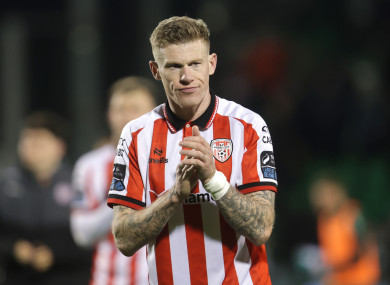
IRISH FOOTBALLER JAMES McClean’s comments in a recent interview about how, as a man, he views speaking to a therapist as a weakness have led to backlash on social media, think pieces in the media and an invitation from a mental health charity to meet him.
Amid the growing conversation, we asked our male readers to share their thoughts on McClean’s comments.
Some felt that the comments were ignorant and could be harmful to those who are struggling, while others felt the footballer was highlighting the existing stigma around male mental health and called for more understanding.
Thank you to everyone who got in touch and shared their own experiences. Here’s some of what you told us.
‘It’s training and it takes time’
A 45-year-old man said he was diagnosed with anorexia in 2022 and received treatment in St Patrick’s Hospital.
“I hated myself my entire life and the source of my eating disorder was all connected to this,” he said. “I did compassion-focused therapy which ultimately changed everything. I began to like myself and found self-compassion.”
The man said he was also diagnosed with bipolar disorder type 2 as a result of opening up.
There is no shame in therapy. It’s made me a stronger person.
Sam (47) from Dublin said he has had almost 14 years of therapy which has helped him to navigate depression.
“It’s not ‘a cure’ on its own, but it’s part of a powerful toolbox that helps me cope at the least and thrive at the best,” he said.
“It’s not for everyone, but it’s certainly not weak. If anything, it makes you stronger – you become better able to help yourself, your family and friends. It’s training and it takes time.”
Sam said describing therapy or any other kind of mental health support as weak is not just untrue, but dangerous.
“It cements a deadly stigma that we are all trying remove,” he said.
He added that everyone faces challenges at some point, whether they be physical or mental, and not addressing them only leads to more pain.
“There is help waiting, support ready, techniques you can learn to manage, thrive and become healthy again. Taking that on is not weakness, but strength.”
‘The mind can be a demon’
Colin (38) from Dublin, who has been attending therapy since he was 15, said the experience has changed his life.
“I went from being a helpless, depressed teenager who couldn’t understand life, people and especially myself. I felt ‘different’ to others due to past experiences,” he said.
He compared therapy to a car service: the car may look okay, but it probably needs some work internally.
“Now, I can function. I can live. I can accept myself for who I am and understand other people. I understand what irks me, what I’m good at and what I need to work on. All the while it’s brought me a sense of clarity, belonging and the ability to find my place in this world.”
He said McClean’s comments remind him of how male mental health was treated years ago, like the idea that “men don’t cry” and should “keep it bottled up”.
“It’s a shame and it’s disempowering to men who are feeling vulnerable and don’t know where to turn.”
He said he can’t advocate for therapy enough.
“The mind can be a demon and having a trained person navigate the journey with you is how we improve men’s mental health and the stigma around it in this country.”
‘It is not for everyone’
Damien (44) from Dublin shared the view that McClean’s comments reflect “old-fashioned” attitudes.
“From someone that had to deal with the ire of the British public for not wearing the poppy and growing up in the environment that he did, you would think he would be the first person to want to talk to someone about his thoughts and feelings and the importance of it,” Damien said.
He said while men are more open to talking nowadays, McClean’s comments could potentially set back young men who are struggling and who could benefit from talking.
He also said he had attended therapy for a number of years and that it had really helped him.
“I will add that, yes, it is not for everyone, so even just talking to a loved one can help.”
A self-described middle-aged man said he has been attending therapy for six years and that the experience “has helped my life immensely in many ways”.
“My life and relationships are much better because of it and I can manage my setbacks and big life events so much better than I did before. Therapy is an investment in myself.
It takes great strength to go to therapy and to talk about your past and difficulties in your present.
He said it was disappointing to hear a prominent person use such outdated language, and that calling people weak for getting help “only stigmatises it and makes it more difficult to seek the help needed”.
“Like the old analogy, if I have a physical ailment, I go to a doctor. Why wouldn’t I go to a therapist for my mental health?”
‘A crock of lies’
Paul from Dublin said he did not hold any ill feelings towards McClean.
Paul has suffered from depression for decades and has recently returned to therapy “after several years in denial”.
It’s easy to judge others when you haven’t walked in their shoes.
“James has spent the majority of his professional career being spat at and abused by opposition supporters ignorant of his background, and has regularly faced death threats against him and his young family.”
Paul said McClean must have felt a sense of pride after leaving his former clubs in England and Wales and returning to his Derry roots with a healthy family “after what they’ve endured”.
He added that McClean “will always be a hero to Irish football fans” and that he and his family do not deserve the backlash he has receied.
‘Crock of lies’
Some men who got in touch said that McClean’s comments tallied with what society expects of men.
A man who wished to remain anonymous told The Journal that while therapy is needed for some men and should not be admonished, he believes that for most men, “society and especially women want them as strong and not vulnerable, independent and capable”.
He said he has been married for 34 years and has always had great communication with his wife, talking through “all sorts of things” throughout that time.
“My girl is not interested in me being vulnerable. This talk of society and women supporting men being openly vulnerable is a crock of lies which most men are, thankfully, far too cute to be taken in by,” he said.
“We know our place: protect, provide and persevere. All of the rest of it is rubbish talk.”
Another man who wanted to remain anonymous said he believes McClean is likely articulating what the vast majority of men in Ireland think about asking for help.
If anything, he’s highlighting that the stigma around reaching out is still very much alive.
“If James had a football injury, he’d no doubt get the help he needs. That he sees asking for help with his mental health as a weakness probably says more about the macho culture around football than it does about him.”
He also said that McClean has spent a large part of his career being abused by British football fans for his stance on wearing the poppy and has “no doubt” put up a lot of walls to protect himself, reflecting the title of his autobiography.
“We can’t walk a mile in James’s shoes, but a little more understanding around his comments might help,” he said.
“In an ideal world, we’d all feel comfortable reaching out for help and support with our mental health and wellbeing. If anything, James’s comments show that we’re not there yet.”
Some of the contributions have been edited for clarity.
If you have been affected by any of the issues mentioned in this article, you can reach out for support through the following helplines. These organisations also put people in touch with long-term supports:
Samaritans 116 123 or email jo@samaritans.org
Text About It – text HELLO to 50808 (mental health issues)
Aware 1800 80 48 48 (depression, anxiety)
Pieta House 1800 247 247 or text HELP to 51444 (suicide, self-harm)
Teen-Line Ireland 1800 833 634 (for ages 13 to 19)
Childline 1800 66 66 66 (for under 18s)