

Spending on renewable energy has vastly more support than for a liquefied natural gas (LNG) import terminal, a new survey shows.
The survey by Talbot Mills, commissioned by Rewiring Aotearoa and 350 Aotearoa, questioned 1328 people aged over 18 about their priorities when it comes to energy policy at this election.
They were asked what option they would prefer if the government were to spend $1 billion on energy security:
57 percent said renewable generation (wind, solar, geothermal and biomass) and storage12 percent wanted support to help people transition from gas12 percent chose an LNG terminal in Taranaki6 percent wanted support for businessesthe roughly 14 percent remaining were unsure.
In a separate question, more than two-thirds (68 percent) said long-term energy and transport cost reduction would be a critical or main factor in their voting, dropping to half (50 percent) if relief was temporary.
The preference held true even when broken down by which party the respondents said they would vote for.
Coalition parties were least likely to consider long-term energy cost reduction a main or critical voting factor, (National 60 percent, ACT 57 percent, NZF 68 percent) but that dropped further (N: 40 percent, A: 44 percent, NZF: 46 percent) for temporary relief.
A further question showed New Zealanders at 63 percent were far more keen on a “binding, long-term National Energy Strategy that accelerates renewable energy to reduce household power bills and provide clean, reliable electricity for everyone”.
Just 21 percent would rather an approach of leaving energy development “to power companies and the market, which are better placed to decide what to build to keep electricity affordable and reliable”, and 16 percent were unsure.
Rewiring Aotearoa chief executive Mike Casey said politicians were “not really reading the room” when it came to energy prices and the cost of living.
“Very, very frustrating that no one’s really talking about long-term energy strategy, long-term fixes, running the country on New Zealand-made energy,” he said.
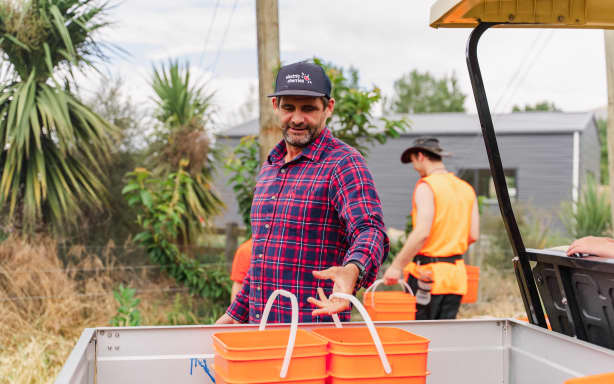
Rewiring Aotearoa chief executive Mike Casey.
Supplied / Rewiring Aotearoa
It was not a problem of having a lack of fiscal headroom, either – saying the right policies would pay for themselves in the long run.
Casey said he was still puzzled at the government pushing ahead with an LNG import terminal, which it had chosen a preferred provider for, but not yet signed the contract.
He said there was not even a case for the terminal to be keeping households and industrial gas users going during the push for more electrification.
“We will have the ratepayers’ assistance scheme introduced into Parliament for the first 100 days. Both the Chrises have promised me that that would be the case and that provides low-interest, long-term flexible finance to get households upgraded, get them electrifying and getting them off gas.
“Our politicians have to be brave. We can’t be fuel agnostic anymore, the writing is clearly on the wall and we have to make sure that as part of a long-term strategy we’re figuring out how to transition our people – and particularly our most vulnerable people – away from an energy source that’s really, really expensive.”
He was confident the problem of peak demand – heating demand on a cold winter night – could be solved with household solar and batteries, and that would also curb the dry-year problem by reducing how much was being drawn from New Zealand’s hydro storage lakes.
“The one thing that the government has done very well is unlock a lot more renewables investment, and as a result the problem is largely diminishing really quickly to the point where we probably don’t need to spend billions of dollars … on an insurance product now.”
He said the problem for industrial users was the “horrifically expensive” cost of a very volatile product and once the terminal was built the price of gas would need to be subsidised if businesses using it were to remain competitive.
“Is that really worth it, compared to just helping these businesses get off gas and onto electric technology where possible? You know, a third of these businesses can probably do this economically now, another third can probably do it with some help.
“The final third we’re going to have to look at alternatives to electrification and gas, and that’s probably in the vicinity of things like bioenergy, but again it requires a strategy.”

350 Aotearoa co-director Alva Feldmeier.
Supplied / 350 Aotearoa
350 Aotearoa co-director Alva Feldmeier said after a winter of high energy bills, it should not be a surprise to politicians that New Zealanders wanted a long-term strategy for a fast and just transition to renewables.
“The current government’s commitment to fund a new LNG terminal shows they’re stuck looking in a rear-view mirror. Some politicians have failed to wake up to the wind of change. New Zealanders know that the best way to bring down bills is to invest in renewable energy.”
The survey was carried out from 8 to 13 October and used quotas for age, gender and regional differences and used further weighting to more closely reflect the adult New Zealand population, and had a maximum sampling error of +/- 2.7 percent. Totals were rounded to zero decimal places.