
Isherwood’s column was published by the New Zealand Centre for Political Research, a right-wing political advocacy organisation founded by former Act MP Muriel Newman.
Colonel (retired) Bernard Isherwood, an Army veteran of 32 years who commanded the New Zealand Special Air Service and Army Schools, also serving as a New Zealand defence adviser in Malaysia.
It follows statements such as that by then Minister of Defence Judith Collins in last year’s Defence Capability Plan – launching $12 billion of defence spending – in which she said an “enduring and flexible” plan was needed “to restore the NZDF to a position where it can make a meaningful contribution to the security and prosperity of New Zealand”.
The dire state of the Defence Force is reflected in its recently released annual report, ending June 30, 2026, which acknowledges years of high personnel losses that depleted military skills and experience.
According to the report, it has left units inadequately trained and some capabilities below the levels required by the Government with the estimated shortage of 700 Army personnel – particularly experienced junior officers and non-commissioned officers – needing up to a decade to restore.
In an interview with the Herald, Isherwood doubled down on his comments, saying current military leaders were “tepid reminders” of their predecessors and lacked the operational military experience in active combat zones required to build a fighting force in a world increasingly riven by strife.
Isherwood is an Army veteran of 32 years who commanded the New Zealand Special Air Service (NZSAS) and Army Schools, also serving as a New Zealand defence adviser in Malaysia.
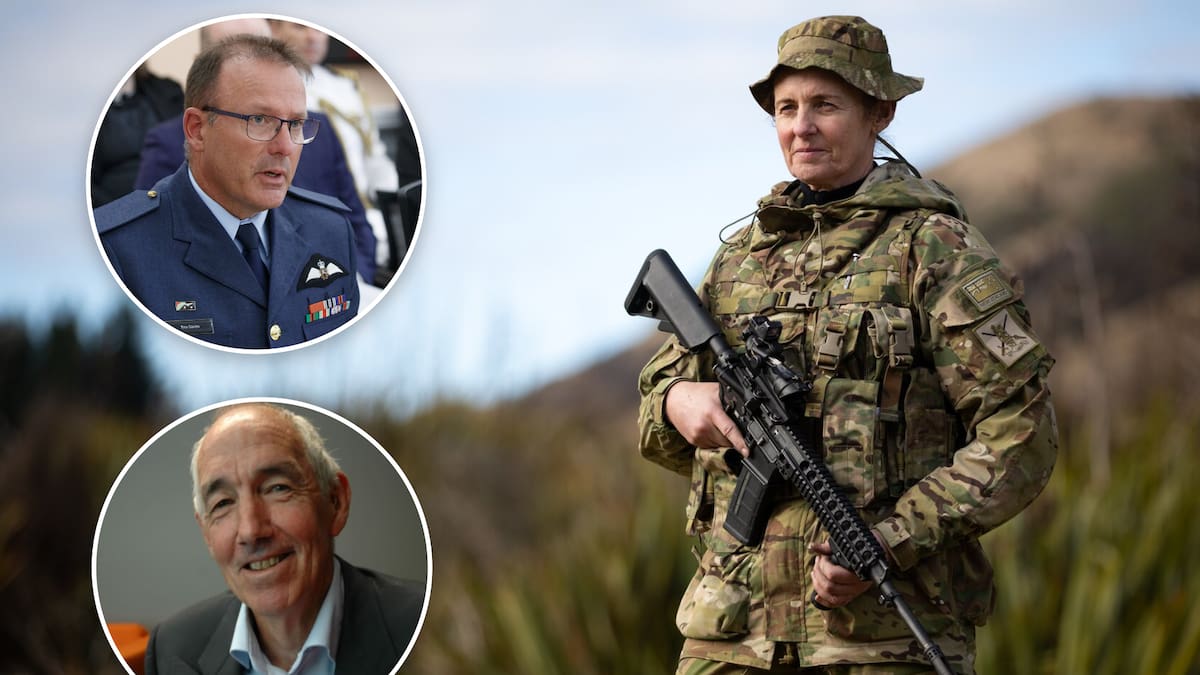
Defence Force Chief Air Marshal Tony Davies. Photo / Mark Mitchell
Isherwood pointed to the Chief of the Defence Force (CDF) role being held currently and previously by Royal New Zealand Air Force officers; Air Marshal Tony Davies, preceded by Air Marshal Kevin Short.
Isherwood’s column said there was a need for the NZDF to restore its fighting edge, saying the current CDF, Davies, and the heads of Army, Navy and Air Force had what he considered to be a “striking lack of command and operational experience”.
He claimed that within the Army, “officers who raise contentious issues are shut down”, resulting in frustration, “a climate of fear” and also an exodus of talent.
Isherwood also claimed the latter left a “compliant pool from which future chiefs are drawn”.
In speaking with the Herald, Isherwood said there was a need to develop our military’s war-fighting capability which was in contrast with leaders without combat leadership experience.
King has served in operational environments, including a six-month deployment to Afghanistan in 2018, where she directed future operations planning for Nato forces during the war against the Taliban. She also served as a United Nations military observer in Croatia.
Isherwood said Davies and Short did not have direct operational combat experience and that the Air Force last engaged in combat operations during the Vietnam War.
The Herald has established that Davies and Short personally served on operations or held command positions in high-risk zones.
Among those, Davies flew Hercules supply missions during the 1990-91 Gulf War and Short commanded New Zealand’s Provincial Reconstruction Team in Afghanistan in 2006.
Isherwood said that the escalation in rank of the current leadership had seen senior officers with what he believes to be the required experience leaving the Defence Force.
He said one limiting factor was the involvement of the Public Service Commission in overseeing the appointment process of senior military commanders and to then monitor their performance.
“Military people are not public servants,” Isherwood said, and public service leaders did not have the experience and knowledge to select or review military leaders.
Chief of Army Major General Rose King renews her weapons licence at the Waiōuru Military Camp firing range in 2025. Major General King has served in the New Zealand Army since 1991. She was appointed Chief of Army in 2024, becoming the first woman to reach the rank of Major General and the first to lead any of New Zealand’s armed forces. Photo / Sylvie Whinray
Documents released by the Public Service Commission show it managed the 2024 selection process for Chief of Defence Force at the request of then Defence Minister Judith Collins.
The five-member interview panel included former Chief of Defence Force Lieutenant General Sir Jerry Mateparae. Davies was appointed on Collins’ recommendation.
Isherwood was critical of each of the three services, claiming King had focused on “cultural priorities”, specifically in relation to the Waitangi Tribunal inquiry into treatment of Māori in military contexts. While he said addressing the place of Māori culture in the NZDF was legitimate, doing so with a focus on “historic [sic] racism” was not.
Isherwood’s column cited Army attrition figures for 2026 that are not yet public, claiming 626 people had submitted their exit papers and that the annual attrition rate was about 14.5%.
The NZDF has told the Herald those figures are “exaggerated and incorrect” with regular force attrition at 7.9% and civilian staff at 13%.
Isherwood: “They are wrong. They are not correct. I have total confidence in the figures I’ve put out there. What they’re telling you is not correct and I stand by that.”
He claimed attrition was made worse with the latest pay round offering an increase below the rate of inflation on pay rates that also suffered against comparable civilian roles, which saw minimal movement in lower ranks but jumps of $20,000 or more at senior levels.
It was also his belief that New Zealand would struggle to deploy a force of 120-150 people into an operational combat environment and be able to sustain it for more than eight to 12 months.
The NZDF’s latest annual report shows the Army achieved just 54% of its Government-directed readiness requirements for global combined-arms operations – an improvement on the previous year.
It acknowledged limitations on sustaining simultaneous operations, saying the Army’s ability to respond at scale in a contested environment would improve as combat capabilities were rebuilt.
Isherwood said in the other services, the loss of the HMNZS Manawanui was a clear example of a strained system and failed leadership. He said the current Chief of Navy, Rear Admiral Garin Golding, was Maritime Component Commander in the period leading up to the Manawanui disembarking on its ill-fated mission to Samoa and held responsibility for its lack of preparedness.
He said a civilian organisation that lost a $100 million asset would have faced greater accountability than that seen at the Navy.
Critical of the time taken to convene the court martial of the three officers aboard the ship at the time, Isherwood pointed to the $100m ship being lost. ”Where is the accountability for that at the top?”
Royal New Zealand Navy divers surveying the area around the HMNZS Manawanui. Photo / New Zealand Defence Force
The Court of Inquiry into the Manawanui’s sinking found a series of organisational failures involving training, qualifications, leadership and operational oversight. It also found the ship had been assigned a surveying task for which it had not been operationally released.
Golding had served as Maritime Component Commander until August 2024, about six weeks before the ship grounded in Samoa.
On the Air Force, Isherwood raised the case of a senior officer recently found guilty under the military justice system of offences but who continued in a senior role. The NZDF has confirmed this, saying an appeal has been lodged.
Asked what the solution was, Isherwood said an independent inquiry was required. “Where do you start? Getting rid of the defence chiefs.”
Minister of Justice Paul Goldsmith said there would be “criticism” in any large organisation but he had confidence in NZDF’s leadership and its ability to meet its operational requirements.
“It is clear that there has been historic underfunding of Defence. That is why this Government has committed to doubling our defence spending to ensure we have a modern, combat-capable NZDF that pulls its weight internationally and domestically.”
Mark, NZ First’s defence spokesman and candidate, said he intended to remove the current defence leadership if made Minister of Defence after the election.
Mark, who served as Minister of Defence from 2017 to 2020 in the Labour-NZ First coalition, said Isherwood was a “highly respected and highly regarded” senior officer whose name still carried weight with the current generation and “clearly has his finger on the pulse”.
“Soldiers I talk to comment in ways I have never heard said about senior leadership.”
He said attrition had cost the Defence Force experienced non-commissioned officers (NCOs) and officers and the recent Chief of Defence letter warning ex-NZDF personnel they could face criminal proceedings if conducting offshore consultancy work was ill-judged and deterred people from rejoining with valuable experience.
“We have to rebuild not only our capability but our credibility. We can’t have an Army, Navy or Air Force if people don’t want to serve there anymore.”
Mark said if returned as minister, he would examine contract expiry dates for leadership and “failing that we will review on performance”.
The NZDF said in a statement it continued to meet “domestic emergency response times and is able to support requests from other Government agencies”.
“The NZDF continues to deliver tailored military response options, while strengthening combat effectiveness and building future capability.
“Persistent workforce challenges shape the pace and scale at which the NZDF can generate and maintain readiness to respond to evolving global security demands and develop contingency for the future.”
The NZDF said it was still recovering from peak attrition following the Covid-19 pandemic.
It said the senior officer referenced by Isherwood was found guilty at summary trial of using a service vehicle for an unauthorised purpose and failing to comply with a written order with the charges currently under appeal.
Asked about the Manawanui, specifically in relation to Golding’s role as Maritime Component Commander, the NZDF responded: “We have no further comment to make.”
David Fisher is based in Northland and has worked as a journalist for more than 30 years, winning multiple journalism awards including being twice named Reporter of the Year and being selected as one of a small number of Wolfson Press Fellows to Wolfson College, Cambridge. He first joined the Herald in 2004.
Sign up to The Daily H, a free newsletter curated by our editors and delivered straight to your inbox every weekday.
Tags:
- accountability
- and
- backs
- believes
- bernard
- blasts
- commander
- commanders
- criticisms
- current
- david
- Defence
- Edge
- exnzsas
- failures
- Fighting
- firsts
- fisher
- force
- former
- get
- Headlines
- hell
- isherwood
- Leadership
- lost
- mark
- minister
- News
- NZ
- nzdf
- nzsas
- of
- replaced
- reports
- rid
- ron
- says
- senior
- them
- through
- Top News
- Top Stories
- TopNews
- TopStories
- wants
- what