
The latest total comprised $191.5m of Vector dividends and $2.9m of interest income. Entrust’s 751 million Vector shares were valued at $3.8 billion at June 30, she said.
This year Entrust paid $377 for each eligible power connection, distributing more than $141m among about 374,000 Auckland households and businesses. Total distributions since 1994 have exceeded $2.5b.
Lee pointed to an October 2025 beneficiary survey that found 90% wanted Entrust to continue paying dividends, while 87% regarded the payment as important or extremely important.
“We’re providing intergenerational benefit to the community … So to everyone, I would like to say tonight, if you’ll allow me, that Entrust is in it for the long haul.”
Lee described Entrust as providing a “stable and consistent majority shareholder for Vector” since the early 1990s.
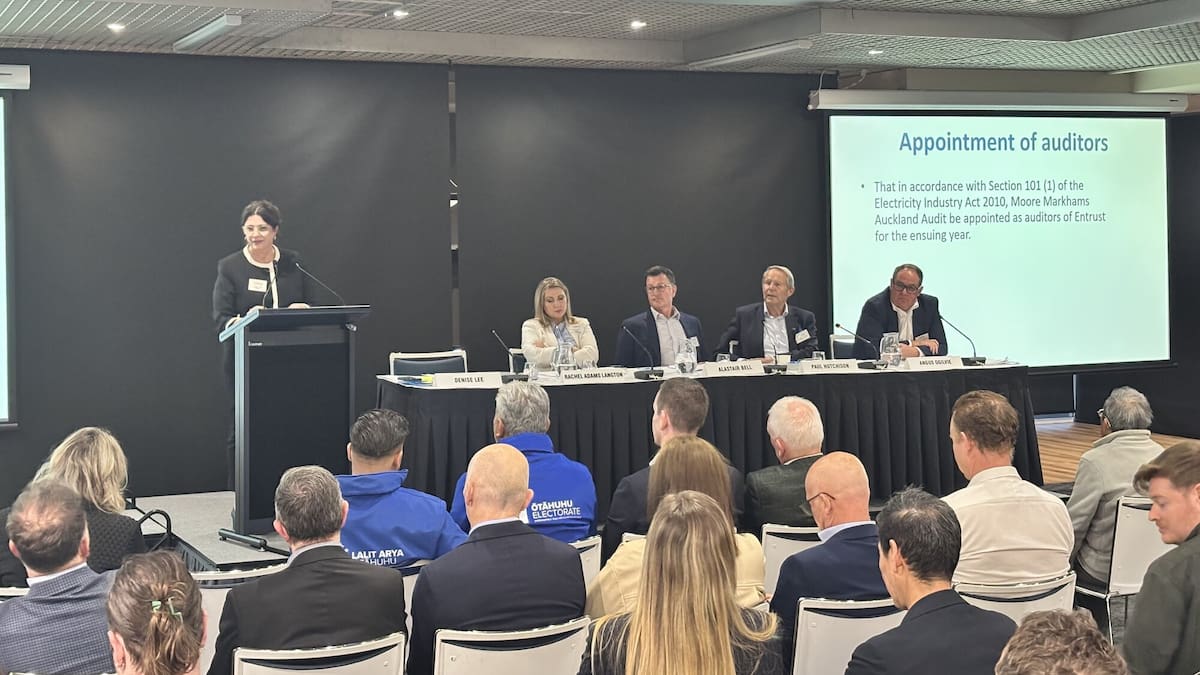
Entrust chairwoman Denise Lee says it is providing intergenerational benefit to the community.
She defended Entrust’s record on infrastructure investment, saying 73.07% of power lines in its district were now underground.
Its agreement with Vector requires at least $12.5m a year to be spent on undergrounding and resilience projects, with $16.6m spent in the latest financial year, including work at Beachlands, Waiheke, Glendowie and along Maraetai Coast Rd.
Vector chief executive Chris Blenkiron then gave his address, outlining the company’s investment programme.
“We’re in the middle of a 20-year, $10b gross capital expenditure programme for the electricity industry. Already, $4.7b has been spent over the last 13 years, with $5.4b to come,” he said.
He argued Vector had kept network charges comparatively affordable despite investment, and said its lines charges remained among the lowest of the six largest distribution businesses.
“The challenge isn’t about building a bigger network, it’s building a smarter and more capable one.”
He pointed out more than 642,000 homes and businesses were connected to Vector’s electricity network. More than 13,000 connections were added in the past year, which he likened to adding a community the size of Panmure and Point England.
Auditor appointment questioned
The meeting became contentious during the usually innocuous resolution to reappoint Entrust’s auditor, Moore Markhams Auckland Audit.
Tex Edwards, from Monopoly Watch, argued Entrust should appoint a Big Four auditor because the scale and complexity of the Vector investment warranted a larger audit firm.
“When we look at the cash flows of the Vector organisation, and then we look at the size of the dividend, and then we look at the consistent increase in debt year on year… the dividend is not in context of financial performance of the business.”
Entrust chief operating officer Helen Keir said Entrust had gone to market about three years earlier but struggled to attract Big Four firms because several performed other work for Vector and therefore faced independence issues.
The meeting ultimately voted to reappoint Moore Markhams.
Entrust critic and investment banker Andrew Body. Photo / Supplied
That drew an interjection from Andrew Body, an Entrust critic and investment banker, who questioned whether Vector representatives in the room had participated in the voice vote.
After a show of hands indicated four Vector representatives present were not beneficiaries, Body argued there was a “potential conflict of interest” if Vector representatives had participated in the decision.
Lee rejected the objection and declined to rerun the vote, saying it had already been declared carried.
From there the meeting grew increasingly acrimonious.
Questions over accountability
Matt Gilligan, representing subdivision advocate SANZ, asked what formal process Entrust had for assessing the individual performance of its two trustee-directors on the Vector board.
Entrust trustees Alastair Bell and Paul Hutchison sit on Vector’s board as non-independent directors.
SANZ has been challenging Vector over the cost and availability of electricity connections for new housing developments.
Lee said Entrust assessed the two trustee directors’ performance annually, using independent advice and a 360-degree review.
“We talk with them, we expect them to talk to us very clearly about their performance, and that’s something that we do around June of every year,” Lee said.
Body then asked how beneficiaries could tell whether they themselves were doing a good job.
Lee’s initial answer was blunt: “It’s something called an election, Mr Body.”
Body responded that only 9.39% of those entitled to vote had participated in the 2024 trustee election and argued that beneficiaries had little information with which to assess the performance of individual trustees.
“Some may do a good job, some may not. We can’t tell,” he said.
Lee said the election remained the most important measure of trustee performance and that candidate information was widely available.
“We’re not the only election around New Zealand that struggles with turnout, and we would love to get that turnout up.”
She said all five trustees underwent performance reviews, including external input, and pointed to Vector’s performance as another way beneficiaries could judge Entrust.
Entrust’s trustees are elected every three years.
Vector’s charges
Body then accused Vector of “double dipping” new connection applicants by charging the full cost of connection plus the same monthly line fee as customers who did not pay the full connection cost.
He used the criticism to call on the trustees to hold a referendum on whether Entrust should continue or be terminated.
“No, we will not be holding a referendum on the termination of the trust,” Lee said.
Vector chief executive Chris Blenkiron argues it has kept network charges comparatively affordable despite investment.
After the meeting, Blenkiron rejected claims Vector was “double dipping” on new connections, saying developers and other new customers were being asked to pay the incremental cost of accommodating growth rather than passing that cost on to existing Auckland power users.
“We’re very mindful of electricity costs and that’s why we actually ask growth to pay for growth. So, if you look at our lines charges in today’s money, they are $4 more than what they were in 2013. We have invested, all of us have invested, $4.7b in the network over that time.
“So, you know, part of the primary reason we ask growth to pay for growth is so that we avoid socialising that cost on all of Auckland who don’t benefit from that growth.”
After the meeting, Lee defended Entrust’s accountability and trustee election processes.
“It’s my job as chair to make sure that we have four other high-performing trustees, and especially the two of them that are on Vector’s board.
“I’m really satisfied with our accountability … and I don’t need to say one more time that every three years is the ultimate job interview. It really is.”
Stay ahead with the latest market moves, corporate updates, and economic insights by subscribing to our Business newsletter – your essential weekly round-up of all the business news you need.