
That’s a load of bollocks, according to Paul, who’s worked every moment of her hardscrabble life since being expelled from school in England at 15.
Her first job after arriving in New Zealand with $18 in her pocket was selling vacuum cleaners door to door.
By the time she made her breakthrough with Natural Glow, the “luminous spheres” that transformed her into a household name in New Zealand, she was nearly 40.
Still on the frontline for Natural Glow’s successor, Thin Lizzy, and a regular on the motivational speaking circuit, Paul turns 70 next month.
It’s not enough to believe in the Law of Attraction, she says. You need to implement the Law of Action, too.
“You can’t just sit on your arsey bum at home and be like, ‘Oh, is someone knocking at the door with my BMW?’ No, they’re not.
“Putting yourself out there, being in those places, meeting people, telling those people what you want to do and what your dreams are, that’s the secret concept.”
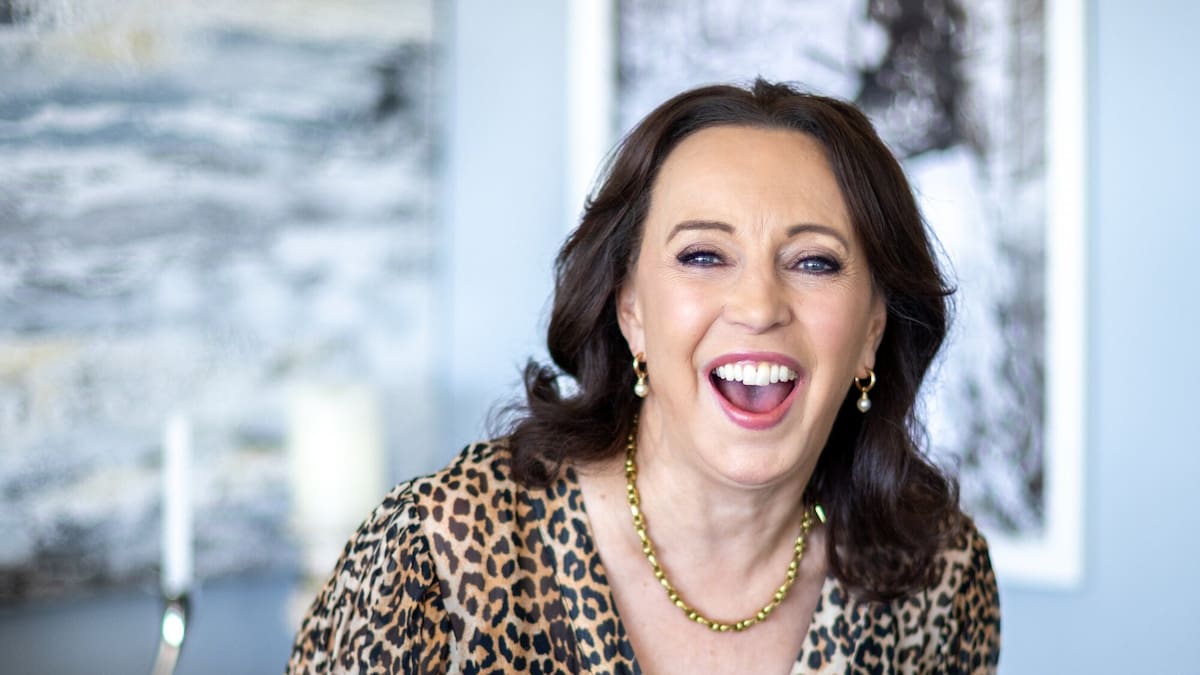
Suzanne Paul says it’s not enough to simply wish for the things you want. Photo / Michael Craig
Paul has a “manifestation board” in her office filled with photos, magazine cuttings and inspirational quotes to signal her intentions for the year.
Her 2026 montage included a new car for her husband, Patrick, a picture of her younger self windsurfing in a bikini (a reminder to stay fit and active), and a photo with Andrew Papas, her co-host on Fork’s Sake.
She and Papas have just finished recording a second season of their food and lifestyle podcast, which comes with a side dish of Agony Aunt-style advice.
When Paul looks at that photo, she visualises them on stage accepting an award. She can picture the dress she’ll wear on the night.
Another yet-to-be-fulfilled manifestation on her board is an image from The Traitors, a cosmic shout-out to the programme’s producers that she’d be more than willing to take their call.
Paul would rather have people lying straight to her face than be stabbed in the back, as she was by her own team on Celebrity Treasure Island a few years ago. She still feels the sting of that one.
“Oh, my crikey, I’d love to be on Traitors. I wouldn’t be coming home to watch it on TV and discovering someone has lied to me, because that’s the whole point of the show.”
Visualisation isn’t magical thinking, she says. You can’t just stick up a picture of something you want then ignore it.
“It’s designed to keep me focused and to keep the dreams alive. And it’s always worked for me.”
Which brings us to the reason I’m here, admiring the view from her Red Beach home on the Whangaparāoa Peninsula, above the softly lapping water of Puawai Bay.
Prominently placed on Paul’s board is the cover of her new book, Your Time is Now, with the word “Bestseller” pinned next to it.
Time will tell whether aspiration meets reality – it’s not out until next week – but she does have form.
Her 2008 memoir, But Wait, There’s More, topped the New Zealand bestseller list, a year after she won Dancing With the Stars and two years after a highly publicised bankruptcy.
Paul’s 2008 memoir, published after her widely publicised bankruptcy.
Your Time is Now is pitched as an inspirational self-help guide, informed by her life experiences – from growing up in working-class poverty to her colourful rise as a TV personality.
Full of practical tips and advice, its final chapter is dedicated to the art of selling, including how to create a sense of connection and build rapport by mirroring a customer’s verbal and physical cues.
(Paul, who says she never sells a product she wouldn’t buy herself, looks horrified when I ask if she ever feels bad about psychologically manipulating people in that way. I suspect it’s never crossed her mind.)
There’s an index of sources and references at the back of the book, a sign that Paul wants it to be taken seriously.
In chapter three, for example, she quotes research by a psychology professor at Dominican University in California who found people were 42% more likely to achieve their goals if they’d written them down.
“Instead of being things you just talk about doing, when you write down your goals they will start to happen,” she writes. “Your life will be transformed, as mine was back in 1991 when I stepped off that plane in Auckland with my list of dreams and goals.”
Paul gets a touch-up during a break in the filming of Style Challenge, a makeover TV series she hosted in the late 90s.
Catastrophisers and “Negative Nellies”, on the other hand, are setting themselves up for failure.
To be successful in sales requires the ability to metabolise daily rejection, so it’s little surprise a key theme of the book is learning how to pick yourself up after a knockback.
Case in point, the book proposal was initially rejected or ignored by every publisher Paul approached. Then, while selling natural health supplements at a shopping mall, she discovered one of her customers worked at HarperCollins. She pounced, giving her an elevator pitch on the spot.
Two decades earlier, But Wait, There’s More had ended when Paul was at rock bottom, bankrupt at 50 after her Māori village project at Northcote Point collapsed.
Your Time is Now picks up where that left off.
“I lost my home, my business, my car and my jewellery,’ she writes. “I lost everything, but I found out that there are worse things to lose than possessions. Because I also lost my confidence, my self-respect and my dignity.
“Everyone in New Zealand knew that I’d failed – big time. I was ashamed to hold my head up in public.”
In her memoir, Paul had outlined the steps she planned to take to rebuild her life, a process she’d followed successfully after other (albeit less spectacular) setbacks.
At first, however, the prospect of starting over filled her with despair.
Paul’s 50s were a tough decade. Her second marriage collapsed. Her beloved dog died (after multiple failed IVF treatments earlier in her life, he’d been like a child to her). She went through menopause.
However, it was the sudden death of her mother, who had come from England to join her in the mid-90s, that rocked her to the core.
At the time, she was selling two clothing lines she had developed for petite women (one called Short & Sweet) and had opened a shop in Remuera. The loss was so devastating she closed the business.
Paul’s boutique in Remuera Mall, which sold her line of clothes for petite women, closed down in 2013. Photo / Michael Craig
“I tried to carry on working, but the joy of it had gone. You can’t do sales when you’re depressed. You’re just dead inside.”
When the Christchurch earthquake struck, she says, it took her mind off her sorrows.
Paul kept busy, arranging for nappies to be sent to women who couldn’t leave the house, and ferrying people from the airport to homes where they had been offered somewhere to stay.
“And then my old business partner rang up and asked if I wanted to come back and do a bit of work at Thin Lizzy, training some of the girls and writing a sales manual.”
Today, she’s still at Thin Lizzy, happily remarried and back in the game, ready to share the lessons she has learned.
“I realised I didn’t want that to be my legacy,” she says of her earlier memoir. “So much has happened since then.
“I get people coming up to me in their 30s, 40s and 50s who think, because of their circumstances or their age, that their life is over; they’ve had their chance.
“I thought, ‘My gosh, I’m 70 this year and I’m still going.’ I’m still thinking of new ideas. I’m still vibrant. I’m still enjoying life, and I wanted other people to know that.”
Paul turns it on for the camera at a fashion shoot for Viva in 2024. Photo / Guy Coombes
It must be exhausting to have become such public property, required to “sparkle and shine” on demand.
“Say it, Suzanne! Say it!” strangers call out when they see her. And she does.
“But wait, there’s more!” she’ll chirp, as they take her photo or capture the moment on video. Some record her voice on their phone, still obsessed with that unmistakable twang that followed her from England.
“Thousands of luminous spheres …”
There must be times – although you’d never get Paul to admit it – when she would rather lick the road clean with her tongue, like one of Monty Python’s four Yorkshiremen.
Once, out for dinner with her husband on New Year’s Eve, she was swept up from the table by tipsy fans who passed her around like a toy.
No one likes being manhandled, but interacting with the public is more than a job to Paul. She almost thinks of it as her calling.
“I always thought that if I’m going to be happy, it’s because I choose to be.” Photo / Michael Craig
Next year, she’ll have lived in New Zealand longer than in the UK, and finding a home here is something she has never taken for granted.
“I’m just interested in people,” she says. “I like talking to them and I like their answers. I don’t think you would find anybody in the whole country who could come forward and say, ‘I spoke to her once and she was rude’.
“When I was a child, I don’t think I brought anyone any pleasure or any joy. I was just there to be tolerated. I felt unlovable for a long time, and I knew from an early age that no one was coming to save me.”
Paul has made peace with that, and the close relationship she later built with her mother is something she’ll always treasure.
“I wouldn’t be where I am and who I am today if I hadn’t gone through that childhood. It made me very self-sufficient, very resilient. I always thought that if I’m going to be happy, it’s because I choose to be.
“The only plan other girls my age had was what they called the man plan. You’d marry someone who would look after you, have a few kids, get the council house.
“That was never my plan.”
Your Time is Now (HarperCollins, $40) is out on October 27.
Joanna Wane is a senior lifestyle writer focusing on social issues and the arts.