
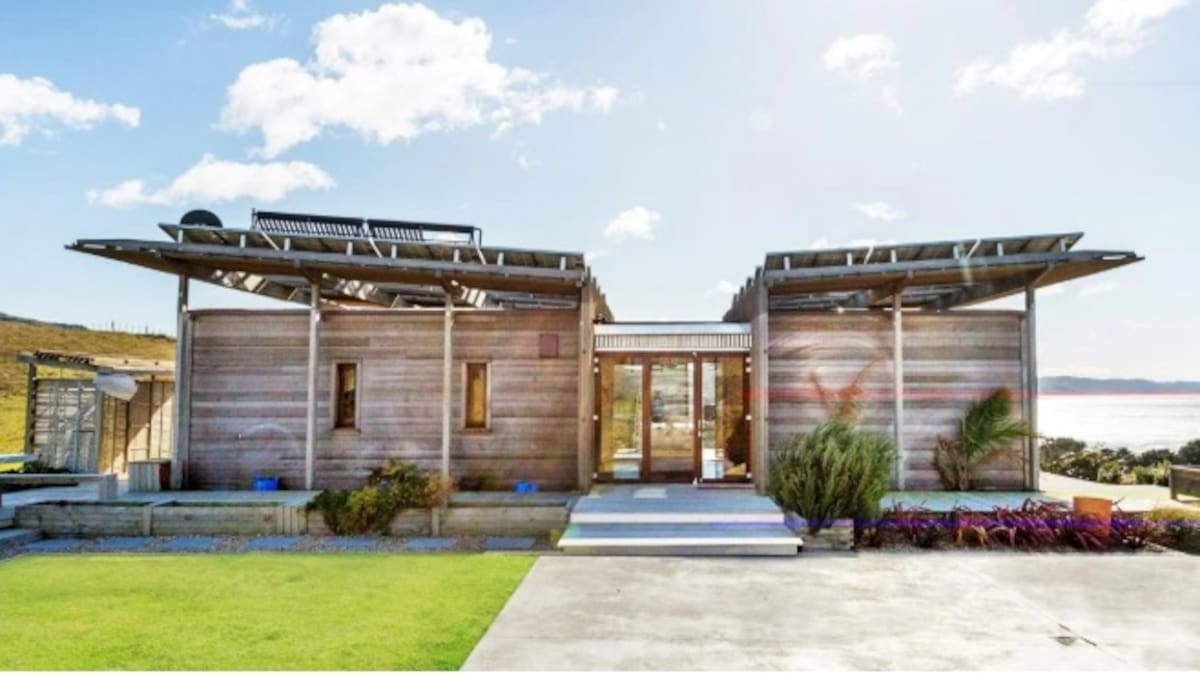
Effectively, First Light House is a bach with wings.
Their practical function is to house solar panels, but I’m more inclined to admire what they do to the aesthetic, which is to lighten the already tiny footprint it has on its whenua.
Now a very popular Bookabach property, many know of its global journey.
In 2009, it started out as the brainchild of four architecture students from the University of Victoria.
The finished solar-powered eco-house’s first public appearance was on Wellington’s waterfront.
Four university students built the bach on Wellington’s waterfront (pictured), before dismantling and building it all over again in the US.
It was then dismantled and shipped to Washington, DC, in 2012 to compete in the prestigious US Department of Energy’s Solar Decathlon, where it came first in engineering, second for architecture and third overall.
More than 10,000 people walked through it over a three-day period.
The university later sold it, with the compact one-bedroom, 70sq m home then re-assembled in its final Waimarama resting spot.
The first sunlight at First Light House, with Bare Island to the right. Photo / Mark Story
The project was seminal for the students. In fact, it was “the making of a team”, including Nick Officer, the director of the bach’s namesake Wellington architecture firm, First Light Studio.
“Fifteen years later we’re still telling the story,” Officer says.
The project remains a major influence in his and the company’s work. “All of our practice is built on sustainable, healthy homes, small and smart.
“This is a super-high-performance bach, but it still has those classic Kiwi bach values.
“It’s affected my whole life from personal to business.”
With a connection to landscape and favouring outdoors, it has the classic feel of a much older bach. Almost all points on its compass boast decking. It’s cosy inside, but outside beckons.
Large bi-fold doors open to extend the living space outdoors, providing for a continuous flow inside and out.
I could see the designers’ quandary: do you face true north and sacrifice wider ocean views, or front the ocean and sacrifice sunlight? There’s some overlap of course, but if solar and passive heating are the goal, then they’ve chosen wisely with the northern aspect.
The central kitchen’s concrete-top island is naturally warmed during the day by skylights. Photo / Mark Story
Besides, the sole small ocean-facing window does a great job of framing Bare Island, and places the bach nicely.
Officer’s favourite feature is the central concrete-top island, warmed during the day by skylights above.
The Don Binney fantail gives the same vibes as the bach itself.
In addition to its design, aspects of the decor strengthen the narrative.
In particular (and my personal favourite) the bedroom’s Don Binney fantail print. The weightless wings channel the place’s airy feel. Both bird and bach are in perpetual states of lift-off.
This delicate build is a must-stop for any bach-spotter. It’s a stellar ray of sunshine.