
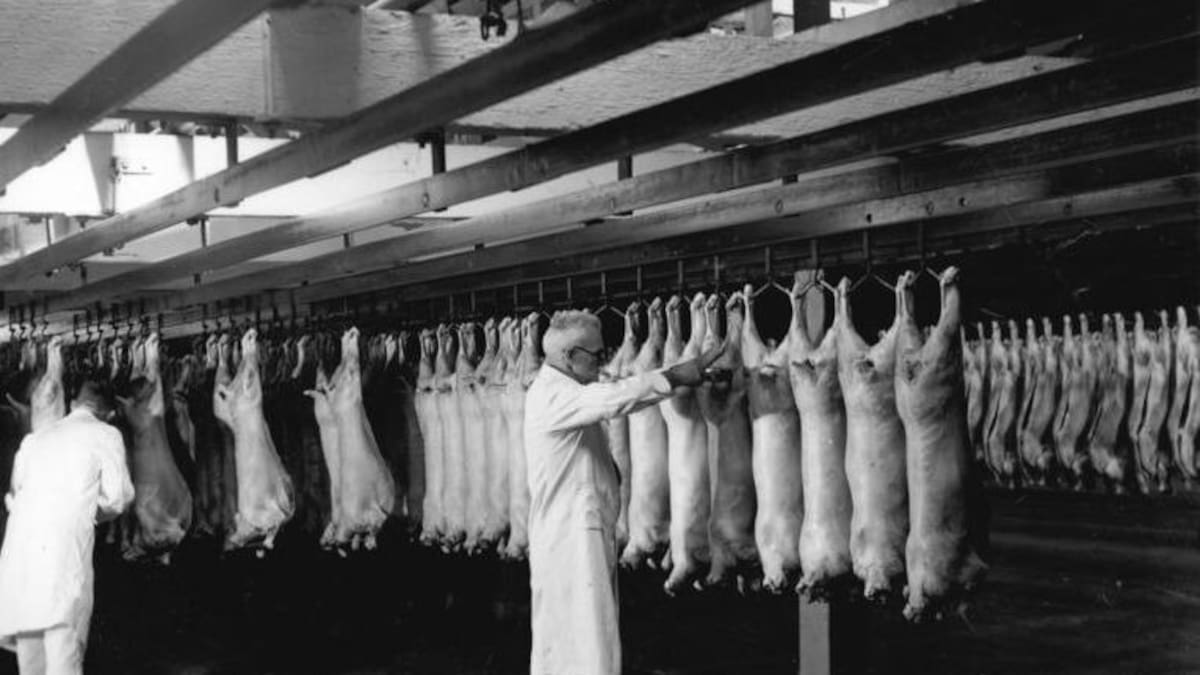
Increasing cool storage space
Kakariki works being reassembled
Plant from the Port Bowen being used
Wanganui Chronicle, September 5, 1940
With a view to increasing the cool storage capacity for meat along the West Coast of the North Island, refrigerating machinery which is being dismantled from the Port Bowen is being taken to the freezing works in Kakariki to be reassembled.
These works, which were built by the Wellington Meat Export Company during the last war, were used for only a short period and have since been closed.
The machinery and all the insulation was taken out and transferred to Wellington.
Pumice used in the insulation was brought to Wanganui and used for making sand-soap.
Before the freezing works in Kakariki were built there was a freezing works in Taihape, since dismantled and the building pulled down.
The Feilding Freezing Works were also built before those in Kakariki, and thus within a comparatively short distance of each other there were freezing works in Otaihape, two in Wanganui, one in Kakariki, one in Feilding and one in Longburn.
Another freezing works hold up
–Press Association)
Support for dismissed cool-store hands
Hawke’s Bay Herald-Tribune, 11 January 1941
(By Telegraph–
Auckland, Jan. 11.
Attempts by the employees of the Southdown Freezing Works to have the Westfield workers rescind their decision by ballot not to take any action in support of the dismissed chamber-hands resulted in a great deal of activity in official union circles at both works throughout yesterday and at the Southdown works two mass meetings held up work for over two hours.
At Westfield there was no interruption of work, but a number of conferences by union delegates were held.
At the second mass meeting at Southdown a resolution was passed calling upon the union executive to convene a special mass meeting of all members of the Auckland Freezing Workers’ and Related Trades Union employed at the Westfield, Southdown and Horotiu Freezing Works and the city cool stores.
The purpose of the proposed meeting would be to consider action in support of the 140 chamber-hands who were dismissed for refusing to handle produce on Sundays.
At the same meeting the men passed a resolution offering to work this afternoon and on subsequent Saturday afternoons to overtake the arrears of work on condition that the dismissed cool store workers were reinstated.
The resolution was submitted to the works management for transmission to the Auckland Farmers’ Freezing Co., Ltd., which controls the city cool stores, and the Southdown and Horotiu Freezing Works.
The general manager of the company, Mr A. G. Brown, stated that the resolution had been received but it could not be entertained.
Work is proceeding normally at the Westfield and Southdown freezing works to-day and no mass meetings have been held.
Some Territorials to go to freezing works
Northern Advocate, December 10, 1943
(P.A.) Wellington, This Day.
A temporary manpower shortage is developing in the freezing works industry.
Already works in Auckland are short of 200 men and further shortages are developing throughout the North Island, as one freezing works after another gets into the swing of seasonal production.
The Minister for Industrial Manpower (Hon. A. McLagan) today announced the Government’s decision to utilise in freezing works a proportion of men selected for one month’s service with the Territorials.
It was hoped, said the Minister, that sufficient men would volunteer for this work to meet the present urgent demand.
If sufficient volunteers were not available, however, it might be necessary to direct suitable men from among those liable for Territorial service.
All men prepared to volunteer were asked to notify their local district manpower officers immediately.
Preference would be given to men residing in districts where freezing works were situated.
A minimum of four weeks’ work would be required from those who exercised this option in lieu of Territorial service.
Pay would be at freezing workers’ rates and every endeavour would be made to facilitate extension of the working period should the men so desire.
The Minister stressed the importance of service in freezing works which was no less urgent than a call to service in harvesting or armed forces.
Supply of food to the Allied nations was one of the most important contributions that New Zealand could make to the united war effort, and this food supply depended on men in freezing works now.
– Source: Papers Past