
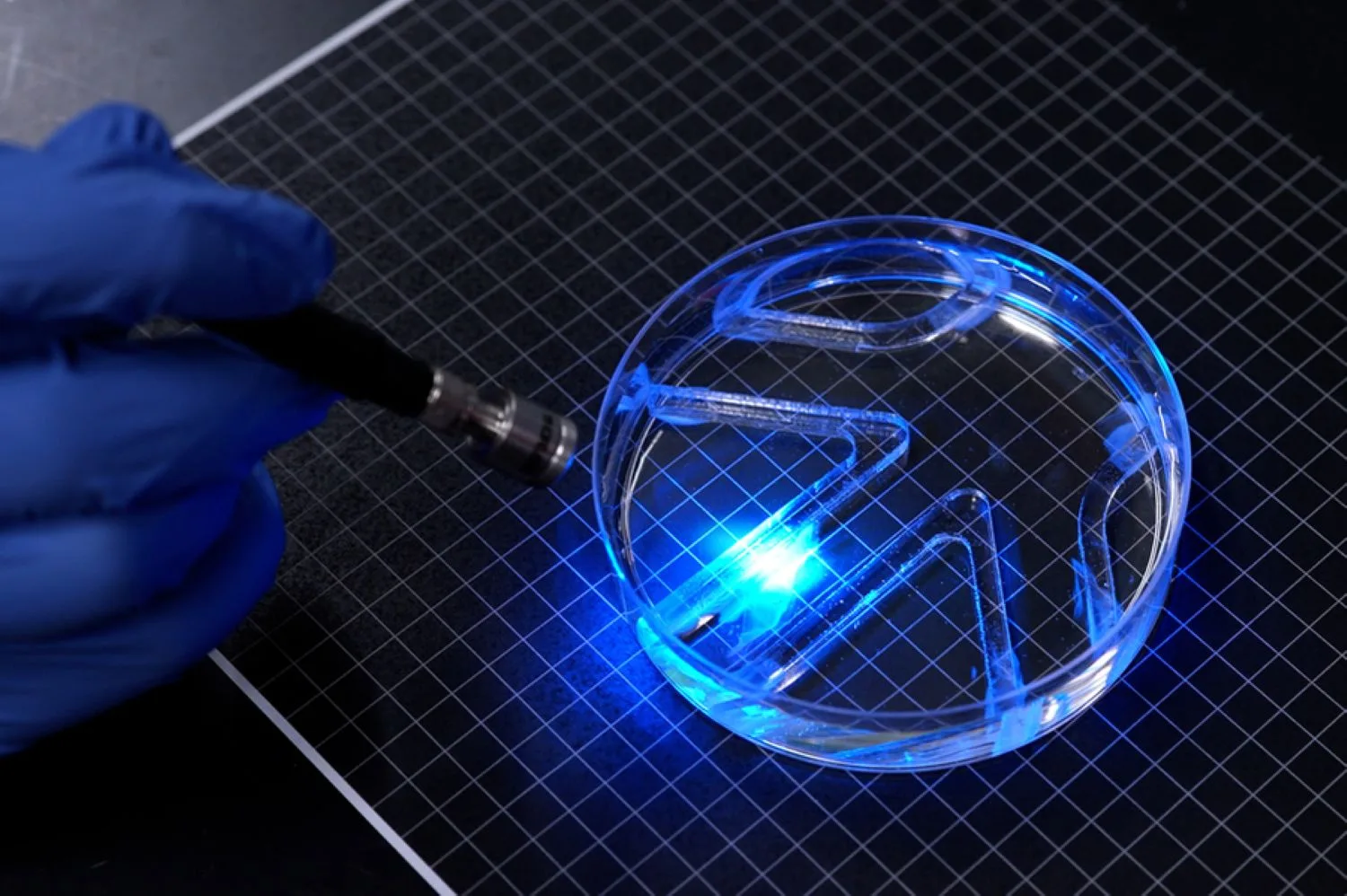
At first glance, it looks more like a sliver of transparent gel than a robot. It’s about the length of a stick of gum, paper-thin, and propelled not by batteries or motors, but by living muscle cells.
Yet this miniature machine can swim.
Engineers at MIT have created a soft, muscle-powered robot that moves through water using a single layer of living muscle tissue. The study, published in Advanced Functional Materials, marks the first demonstration of a thin, two-dimensional biohybrid robot capable of locomotion.
The work represents a step toward a new generation of robots built not from metal and electronics alone, but from living tissues engineered to perform useful tasks.
The robot’s body consists of a flexible gel film roughly half a millimeter thick. The film is divided into two fin-like sections, each coated with a layer of living muscle cells far thinner than a human hair. Those muscle cells were genetically engineered to respond to light.
When researchers direct light to one of the fins, the cells will contract and cause the fin to flap. This action creates enough force to move the robot forward in the water. Through the control of which fin gets light and how many times it gets light, the researchers are able to guide the robot and control the amount of speed that the robot has.
The small swimmer was able to navigate a basic underwater maze. Its fastest travel time was roughly 4 times its own length every minute. This might seem like a low rate of travel; however, for such a minuscule living device, this is a remarkable accomplishment. The rate of travel is similar to the average cruising speed of certain types of sharks in the ocean.
“It takes a lot of force to move through water versus air,” says study author Ritu Raman, associate professor of mechanical engineering at MIT. “The robot’s quite strong, given its size.”
Biohybrid robotics has become an increasingly active area of research as scientists explore ways to combine the adaptability of living tissues with engineered materials.
Living muscle has several advantages over traditional actuators. It is soft, energy efficient, responsive to environmental conditions, and capable of self-repair. But creating robots powered by muscle cells has proven difficult.
Most existing designs rely on bulky, three-dimensional chunks of lab-grown muscle tissue that require millions of cells and complex fabrication processes.
“Currently, biohybrid robots from our group and others’ are built from bulky, 3D chunks of lab-grown skeletal muscle that require millions of cells to fabricate,” Raman says. “We believe that biohybrid robots powered by living muscle could one day perform delicate jobs like exploring environments too fragile or unpredictable for conventional hardware, because living tissue is soft, responsive to its surroundings, and can heal itself.”
The MIT team wanted to find a way to achieve meaningful movement using far less tissue. The project builds on earlier work from Raman’s laboratory.
Last year, the team demonstrated an iris-inspired artificial muscle system in which muscle cells grew in carefully patterned arrangements on a soft gel. Those engineered tissues could contract in multiple directions, mimicking how the pupil of the eye expands and contracts.
But the movements were tiny, only about 100 microns.
“People hadn’t seen this muscle architecture engineered from scratch before,” Raman says. “And the cells were moving in multiple directions. But they only moved about 100 microns. From a robotics perspective, their movements were tiny.”
For a swimming robot, the muscles needed to generate much more force. The researchers realized that the key wasn’t just the muscle cells themselves; it was the material underneath them. The team systematically redesigned the scaffold on which the muscle cells grow.
They tested different gel types, varying degrees of stiffness, and small grooves etched onto the surface of the gel. The small grooves help to direct the way the muscle cells align themselves, which will ultimately result in the muscle cells being able to form into stronger muscle fibers.
The researchers discovered that square-bottomed grooves worked better than curved ones because they encouraged more uniform alignment. They also replaced the ultrasoft material used previously with gelatin methacrylate (GelMA), a material commonly used in tissue engineering.
Stiffer versions of GelMA turned out to provide better support, enabling muscle cells to grow in organized patterns and produce more force.
After determining the ideal combination of stiffness, geometry, and thickness, the team trained the tissue using repeated flashes of light, essentially giving the muscles a workout before installing them in the finished robot.
The final design resembles a tiny aquatic creature with two independently controlled fins.
“You can think of the robot as having two independent muscles,” Raman says. “If we shine a light on just one, only that muscle moves. If shining on both, they both flap.”
That simple control system allowed researchers to guide the swimmer through water by moving a light source around a petri dish. The robot followed the light, turning and maneuvering through obstacles as its fins responded.
The tiny swimmer won’t be competing with marine animals anytime soon, but that’s not the point.
The significance lies in showing that a very thin layer of living muscle can generate enough force to perform useful work in water, a far more demanding environment than air. The achievement could help researchers build smaller, cheaper, and more efficient biohybrid machines.
Such robots might eventually be used for environmental monitoring, studying fragile ecosystems, or operating in places where traditional rigid machines struggle.
“Our next goal is to optimize the body design to enable faster swimming,” Raman says. “But even at slow swim speeds, one could imagine a muscle-powered swimmer being used for purposes like environmental monitoring in aquatic environments.”
For now, the robot provides an inside look into a future where robots will be constructed of both manufactured parts and biological materials, as well as how a very thin layer of muscle tissue could potentially form a small aquatic organism that would navigate its way through an underwater environment.
Journal Reference:
Maheera Bawa, Arielle Berman, Laura Schwendeman, Ferdows Afghah, Seanbiron Johnson, Ritu Raman. 2D Skeletal Muscle Thin Film Actuators Enhance Efficiency of Biohybrid Robots. Advanced Functional Materials. DOI: 10.1002/adfm.78065