
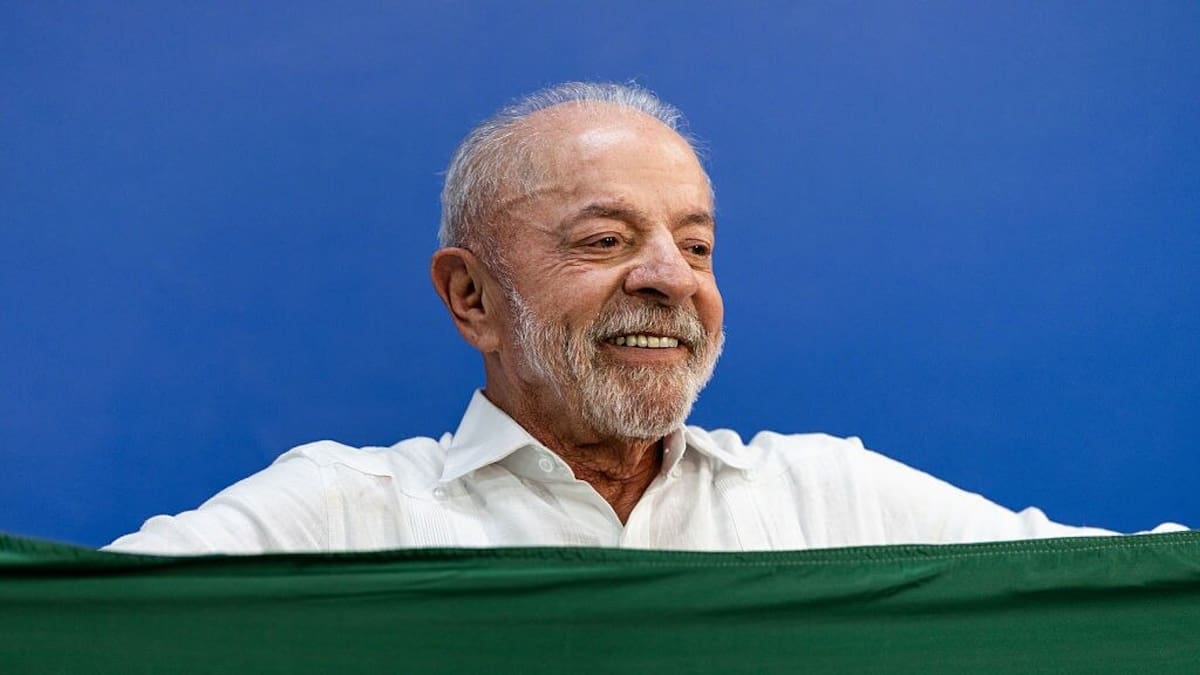
Visibly emotional, Lula added he had “learned many lessons” and would “change the way we govern”, expanding public participation and digital communication.
He acknowledged Brazil’s deep divisions but said the President must govern for everyone. He also vowed to regulate digital platforms, accusing them of interfering in the election. “We cannot have monstrous companies making billions, paying no taxes and trying to steer the electoral outcome of this country,” he said.
The younger Bolsonaro refused to concede defeat and said he would seek to annul the election over a court decision to extend voting hours by two hours. “It is impossible to recognise the election results,” he told reporters in Brasília. “We’re not here to play games.”
However, the head of Brazil’s electoral court said the decision by a fellow Supreme Court justice to extend voting hours had not changed the outcome.
Bolsonaro had run on promises to free his father, who is serving a 27-year sentence for attempting a coup after losing the 2022 election to Lula, pardon their supporters and impeach the Supreme Court justices who presided over their prosecutions. With the most conservative Congress since the end of Brazil’s military dictatorship in 1985, he would have had the votes to change the Constitution.
But the prospect of a Bolsonaro restoration galvanised voters. His father’s presidency, from 2019 to 2023, was marked by institutional turmoil and environmental setbacks. Jair Bolsonaro downplayed the coronavirus pandemic, which killed more than 700,000 in Brazil, attacked democratic institutions and pursued policies that alienated women, black and indigenous Brazilians.
In the final weeks of the campaign, Lula’s supporters took to the streets and mobilized on social media.
The result deals a setback to US President Donald Trump, who has sought to build a conservative, US-aligned bloc across Latin America with Argentina, Colombia and others.
US President Donald Trump. Photo / Getty Images
Trump didn’t endorse Flávio Bolsonaro, as he did his father in 2022. But his administration took several steps sought by the Bolsonaro family. It imposed tariffs on Brazilian products and sanctions on key officials to pressure the country to drop the prosecution of Jair Bolsonaro and planned this summer to send senior officials to question the integrity of Brazil’s elections.
The eldest Bolsonaro also refused to concede his loss in 2022, fled to Florida and skipped Lula’s inauguration. A week later, his supporters stormed government buildings in Brasília in a January 6-style attack that prosecutors linked to a coup plot aimed at overturning the election.
Voting hours were extended nationwide on Sunday after reports of transportation problems prompted Lula’s campaign to seek judicial intervention. Bolsonaro’s campaign later filed a similar request, citing rain and flooding in some parts of the country.
Electoral court president Kassio Nunes Marques, appointed by Jair Bolsonaro, did not decide on the requests, prompting Lula’s campaign to appeal to the Supreme Court. Justice Cristiano Zanin, appointed by Lula, then ordered polls to remain open until 7pm (local time), two hours later than scheduled, in an unprecedented decision.
“Given the seriousness of the facts described,” Zanin wrote, “and in view of the clear urgency of the matter, I hereby order that the deadline for voting at all polling stations throughout Brazil be extended by two hours.” The extension drew fierce criticism from allies of Flávio Bolsonaro, who called it a “judicial coup”.
Voters reported bus shortages and other transportation problems in the Northeast, Lula’s strongest region, and in São Paulo, the largest city in the country. Lula won 63% of the Northeast’s vote in the first round, compared with 30% for Bolsonaro. Public transportation is required to operate free of charge on election day, with cities expected to make their full bus fleets available.
Now Lula wins another term leading a deeply polarised country, where voters were frustrated with the government even as economic indicators improved. Record employment did little to ease concerns about the cost of living, and Lula struggled to turn his record into a compelling case for reelection.
His unexpectedly weak first-round performance forced his campaign to overhaul its digital strategy and messaging from claiming past achievements to making new promises, including debt relief for families and an increase in Brazil’s main cash-transfer program.
His campaign sought to mobilize women voters by highlighting Flávio Bolsonaro’s record on women’s rights. As a state representative in Rio, Bolsonaro voted against extending maternity leave and against disarming police officers accused of domestic violence.
His past remarks, including a 2006 speech in which he called Brazilian women “a tourist attraction of our country”, drew accusations of misogyny.
Bolsonaro initially sought to cast himself as a more moderate version of his father, but it didn’t last. As Lula opened a lead in early polls, Bolsonaro moved further right, embracing a hard-line agenda on crime that included chemical castration for rapists, reducing the age of criminal responsibility for serious crimes to 14 and building prisons modelled on those of Salvadoran President Nayib Bukele.
Lula drew particular strength from lower-income voters and women, groups that historically have been resistant to the Bolsonaros.
The campaign unfolded amid a deepening debate over the role of technology platforms in elections.
Brazilian presidential candidate Flavio Bolsonaro. Photo / Getty Images
Lula’s campaign accused Meta of tilting its platforms toward Flávio Bolsonaro, alleging that search results sidelined progressive activists, videos critical of the right-wing challenger were removed without explanation and pro-Lula posts reached fewer people.
Meta, the parent company of Facebook, Instagram and WhatsApp, denied favoring Bolsonaro. In a statement, the Silicon Valley tech giant attributed the incidents to technical glitches and errors in its AI safeguards, “which affected campaigns across different political spectrums in Brazil’s 2026 elections”.
Lula was born in 1945 in Pernambuco, one of Brazil’s most impoverished states, moved to São Paulo as a child and became a metalworker. He rose to prominence as a union leader, helped found the Workers’ Party in 1980 and was elected President in 2002.
During those first two terms, he harnessed a global commodities boom to expand social programmes, lift millions out of poverty and steer the country through years of economic growth.
He left the presidency in 2011 with approval ratings around 85% and the country in the hands of a protégée, Dilma Rousseff.
After Rousseff was impeached and removed from office in 2016, Lula planned to run again. Polls showed him to be the front-runner for 2018, but in 2017 he was convicted of corruption, barred from running and imprisoned.
In his absence, Jair Bolsonaro, a previously obscure congressman who styled himself the Trump of the Tropics, won the presidency on promises to make Brazil great again.
Lula was released after 580 days and the Supreme Court eventually annulled his convictions, ruling that the judge who oversaw his case had been biased against him and the court lacked jurisdiction.
He defeated Jair Bolsonaro in 2022 by the narrowest margin in Brazil’s young democracy.
– The Washington Post
Sign up to Herald Premium Editor’s Picks, delivered straight to your inbox every Friday. Editor-in-Chief Murray Kirkness picks the week’s best features, interviews and investigations. Sign up for Herald Premium here.