
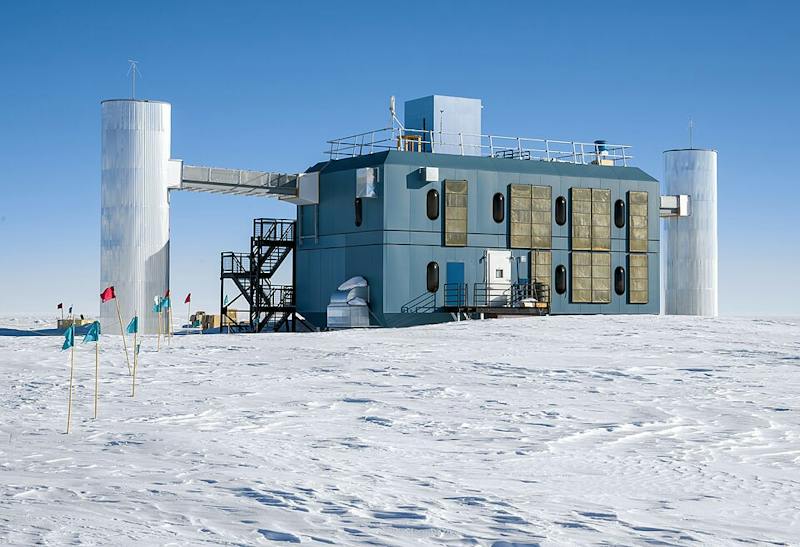
The Nobel Prize committee, carrying out its annual recognition of key discoveries and innovations in various scientific fields, recognized Francis Halzen of the University of Wisconsin-Madison for its prize in Physics this year. On October 6th, the institution announced the honor, citing Halzen’s “decisive contributions to the IceCube Neutrino Observatory and the discovery of high-energy neutrinos of astrophysical origin.”
In an interview with The News-Letter, Physics PhD student Andrew Mattson offered insights into the significance and science behind the committee’s decision this year for the world of physics. Mattson’s research uses techniques rooted in quantum sensing to detect gravitational waves in an attempt to search for dark matter – of which little is known or understood, other than that it has some effect on gravity and is unlikely to be made of the same components as normal matter like protons, neutrons or electrons. His research operates with the working theory that a new group of particles can help describe this behavior.
The hunt for particles is what underpins the Nobel’s decision this year to award neutrino research. Neutrinos are considered incredibly small and elementary particles that are only affected by weak nuclear forces and gravity, but not the strong force or electromagnetism. Their unique qualities have led to several proposed mechanisms and theories regarding their activity and potential to explain fundamental mysteries of the universe.
The decay of radioactive isotopes is essential to our understanding of neutrinos. Mattson went on to elucidate the process resulting from instability within specific atoms. This could lead to several decay channels, of which the most relevant is the process of beta decay, where a neutrino and electron are emitted from the unstable atom. This led to the discovery of the neutrino thanks to the application of several key principles. The measurable electron ‘spit out’ by the isotope did not have the same energy each emission, which would not align with the principle of the conservation of energy if it was the only particle produced. Thus, physicist Wolfgang Pauli suggested the existence of a non electrically-charged particle which could carry away the remaining decay energy while barely interacting with its surroundings – leading to his hypothesis of the neutrino particle in the 1930s.
Further analysis would reveal greater complexity regarding the process of beta decay, where a decay event could be distinguished either as beta-minus decay (producing an antineutrino and electron) and beta-plus decay (producing a neutrino and a positron), altering the identity of the atom and nucleus. Even more considerations arise, such as in the hypothesized case of neutrino-less double beta decay.
“There’s a proposed idea that a neutrino could act as its own antiparticle, and if a particle and antiparticle come near each other, they annihilate and release energy. So if the neutrino is its own antiparticle, then the neutrinos interacting with themselves would annihilate, and you could see this through certain decays of radioactive isotopes. If that were to happen, it would explain why we have so much matter and so little antimatter in the universe… Because if we had equal parts matter and antimatter in the universe, nothing would be around, because it would have all it would have all annihilated.” Mattson explained.
Furthermore, with several further layers of classification playing a role in our understanding of these particles, it is important to acknowledge the neutrinos being considered are not all necessarily the same kind of neutrino, with scientists suggesting multiple types or flavors of neutrinos. Neutrinos are a type of uncharged lepton, a broader term for elementary particles that do not experience the strong nuclear force.
“There’s electron neutrinos, there’s muon neutrinos and there’s tau neutrinos… one neutrino can have a certain mass, and it can switch between different flavors while it travels through the air.” Mattson described.
This facet of neutrinos has been previously recognized by the Nobel Prize Committee in 2015, when they awarded the discovery of neutrino oscillations. Neutrino research was also previously awarded in 2002 for scientists who detected cosmic neutrinos from stellar sources including the sun. However, the technology used at the time to measure these oscillations were not fully effective, leaving a discrepancy in their obtained and expected measurements.
“They realized that what was happening was the original experiments were only sensitive to one type of neutrino, but a lot of neutrinos from the sun were switching into other types of neutrinos as they made their way to the Earth, and that’s why we weren’t observing them,” Mattson said.
This made the improved detection of neutrinos a significant frontier for the future of this research, which brings us to this year’s prize-winning IceCube neutrino observatory that is capable of detecting all three flavors. Since neutrinos are neutrally charged and display very minor interactions, neutrino detectors are required to be incredibly large sizes to maximize their chances of interacting with a neutrino – with IceCube being 1 cubic kilometer of Antarctic ice.
“The really cool thing about what Ice Cube did is it measured neutrinos from outside not only the solar system, but also from outside the galaxy,” Mattson said. “That was groundbreaking because that allows you to now learn about these sources that are super super far away… all these crazy objects like a black hole, like a supernova, like a quasar… So it really made this whole new field of neutrino astronomy [possible], where you don’t only have to look at photons… you can now also look at these neutrinos.”
The very same qualities of neutrinos that were previously discussed become incredibly useful in this context: since these particles barely have any interactions, they can carry an extremely clear representation of far objects relative to particles like photons, which are more likely to experience interfering interactions on the way.
“The cool thing about IceCube is if you have a kilometer cube device and you have a particle come in and do its Cherenkov flash, then you’re gonna be able to see a couple flashes in a row and trace out a path… that the particle came from… It’s not super precise, but it’s close enough that you can then… point [telescopes] at it… and then [judge] if there are any possible sources over there.” Mattson said.
This has been previously demonstrated by IceCube, which has been used to identify sources of high-energy neutrinos from other active galaxies. Now that this technology exists and is already being celebrated by the field, further innovations and advancements are possible. The question arises, what next?
“The easy answer is they want to do an IceCube Gen2, which is going to be eight kilometers cubed instead of one kilometer cubed… I think it’s fair to assume that this probing [of] the nature of the universe… will lend itself to things that are beneficial to humanity that we can’t necessarily predict right now,” Mattson concluded.