
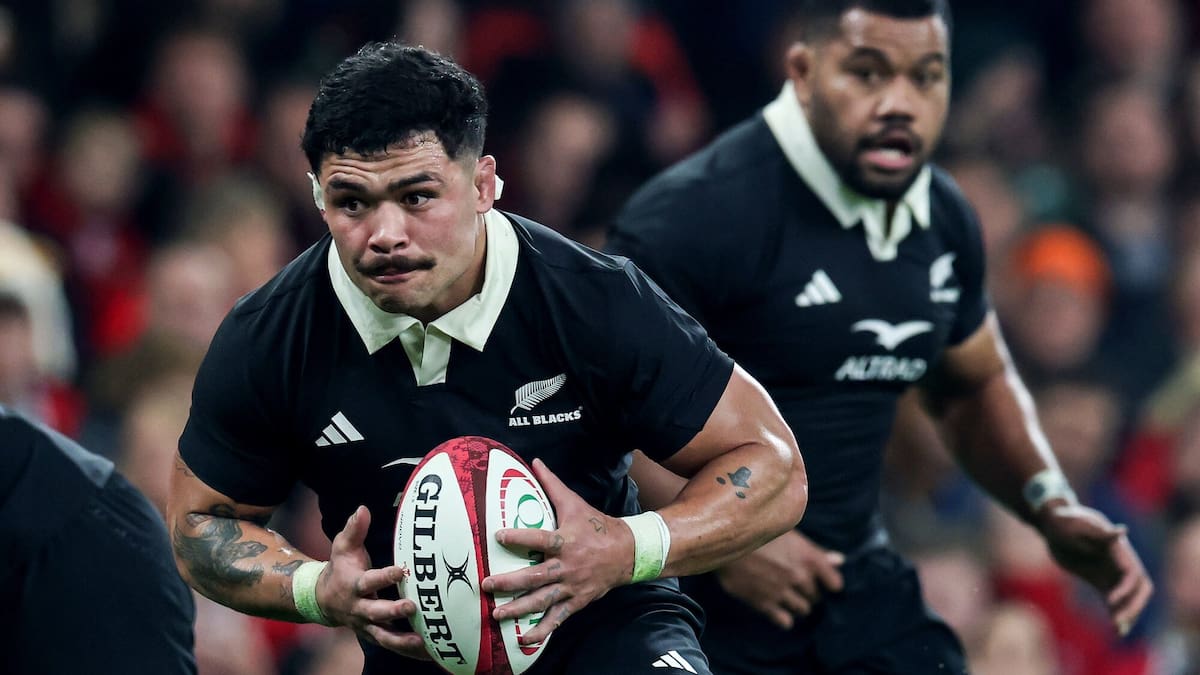
Jamie Hannah is the big mover, forcing Canterbury teammate Darry to the fringe, with head coach Dave Rennie suggesting he brings more punch in contact.
Tuipulotu will be nervous, too. While a calf complaint and lack of recent match time combined to leave the 33-year-old veteran vulnerable, he now needs an injury to break back into the squad.
After a dominant performance against Ireland at Eden Park in July, Tuipulotu’s impact faded in South Africa.
All Blacks lock Patrick Tuipulotu celebrates scoring against Ireland. Photo / Photosport
An off-season to prime his frame to press his physical claims with the Blues could yet propel him back into the core conversation, but Tuipulotu needs to conjure his consistent best next year.
Emoni Narawa’s omission remains curious. He’s had limited chances to showcase his silky skills – and has now been forced out by Chay Fihaki.
Fihaki’s aerial ability and kicking strengths suit the test game but his defence is a concern.
It won’t be easy for Narawa to demand a recall, either. Caleb Clarke and Leroy Carter will return next year while Caleb Tangitau and Kyren Taumoefolau are lurking in the wings.
Over the summer, Du’Plessis Kirifi must be considering his options.
Ardie Savea, Luke Jacobson, Shannon Frizell and Simon Parker are unavailable but with Anton Segner returning and Christian Lio-Willie included for the first time this season, Kirifi remains well down the pecking order.
Lio-Willie deserves his call up after his compelling form for the Crusaders and Otago. He fits Rennie’s workrate mould but doesn’t beef up an undersized loose forward contingent.
Semisi Ta’eiloa was a heftier option but he is raw and his fitness needs to improve at the Hurricanes next season.
At this point, it’s difficult to envision a way in which Kirifi can change Rennie’s mind. He featured eight times for the All Blacks under Scott Robertson – largely off the bench – but Segner’s rise and a belief he gives away too many penalties at the breakdown has blocked Kirifi’s path.
Last year, Kirifi rebuffed a lucrative Japanese offer to fulfill his All Blacks dream but, with the World Cup a seemingly unlikely proposition, the time has probably come to explore his offshore options beyond next year’s Super Rugby Pacific campaign.
Du’Plessis Kirifi (from left), Fletcher Newell and Leicester Fainga’anuku. Photos / Photosport
Tighthead test
Set-piece improvements will be in the spotlight as the All Blacks trek north.
Delivering a stable platform against the Wallabies is one thing. Savouring similar results against Scotland, England and, potentially, France in winter conditions is another proposition.
Scrum issues in South Africa were amended in the Bledisloe sweep, but Tyrel Lomax’s absence with an ongoing neck concern evokes nerves for the depth at tighthead prop.
Fletcher Newell is usually rock solid but, behind him, Pasilio Tosi and Saula Ma’u are unproven scrummagers.
Tosi endured a challenging tour of South Africa, where he struggled at scrum time.
While Ma’u is a huge human, weighing 140kg, with long-term upside as a scrummaging unit, he has much to learn as a test rookie.
Cam Roigard and Jordie Barrett rank as the All Blacks’ most influential, irreplaceable figures but, on this tour, Newell’s importance cannot be understated.
Harness the hybrid
Fainga’anuku could evolve into a game-changing inclusion – primarily because it places the 6-2 bench firmly on the table.
The All Blacks have been reluctant to indulge the risks associated with carrying one fewer backs among their reserves – the Springboks were exposed with their lack of outside back cover in the first Greatest Rivalry series test loss at Ellis Park.
Fainga’anuku’s return, though, should alter that picture.
Since returning to New Zealand from France, Fainga’anuku has featured at openside flanker (seven times), midfield (10) and wing (four).
He’s named among the loose forwards but will be used to cover all those areas which could allow the All Blacks to carry another forward in their reserves against larger packs such as England.
Fainga’anuku is the first genuine hybrid selection for the All Blacks to follow this likes of South Africa’s Andre Esterhuizen and Kwagga Smith, England’s Ben Earle, Fiji’s Levani Botia, the original prototype, and Irish hooker Dan Sheehan who played 80 minutes at No 8 for Leinster last weekend.
Unleashing Fainga’anuku, wherever he features, and Asafo Aumua off the bench is a powerful prospect.
Fainga’anuku is, perhaps, in danger of being tagged as a versatile weapon without commanding one position but as the All Blacks squad sizes shrink, his destructive point of difference could be undeniable.
Leicester Fainga’anuku on the break for the All Blacks against Wales. Photo / Photosport
Injured brigade defers selection cull
The lengthy causality ward reinforces the All Blacks’ depth – and the selection headaches Rennie will face for next year’s World Cup.
When fit, Savea, Frizell, Clarke, Jacobson, Tamati Williams and Ruben Love walk back into the squad.
Samisoni Taukei’aho, Tyrel Lomax and Leroy Carter are highly likely to be recalled, too, which would require nine players from this northern tour squad dropping out.
The pecking order can shift. Rennie has rewarded form. But the likes of Lio-Willie, Fihaki, Ma’u, George Bell, Hannah, Fehi Fineanganofo, Josh Jacomb, Ethan Blackadder and Xavier Numia, must seize their chances before the cavalry returns.
Liam Napier is a Senior Sports Journalist and Rugby Correspondent for the New Zealand Herald. He is a co-host of the Rugby Direct podcast.
Listen to Elliott Smith’s live commentary on Newstalk ZB Sport and iHeartRadio, or join the Alternative Commentary Collective on iHeartRadio and Radio Hauraki.