
An international organisation that tracks climate action says New Zealand’s rollback of policies is “staggering” when compared with other countries.
Climate Action Tracker (CAT) says New Zealand’s current policies are “inadequate” to meet its 2030 target without relying on buying offshore credits, and the proportion it would be required to purchase “is by far the largest in the world.”
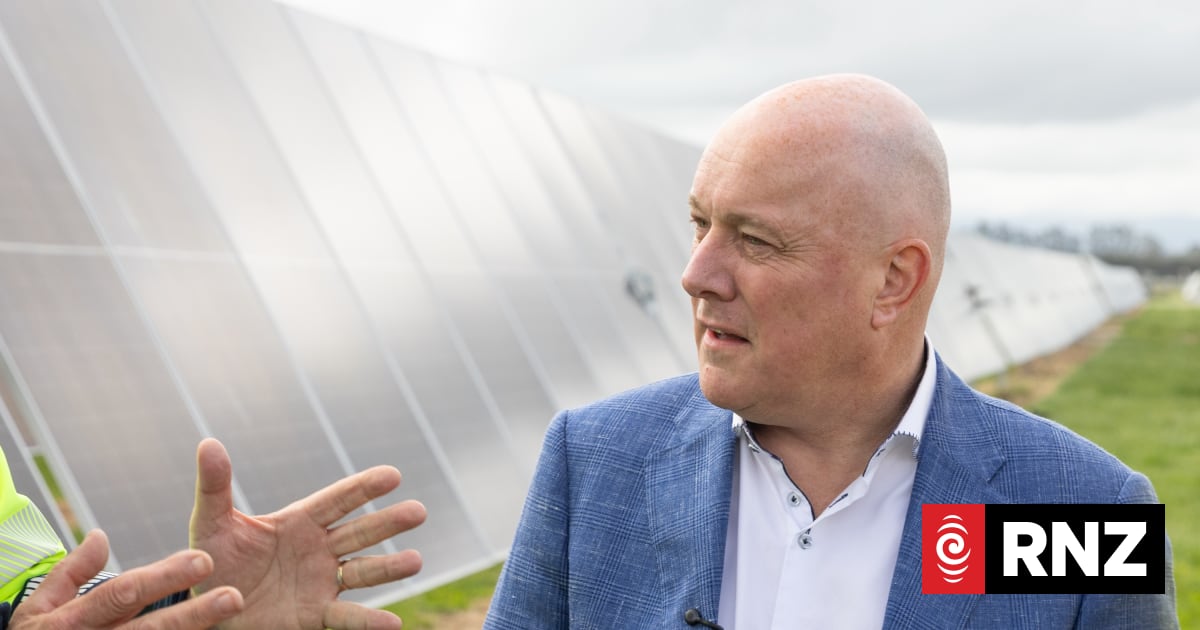
That’s despite the Prime Minister maintaining New Zealand wouldn’t send billions of dollars offshore.
“By any international comparison, the list of climate policy rollbacks and reversals is staggering,” according to the organisation, which measures government action globally on climate change against the globally agreed Paris Agreement goals.
It said the only two comparable examples CAT was aware of were the United States and Canada.
New Zealand’s climate targets for 2030 and 2035, both committed under the Paris Agreement, aim to reduce net emissions by 50% below 2005 gross levels by 2030 and 51-55% by 2035.
The Climate Change Minister told RNZ on Friday the latest emissions projections suggest New Zealand is on track to meet its first two emissions budgets, and its 2050 climate target.
But Treasury estimated earlier this year it could cost up to $5 billion to pay for the overseas carbon credits New Zealand would need to honour the agreement, while a further $1.6 billion would be required to meet the 2035 commitment.
The Prime Minister has consistently said he won’t send money offshore, but that the government was “gonna do everything we can” to honour the country’s Paris Agreement pledge to halve emissions by 2030.
In a briefing released ahead of the election, the NGO CAT, a collaboration between Climate Analytics and NewClimate Institute, said that while the government has not committed to sending money offshore, it continues to cut climate policies at home.
The NGO last reviewed New Zealand in 2022, noting its policies were rated “highly insufficient” with its domestic target being marked as “almost sufficient.” It had been “insufficient” in late 2017 under the then National government before being downgraded.
CAT’s most recent policy projections indicate that New Zealand is not on track to achieve its 2030 or 2035 Paris Agreement commitment.
It referenced a range of policy changes it said “weakened New Zealand’s climate policy framework” in areas such as agriculture, transport, the Emissions Trading Scheme, climate governance and industry. Specifically the government scrapping plans to price agricultural emissions, ending electric vehicle subsidies and reversing the ban on oil and gas exploration.
Under current policies, New Zealand would be “roughly 27-33% above a 1.5°C-compatible level by 2030, and around 40-52% above it by 2035.”
CAT said the scale of New Zealand’s reliance on acquiring internationally transferred mitigation outcomes (ITMOs) under Article 6 of the Paris Agreement was “striking”.
Article 6 allows for a country that has cut emissions past its target to sell those extra units to another country.
CAT stated Treasury’s estimation that New Zealand would need to secure offshore mitigation at a scale which was larger than New Zealand’s total annual emissions in 2024.
“The proportion of Article 6 units (ITMOs) required to meet New Zealand’s target is by far the largest in the world.
“It goes against the CAT’s recommendations on the use of Article 6, and the stated purpose of Article 6, which make it clear that governments must first set domestic targets and policies on track to align with 1.5˚C emissions pathways before relying on the use of international carbon credits.”
The report added there was also no guarantee that enough high-quality international credits would be available.
The Green Party said the analysis painted a clear picture of the “climate vandalism of Luxon’s Government.”
“Luxon and his Government have chosen to shred climate action and protect polluters’ profits, knowing that costs New Zealanders. These staggering rollbacks put him in the Donald Trump league of climate deniers,” Co-leader Chlöe Swarbrick said.
“The report spells out that if we’re to believe the Prime Minister when he says he’s committed to the Paris Agreement, that necessitates him paying billions to get other countries to reduce their emissions because he’s refused to do that here at home.”
Just last month, another international organisation took aim at New Zealand’s climate policies, accusing it of breaking its promises in the free trade agreement with the EU, which the Trade Minister rejects.
Climate Change Minister Simon Watts said National remained committed to the Paris Agreement, meeting its climate targets and building community resilience.
He said it was “encouraging” to see total annual emissions decreased 2.9 per cent in the year ended June 2026 in Stats NZ’s latest greenhouse gas emissions update, and the emissions intensity of our economy is 41.1 per cent lower in the June 2026 quarter than it was in the March 2010 quarter.
He credited those reductions to an “immense uptake in renewable energy.”
“There has been more renewable generation commissioned in the last 18 months than in the last 10 years.
“We’ve focused on taking an industry-led approach to reducing emissions from agriculture and are confident this will deliver, supported by the Government’s investments in Agri Zero. It makes no sense to price our farmers out of existence and send that production offshore.”
CAT suggested the next government should “treat climate policy as core economic policy,” and recommended it strengthen climate targets and the Emissions Trading Scheme, as well as redirect investment from fossil fuel expansion towards a clean energy transition.
Christopher Luxon was asked about the CAT report on Friday, and insisted “we’re not doing”, in regards to sending money offshore.
“We’re making New Zealand wealthier.
“We’re not going to punish our farmers and punish every man, woman, and child in New Zealand.”
He maintained he was committed to achieving net zero emissions by 2050.