
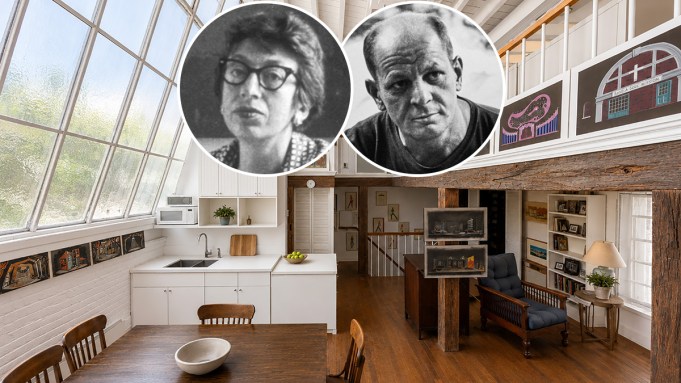
In the early 1950s, abstract expressionist painters Lee Krasner and Jackson Pollock borrowed a former carriage house in New York’s Greenwich Village from their friend and benefactor Alfonso Ossorio, using it as a shared studio. A well-to-do painter, arts patron, and collector, Ossorio cofounded the short-lived but influential Signa Gallery in East Hampton in 1957 and once owned the Creeks, a 57-acre estate now belonging to former Revlon chairman and prolific contemporary art collector Ron Perelman.
MacDougal Alley, a gated mews of former carriage houses that once served townhouses along Washington Square North and West Eighth Street, has deep artistic roots. In 1907, Gertrude Vanderbilt Whitney converted a former stable and hayloft into a sculpture studio, eventually buying several more buildings to provide other artists with places to live and work. Sculptor Daniel Chester French worked at No. 17, and Isamu Noguchi also maintained a studio on the alley.
RELATED: Pink Just Dropped $21.5 Million on a Six-Story Townhouse in Greenwich Village
For the last 45 years, 9 MacDougal Alley has been the home and creative space of Fred Kolo, an artist, set designer, and longtime creative partner of the late experimental theater director and playwright Robert Wilson. Now in his 80s, Kolo is ready to pass the property to a new owner, listing it for just under $8 million. Mae Bagai and Jonathan Hettinger of Sotheby’s International Realty Downtown Manhattan Brokerage share the listing.

The property includes a dedicated parking area for a full-sized vehicle.
Zdravko Cota for Sotheby’s International Realty
Dating to 1879, the 25-foot-wide red brick residence measures about 1,500 square feet across three floors. Beyond the black door, a shared vestibule leads to a self-contained ground-floor studio with a wood-burning fireplace, kitchenette, and bathroom. A row of south-facing windows looks out onto the mews, while the rear opens onto a nearly 250-square-foot garden planted with mature trees and hydrangeas.
Upstairs, French doors in the living area open to a balcony overlooking the mews. At the back, an angled roof composed of a grid of obscure-glass panes preserves privacy from neighboring residences while filling the double-height kitchen and dining area with natural light. A small bath is tucked behind the kitchen, while rustic wood columns support a lofted bedroom with a small walk-in closet and floor-to-ceiling bookshelves.
Out front, a dedicated parking space is large enough for a full-sized car and a scooter. Marketing materials also suggest the roof could be decked and landscaped or, with the necessary permits and approvals, potentially accommodate an additional penthouse level.
RELATED: Inside Irish Comedian Graham Norton’s Former N.Y.C. Pied-à-Terre for $5.6 Million
The ground-floor studio opens to a 250-square-foot courtyard garden.
Zdravko Cota for Sotheby’s International Realty
Before borrowing Ossorio’s studio, Pollock and Krasner lived and worked a few blocks away in an unheated tenement apartment on East Eighth Street that Pollock initially shared with his brothers Charles and Sande. The building has since been demolished. After marrying in 1945, the couple moved to the Springs area of East Hampton, buying a derelict 19th-century farmhouse and barn with financial help from art collector Peggy Guggenheim. Pollock converted the barn into a studio, and after his death in 1956, Krasner took it over as her own workspace, remaining there until her death in 1984. Today, the property operates as a museum and research archive.
Another of Pollock’s early workspaces is also on the market: a loft on Carmine Street in the West Village where he lived and worked in the early 1930s recently listed for about $2 million. Like the MacDougal Alley carriage house, it offers a glimpse of the downtown spaces where Pollock developed his practice before he and Krasner moved to Long Island.
Click here for more photos of the Greenwich Village carriage house.
Zdravko Cota for Sotheby’s International Realty
Authors

Mark David
Mark David got his start writing about real estate with the saucy cult-favorite blog The Real Estalker, on which he obsessively tracked the secretive world of celebrity property transactions. A much…