
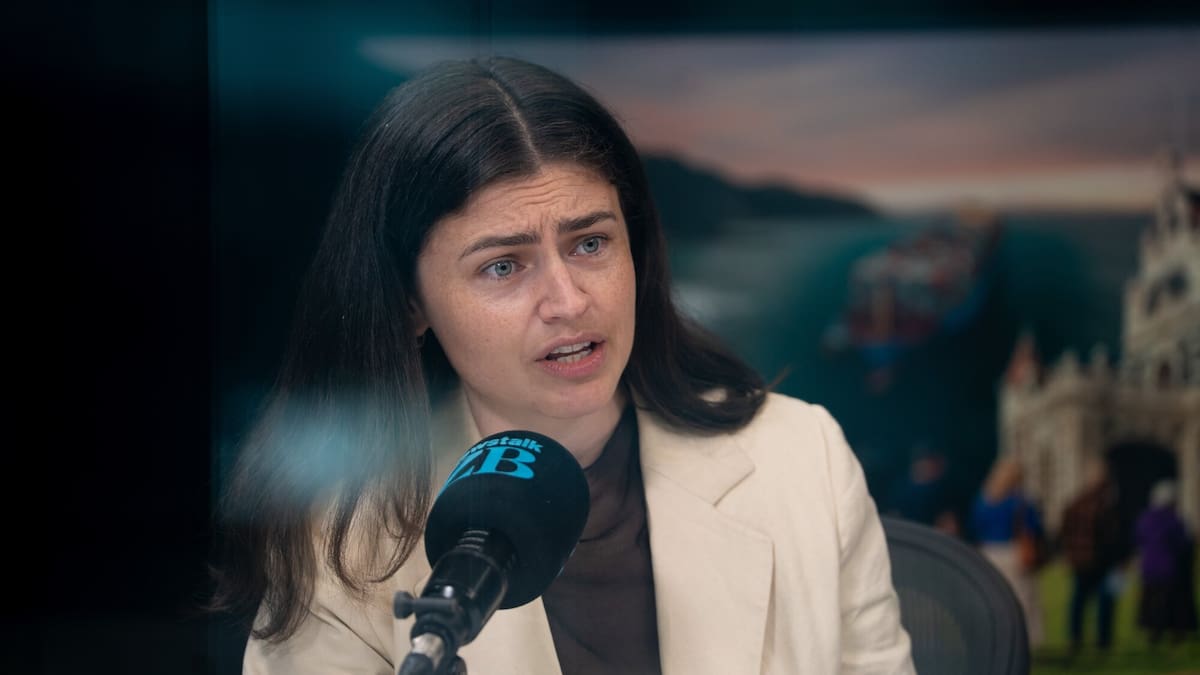
She said the threshold was chosen to “not be immediately equivalent to most people’s family home”, therefore reassuring them they would not be hit by the tax.
However, she added that once the tax was implemented and was proved to be working, there might be a conversation about lowering the threshold to capture more people.
“If we implement it, and we demonstrate to people that it works, then hopefully there is also the continuing arguments to obviously lower the threshold,” Swarbrick said.
A lower threshold would mean that people who were less wealthy would pay the tax.
National campaign chair Simeon Brown attacked the Greens’ and Labour’s tax plans. Photo / Dean Purcell
National’s campaign chair Simeon Brown leapt on the comments, pushing out a press release accused the Swarbrick of letting “the real plan slip”.
“There you have it. Ten million dollars is where the Greens want to start, not where they intend to stop.
“The $10 million threshold is a Trojan horse. The Greens want to get the wealth tax through the door first, then lower the threshold so it captures more New Zealanders,” Brown said.
Brown noted that in 2020 Labour campaigned on one tax change, but implemented several more in government.
Brown should ‘have a cup of tea and a lie down’ – Swarbrick
Swarbrick told the Herald if National wanted to attack the Greens’ tax plans it should agree to a debate between its finance spokeswoman Nicola Willis and Swarbrick.
Swarbrick has featured heavily in National’s attack ads in the final weeks of the campaign, with National arguing that Labour’s relatively poor polling would see Swarbrick as a potential contender for finance minister. Labour has ruled this possibility out.
“It would be awesome if National’s finance spokesperson wanted to accept the many offers for a public debate so we could discuss economics like adults, as this country deserves.
“We’re focused on campaigning on the things that matter. Unlike the National Party, the Greens don’t intend on ramming through profoundly unpopular laws we didn’t campaign on. We are campaigning on a wealth tax with a threshold of $10 million excluding the family home. Simeon Brown could use a cup of tea and a lie down,” Swarbrick said.
Swarbrick also took aim at Brown’s allegation that working New Zealanders would have their taxes hiked under the Greens. The party is promising a tax-free threshold giving 96% of New Zealanders a tax cut. The plan does include hiking income tax rates for those earning $160,000 or above. The Greens would set a new 45% top income tax rate at this level.
Rich pay half effective tax rate of middle-income people – report
Meanwhile, Swarbrick celebrated the release of a report from a pro-tax campaign group, Better Taxes for a Better Future, which argued New Zealand’s “very wealthy” paid 47% less of their income in tax than a middle-income earner.
The report picks up from IRD’s report into the tax paid by the richest New Zealanders, which was commissioned by Labour’s Revenue Minister David Parker during the last term to make the case for a wealth tax.
That report looked at the “economic income” that wealthy people derived from their ownership of property and companies and compared the tax paid on this income to the tax most other New Zealanders pay, which is predominately income tax and GST.
The new report, by economist Tayla Forward, argued that the very wealthy pay roughly 47% the effective tax rate of the median-wealth adult. The very wealthy are defined as a synthetic dataset roughly equivalent to the 311 very wealthy individuals who were forced to take part in Parker’s IRD project.
The report argued that simply increasing the tax rates of the taxes we already have will not address the problem and new taxes are needed.
Labour leader Chris Hipkins defended a tax level 10% higher than National’s. Photo / NZME
Swarbrick said of the report showed the “super rich are being given a hall pass to rip hard-working New Zealanders off”.
New research today proves, once again, how the system allows them to make bank at everyone else’s expense,” Swarbrick said.
“Nicola Willis says, ‘There’s no magic money tree’, while she upholds a system that makes hard-working New Zealanders pay double the effective tax rate of multi-multi-millionaires and billionaires.
“She knows that she’s starving our public services and driving up the cost of living for regular people, but I guess she’s keeping National’s donors happy,” Swarbrick said.
Labour defends manifesto pledge to lift share of taxation
Meanwhile, in Dunedin, Labour defended wording in its manifesto which appeared to concede the party plans to lift taxation as a share of the economy.
The argument harks back to a scrap earlier in the campaign, when the Labour Party released its fiscal strategy, which included the “objective” of having government spending and revenue “maintained at around 33%” of gross domestic product (GDP) once Labour’s capital gains tax (CGT) is fully implemented.
In dollar terms, spending and revenue at that 33% level would be substantially higher than what is forecast in the coming years and 10% higher than National’s target of 30% of GDP, or about $12b less in dollar terms.
With Labour’s GCT netting only about $1.35b once fully rolled out in 2030, National seized on the plan to argue Labour planned hidden taxes to make up the difference.
Labour took down the document and amended the language, with leader Chris Hipkins has pushed back on suggestions it’s a target by instead calling it a “ceiling”.
Labour’s recently released manifesto states that as one of Labour’s “priorities” will be having spending and revenue around 33% of GDP over the medium term.
National seized on the language, with Brown claiming Labour had “quietly slipped this multi-billion-dollar promise back into its agenda, hoping nobody will notice”.
On Friday, Labour’s finance spokeswoman Barbara Edmonds said the priority was “not a target”.
“The reason why we said 33% is when you bring in a CGT is the revenue for the CGT ramps up over time. So it ramps up to the point where you could spend up to 33%,” Edmonds said.
Edmonds said the wording described the idea as a “priority” because it was a priority to invest in public services.