SScience Read More The missing 500 million: Cosmic bombardment melted Earth’s first crustJuly 5, 2026 The simulations that captured the localized effects of individual large impacts also produced wholesale recycling of crust back…

EEnvironment Read More Targeted conservation in Brazil could help protect the Amazon’s flying riversJuly 5, 2026 The Amazon’s atmospheric moisture flows known as “flying rivers” provide over 70% of rainfall in parts of…
SSpace Read More The James Webb Space Telescope has detected the same unexplained absorption signal on the surfaces of Pluto and Titan — two frozen worlds with very different environments but methane-and-nitrogen chemistry in common — and so far, scientists cannot match it to any confirmed molecule in the lab.July 5, 2026 The James Webb Space Telescope has picked up the same unexplained absorption signal on the surfaces of two…
SScience Read More Alien-Like Reproductive Strategy Found in 125-Million-Year-Old Fossil : ScienceAlertJuly 5, 2026 Nature has imbued its mothers with many surprisingly strange ways to reproduce and care for their babies. Some…
SSpace Read More Life Out There review – astronauts search for meaning in atmospheric space oddity | StageJuly 5, 2026 From David Bowie’s Maj Tom and Elton John’s Rocketman via Capt Oates in Tom Stoppard’s Jumpers to this…
SScience Read More Hayabusa2 flies past asteroid as Japan aims to acquire data for planetary defenseJuly 5, 2026 Japan’s Hayabusa2 probe flew past the asteroid Torifune on Sunday — one of the closest encounters ever attempted…
SScience Read More For much of the past century, scientists believed dinosaurs were already in decline when the asteroid struck 66 million years ago — but a 2025 study published in Science found fossils in New Mexico showing they were flourishing in diverse, thriving ecosystems right up until the moment of impactJuly 5, 2026 For much of the past century, many scientists believed the dinosaurs were already in decline when the asteroid…
SScience Read More If Earth Is Farthest From The Sun This Week, Why Is It So Hot?July 5, 2026 Earth reaches aphelion on Monday, July 6, 2026, placing the planet at its farthest point from the sun…
SSpace Read More ‘Space balls’: Mysterious debris found on Australian beaches could contain toxic rocket fuel – The Irish TimesJuly 5, 2026 Six pieces of suspected space debris found washed up on Australianbeaches could be “space balls” that are often…
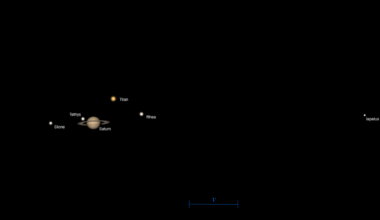
SScience Read More The Sky Today on Sunday, July 5: Capture a view of Saturn’s moonsJuly 5, 2026 Back to Article List Several of Saturn’s moons are on view this morning, including its brightest satellite, Titan,…
SScience Read More Scientists have now made the most comprehensive tally yet of deep-sea exploration — 43,681 dive records dating back to 1958 — and found that humans have directly seen less than 0.001% of the deep ocean floor, an area roughly the size of Rhode Island, leaving the vast seafloor across 66% of Earth’s surface essentially unobserved.July 5, 2026 Humanity has sent cameras to the Moon, Mars, Venus and the outer planets, but on Earth itself there…
SSpace Read More NASA’s Hubble captures a crimson stellar nursery sparkling with blue and white starsJuly 5, 2026 A spectacular new image from NASA’s Hubble Space Telescope offers a front row view of one of the…