New Zealand News Beep
  • News Beep
  • New Zealand
  • Headlines
  • Business
  • Entertainment
  • Health
  • Science
  • Sports
  • Technology
New Zealand News Beep
  • News Beep
  • New Zealand
  • Headlines
  • Business
  • Entertainment
  • Health
  • Science
  • Sports
  • Technology

Browsing Tag

Astrophysics

128 posts
SSpace
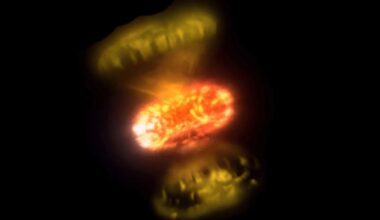
An illustration of the red supergiant star Betelgeuse, its companion star, and a dusty wake. The disk of a red-orange star is in the center. It is surrounded by a diffuse orange cloud representing its extended atmosphere. Below it about one stellar diameter away is a yellow dot representing a smaller companion star. From the companion, a dark red cloud wraps around in a counterclockwise direction. It begins very narrow and expands as it gets further from the companion, finally disappearing at the outer edge of the diffuse orange cloud around 10 ou2019clock. The words u201cartistu2019s conceptu201d are at lower right.
Read More

NASA Hubble Helps Detect ‘Wake’ of Betelgeuse’s Elusive Companion Star

  • January 5, 2026
Using new observations from NASA’s Hubble Space Telescope and ground-based observatories, astronomers tracked the influence of a recently…
SScience
This artist’s concept depicts a smaller white dwarf star pulling material from a larger star, right, into an accretion disk. Earlier this year, scientists used NASA’s IXPE (Imaging X-ray Polarization Explorer) to study a white dwarf star and its X-ray polarization.
Read More

NASA’s IXPE Measures White Dwarf Star for First Time

  • January 5, 2026
By Michael Allen  For the first time, scientists have used NASA’s IXPE (Imaging X-ray Polarization Explorer) to study a…
SSpace
A region of space mostly filled with background galaxies, with one prominent star at upper left. A large blob of purple haze occupies much of the field. Within the purple region, an unremarkable area is outlined with a dashed white circle.
Read More

NASA’s Hubble Examines Cloud-9, First of New Type of Object

  • January 5, 2026
A team using NASA’s Hubble Space Telescope has uncovered a new type of astronomical object — a starless,…
SScience
This release features a composite image of a galaxy cluster first discovered on New Year's Eve day, 2020. The cluster appears here as a large collection of brilliant white lights, each a distinct galaxy. A neon purple cloud stretches across the cluster's crowded core. Many of the hundred-plus galaxies in the cluster are in two clumps of galaxies towards the top and bottom of center. Some are encircled by a faint glowing haze, while a few foreground stars gleam with diffraction spikes. Some of the smaller galaxies are tinted blue, orange, or red, and some appear more oblong than round, suggesting spiral shapes viewed edge-on. The neon purple cloud sits at the heart of the image, surrounding the most densely-packed part of the cluster. This cloud, which spreads vertically across the cluster, is multimillion-degree gas observed by Chandra. The two clumps of observable galaxies, and the spread of superheated gas, reveal that the Champagne Cluster is in fact two clusters in the process of colliding. With the two clusters of sparkling light clinking together, and the auspicious discovery date, astronomers have dubbed the merged cosmic structure "The Champagne Cluster".
Read More

NASA’s Chandra Rings in New Year With Champagne Cluster

  • December 30, 2025
Celebrate the New Year with the “Champagne Cluster,” a galaxy cluster seen in this new image from NASA’s…
SScience
Space scientists’ cosmic calendar has 12 out-of-this-world wonders | Northwest & National News
Read More

Space scientists’ cosmic calendar has 12 out-of-this-world wonders | Northwest & National News

  • December 26, 2025
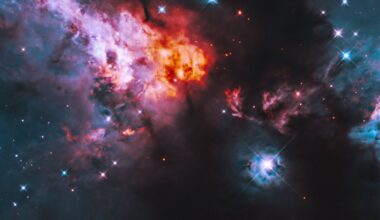
This Hubble image captures incredible details in the dusty clouds in the outskirts of a star-forming region called…
SScience
The Blueprint
Read More

Contactless method tracks electrical flow in matter hotter than sun

  • December 20, 2025
Deep inside stars, giant planets, and even Earth’s core, matter exists in a strange in-between state—neither solid nor…
SSpace
A nearly edge-on spiral galaxy. Its disk holds pink light from star-forming nebulae and blue light from clusters of hot stars. Thick dark clouds of dust block the strong white light from galaxy’s center. A faint, glowing halo of gas surrounds the disk, fading into the black background of space. A bluish plume of gas also extends from the galaxy’s core extending toward the lower-right corner of the image.
Read More

Hubble Glimpses Galactic Gas Making a Getaway

  • December 20, 2025
A sideways spiral galaxy shines in this NASA/ESA Hubble Space Telescope image. Located about 60 million light-years away…
SSpace
A cluster of multicolored stars
Read More

NASA’s Fermi Spots Young Star Cluster Blowing Gamma-Ray Bubbles

  • December 19, 2025
For the first time, astronomers using NASA’s Fermi Gamma-ray Space Telescope have traced a budding outflow of gas…
SScience
NASA’s SPHEREx Observatory Completes First Cosmic Map Like No Other
Read More

NASA’s SPHEREx Observatory Completes First Cosmic Map Like No Other

  • December 18, 2025
This panoramic view of SPHEREx’s first all-sky map simulates how the sky looks to the telescope. It transitions…
PPhysics
Astronomers May Have Finally Solved the Mystery of These Freaky Blue Cosmic Flashes
Read More

Astronomers May Have Finally Solved the Mystery of These Freaky Blue Cosmic Flashes

  • December 17, 2025
The cosmos is so full of mysteries that sometimes, astronomers will find answers to things you’ve probably never…
SScience
Chandra & IXPE composite image of the Perseus Cluster.
Read More

NASA IXPE’s Longest Observation Solves Black Hole Jets Mystery

  • December 16, 2025
Written by Michael Allen An international team of astronomers using NASA’s IXPE (Imaging X-ray Polarimetry Explorer) has identified…
SSpace
llustration labeled u201cartistu2019s conceptu201d at right bottom corner. At left bottom corner, a partially illuminated, lemon-shaped exoplanet appears against a black background. This planet is most brightly illuminated at its elongated tip on its right side. On the left side, which is wider, the planet trails off into the darkness of the background. The planet is colored in varying, mottled shades of red, light pink, and fuchsia. Most of the pink occurs closest to the tip, while most of the fuchsia is at the top and bottom edges. At right top corner, a white beam emanates diagonally, oriented from 10 ou2019clock to 4 ou2019clock, from either side of a small, glowing, white star.
Read More

NASA’s Webb Observes Exoplanet Whose Composition Defies Explanation

  • December 16, 2025
Scientists using NASA’s James Webb Space Telescope have observed a rare type of exoplanet, or planet outside our…
New Zealand News Beep
www.newsbeep.com