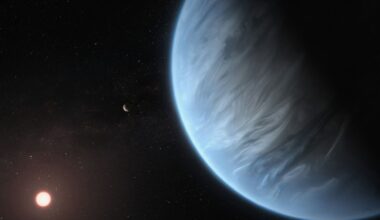
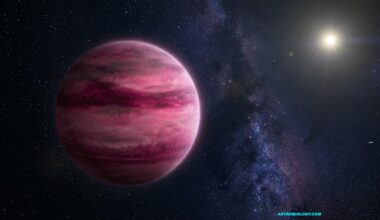
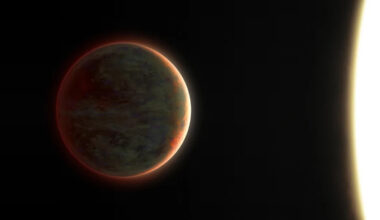
SSpace Read More This exoplanet, located about 25 light-years from Earth, could be habitableJuly 9, 2026 ⓘ NASA – Unsplash An artist’s illustration showing an exoplanet and a star. Astronomers have recently conducted new…
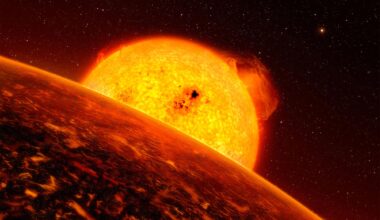
SScience Read More James Webb Uncovers the Atmosphere of a Hellish Lava World 41 Light-Years AwayJuly 4, 2026 Artist’s illustration of lava exoplanet CoRoT-7 b. Credit: ESO/L. Calçada JWST data suggest 55 Cancri e may be…
SScience Read More Astronomers Find Potentially Habitable Super-Earth Just 25 Light-Years AwayJuly 1, 2026 Astronomers have discovered a rocky exoplanet about twice Earth’s size just 25 light-years away, orbiting in the habitable…
SScience Read More Webb Sees Jupiter-Size Exoplanet Being Roasted by Its StarJune 22, 2026 HD 80606b has one of the most extreme orbits of any known exoplanet and the NASA/ESA/CSA James Webb…
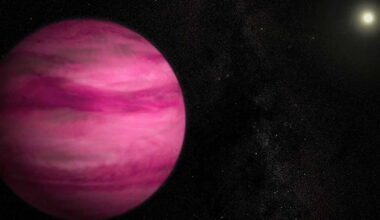
SScience Read More Famous Pink Planet Harbors A Salty SurpriseJune 22, 2026 GJ504b – Grok via astrobiology.com Northwestern University-led astronomers have discovered salty skies surrounding the universe’s famous “Pink Planet.”…
SSpace Read More James Webb Space Telescope Made a Salty Discovery in This Unusual Exoplanet’s SkiesJune 21, 2026 James Webb Space Telescope (JWST) observations have revealed the colorful secret of the Pink Planet, the coldest object…
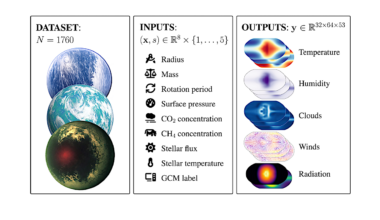
SScience Read More ThousandWorlds: A Benchmark For Climate Emulation Of Potentially Habitable ExoplanetsJune 20, 2026 Dataset overview. Output fields are defined on a 32 × 64 latitude–longitude grid. There are 53 fields in…
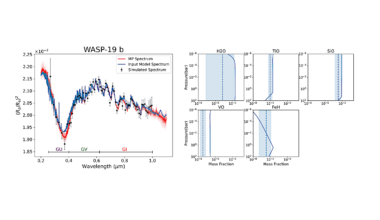
SScience Read More The Capability Of CSST In Characterizing Planetary Atmospheres. I. Transmission Spectroscopy Of Hot JupitersJune 18, 2026 Free-chemistry retrieval results for WASP-19 b. Left panel: The transmission spectrum derived from simulated CSST transit observation consisting…
SScience Read More James Webb reveals a hellish exoplanet where dawn and dusk have wildly different chemistryJune 16, 2026 James Webb Space Telescope (JWST) observations suggest that the two day-night boundary zones on the gas exoplanet WASP-121…
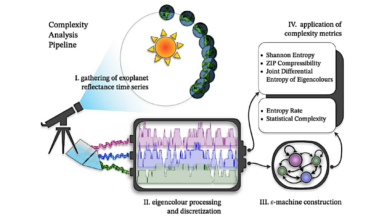
SScience Read More Reflections of Life: Distinguishing Living from Nonliving Worlds with Complexity MetricsJune 14, 2026 Biosignatures & Paleobiology Status Report The Astronomical Journal June 14, 2026 Analysis pipeline employed in the present work.…
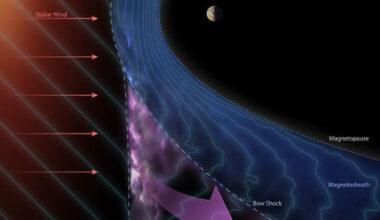
PPhysics Read More Jupiter Accelerates Electrons to Near-Light Speed, Offering Clues to Cosmic Ray OriginsJune 11, 2026 The giant planet’s bow shock isn’t just deflecting the solar wind, it’s acting as a powerful particle accelerator,…
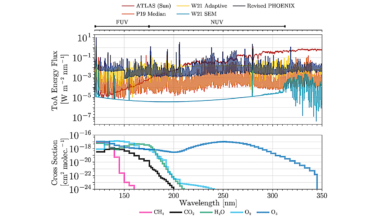
SScience Read More Ultraviolet-Driven Atmospheric Degeneracies Challenge Conventional Biosignature Frameworks for Terrestrial Planets with Ultracool M Dwarf Hosts: An Archean-Analog TRAPPIST-1 e Case StudyJune 8, 2026 Comparison of input SEDs used in this study and molecular photoabsorption cross sections relevant to Archean-analog photochemistry. The…