New Zealand News Beep | NewsBeep.com
  • News Beep
  • New Zealand
  • Headlines
  • Business
  • Entertainment
  • Health
  • Science
  • Sports
  • Technology
New Zealand News Beep | NewsBeep.com
  • News Beep
  • New Zealand
  • Headlines
  • Business
  • Entertainment
  • Health
  • Science
  • Sports
  • Technology

Browsing Tag

Quasar

12 posts
SSpace
Reuters
Read More

Ancient quasars add to a ‘major unsolved problem’ in astrophysics

  • July 9, 2026
By Will Dunham WASHINGTON, July 8 (Reuters) – A quasar — among the universe’s most luminous and energetic…
PPhysics
Astronomers detect winds from a black hole reaching 30% of the speed of light
Read More

Astronomers detect winds from a black hole reaching 30% of the speed of light

  • June 11, 2026
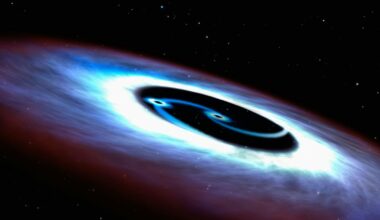
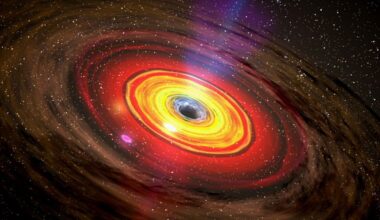
ⓘ NASA – Unsplash An illustration showing two black holes. Recently, astronomers have detected powerful winds in a…
SSpace
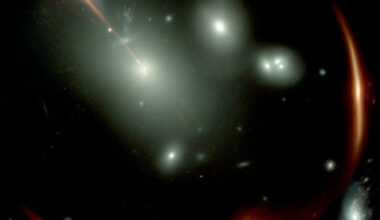
This Webb image shows the highly distorted red galaxy MRG-M0138 seen through a foreground cluster of galaxies (white sources). Image credit: NASA / ESA / CSA / Webb.
Read More

Webb Weighs Most Distant Inactive Black Hole Ever Found

  • June 6, 2026
A supermassive black hole 6 billion times the mass of the Sun lurks in MRG-M0138, a gravitationally lensed…
SScience
Radio signal from the quasar TXS 2005+403 travels roughly 10 billion light-years to reach Earth, traversing the Cygnus region, one of the most turbulent and scattering environments in the Milky Way Galaxy. On the left, this artist’s conception shows the quasar as it truly appears, with a bright accretion disk and jets blasting into the Galaxy like a beacon through the darkness. On the right, we see how turbulent gas distorts scientists’ view of the quasar in much the same way heat haze from a fire warps our view of the objects behind it. Image credit: Melissa Weiss / CfA.
Read More

Astronomers Catch Interstellar Turbulence Warping Light across Milky Way

  • May 15, 2026
For the first time, astronomers have directly detected how turbulent clouds of ionized gas between the stars bend…
SScience
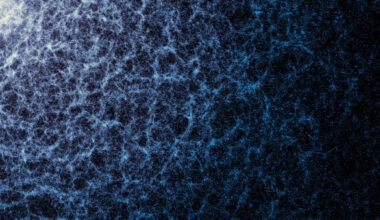
A small portion of DESI’s year-five map in which the large-scale structure of the Universe, created by gravity, is visible; each dot represents a galaxy; the denser areas indicate regions where galaxies and galaxy clusters have clumped together to form the strands of the cosmic web; also seen are large voids between the filaments. Image credit: DESI Collaboration / DESI Member Institutions / DOE / KPNO / NOIRLab / NSF / AURA / R. Proctor / M. Zamani, NSF’s NOIRLab.
Read More

Record-Breaking Map Charts Universe in 3D Like Never Before

  • April 17, 2026
Astronomers using the Dark Energy Spectroscopic Instrument (DESI) on NSF’s Nicholas U. Mayall 4-m telescope have produced the…
SSpace
This distant galaxy has lost 95% of its brightness in less than 20 years
Read More

This distant galaxy has lost 95% of its brightness in less than 20 years

  • April 12, 2026
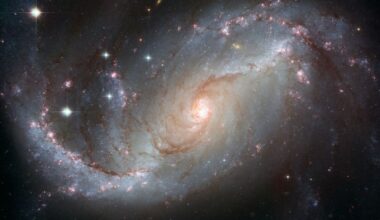
ⓘ NASA – Unsplash An image showing a spiral galaxy. Astronomers have discovered a galaxy located about 10…
SScience
A cosmic giant caught breaking the universe’s growth rules
Read More

A cosmic giant caught breaking the universe’s growth rules

  • January 24, 2026
In the early universe, astronomers found a rare light that breaks the rules of how black holes grow.…
PPhysics
This black hole released energy equivalent to 10,000 billion suns
Read More

This black hole released energy equivalent to 10,000 billion suns

  • November 7, 2025
Black holes are certainly one of the most powerful structures in the universe. And if you still had…
SScience
Former US landfill turned into 213-acre solar farm to deliver 7 MW of clean power
Read More

Astronomers detect ultra-luminous infrared galaxy lurking behind quasar

  • October 12, 2025
Astronomers have uncovered a remarkable new addition to the catalog of ultra-luminous infrared galaxies (ULIRGs) – cosmic powerhouses…
SScience
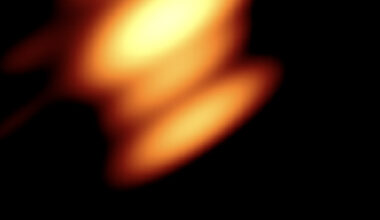
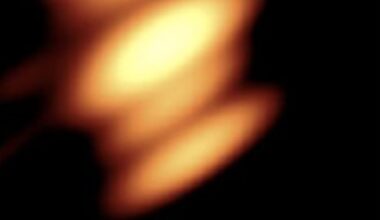
This RadioAstron map two supermassive black holes at the center of OJ 287, a galaxy located about 5 billion light-years away in the constellation of Cancer: if the central component corresponds to the primary black hole, then the next one upwards marks the secondary black hole, and the highest component represents a knot in its jet; the elongation of the individual components is not real, but is a reflection of the beam shape. Image credit: Valtonen et al., doi: 10.3847/1538-4357/ae057e.
Read More

RadioAstron Captures Radio Image of Two Supermassive Black Holes Circling Each Other

  • October 10, 2025
Using data from the RadioAstron satellite, astronomers have produced a radio image of two supermassive black holes at…
PPhysics
Scientists Spot Two Black Holes Caught in a Deadly Orbital Dance for the First Time
Read More

Scientists Spot Two Black Holes Caught in a Deadly Orbital Dance for the First Time

  • October 10, 2025
When two black holes meet, they are drawn to one another by way of their enormous gravity, initiating…
PPhysics
Turns Out the First Supermassive Black Holes Weren’t So Supermassive, Research Suggests
Read More

Turns Out the First Supermassive Black Holes Weren’t So Supermassive, Research Suggests

  • September 25, 2025
All galaxies have a supermassive black hole at their center. A new finding doesn’t contradict that observation, but…
New Zealand News Beep | NewsBeep.com
www.newsbeep.com