New Zealand News Beep | NewsBeep.com
  • News Beep
  • New Zealand
  • Headlines
  • Business
  • Entertainment
  • Health
  • Science
  • Sports
  • Technology
New Zealand News Beep | NewsBeep.com
  • News Beep
  • New Zealand
  • Headlines
  • Business
  • Entertainment
  • Health
  • Science
  • Sports
  • Technology

Browsing Tag

Radio signal

8 posts
SScience
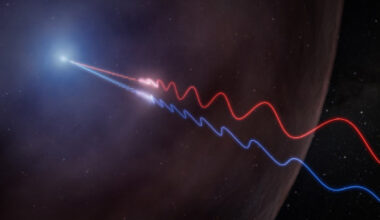
This illustration depicts Faraday rotation in the afterglow of a gamma-ray burst. A powerful jet (upper left) sends polarized radio waves outward through the thin wall of a surrounding bubble of magnetized gas called an HII region. As the light passes through this material, its polarization angle is twisted by the magnetic field. Because the effect is stronger at longer wavelengths, the red and blue waves, which represent different radio wavelengths, exit the bubble oscillating in different directions. By measuring this difference, astronomers were able to map the magnetic environment surrounding GRB 260310A for the first time. Image credit: NSF / AUI / NRAO / M. Weiss
Read More

Astronomers Detect Gamma-Ray Burst’s Magnetic Fingerprint

  • July 15, 2026
Using NSF’s Very Large Array (VLA), astronomers made the first radio detection of polarized light and Faraday rotation…
SSpace
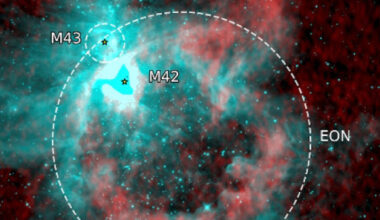
Extended Orion nebula shell sampled by HI emission from the combined VLA and FAST observations (shown in red), Hα emission from the European Southern Observatory Digitized Sky Survey (shown in green), and 3.4-μm emission registered by the Wide-field Infrared Survey Explorer (WISE) satellite (shown in blue). Image credit: Juan D. Soler, University of Vienna / NRAO / VLA / NASA / WISE.
Read More

Astronomers Uncover Hidden Structures Surrounding Orion Nebula

  • July 11, 2026
Using the Karl G. Jansky Very Large Array (VLA) s and the Five-hundred-meter Aperture Spherical Radio Telescope (FAST),…
SScience
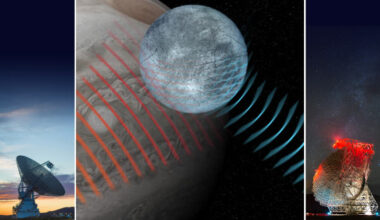
This artist’s impression shows radar waves from NASA’s Goldstone Solar System Radar pinging Europa; the radar waves penetrate Europa’s icy surface before bouncing back to be collected by NSF’s Green Bank Telescope on Earth. Image credit: NSF / AUI / NSF’s NRAO / P.Vosteen.
Read More

Radar Observations Reveal New Clues about Europa’s Hidden Interior

  • June 17, 2026
Using NASA’s Goldstone Solar System Radar and NSF’s Green Bank Telescope, astronomers from the University of California, Los…
SScience
Radio signal from the quasar TXS 2005+403 travels roughly 10 billion light-years to reach Earth, traversing the Cygnus region, one of the most turbulent and scattering environments in the Milky Way Galaxy. On the left, this artist’s conception shows the quasar as it truly appears, with a bright accretion disk and jets blasting into the Galaxy like a beacon through the darkness. On the right, we see how turbulent gas distorts scientists’ view of the quasar in much the same way heat haze from a fire warps our view of the objects behind it. Image credit: Melissa Weiss / CfA.
Read More

Astronomers Catch Interstellar Turbulence Warping Light across Milky Way

  • May 15, 2026
For the first time, astronomers have directly detected how turbulent clouds of ionized gas between the stars bend…
SScience
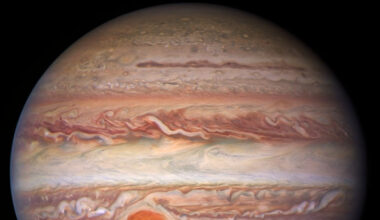
Jupiter is Smaller and More ‘Squashed’ than Previously Believed, New Juno Data Reveal
Read More

Jupiter is Smaller and More ‘Squashed’ than Previously Believed, New Juno Data Reveal

  • February 5, 2026
Using high-precision radio-occultation measurements from NASA’s Juno mission and incorporating the effects of zonal winds, planetary scientists derived…
SScience
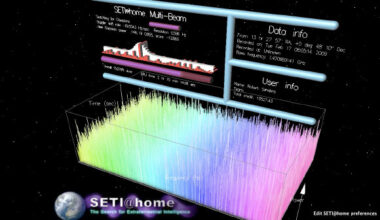
A screenshot of the SETI@home user interface on a desktop computer in 2009. Image credit: Robert Sanders / UC Berkeley.
Read More

Millions Joined SETI@home Project, Now Astronomers Zero In on 100 Promising Signals

  • January 14, 2026
SETI@home, the pioneering distributed-computing project launched in 1999 that enlisted millions of volunteers to analyze radio signals from…
SScience
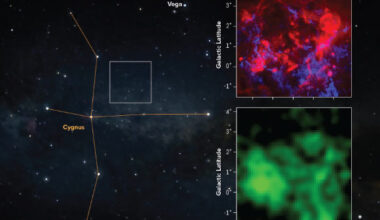
These images show the location of CO-dark molecular gas in Cygnus X. Image credit: NSF / AUI / NSF’s NRAO / P.Vosteen.
Read More

Green Bank Telescope Maps Cool ‘Dark’ Gas in Cygnus X

  • October 30, 2025
Astronomers using the Green Bank Telescope (GBT) have created the large-scale maps of carbon monoxide (CO)-dark molecular gas…
SScience
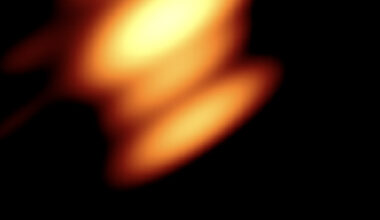
This RadioAstron map two supermassive black holes at the center of OJ 287, a galaxy located about 5 billion light-years away in the constellation of Cancer: if the central component corresponds to the primary black hole, then the next one upwards marks the secondary black hole, and the highest component represents a knot in its jet; the elongation of the individual components is not real, but is a reflection of the beam shape. Image credit: Valtonen et al., doi: 10.3847/1538-4357/ae057e.
Read More

RadioAstron Captures Radio Image of Two Supermassive Black Holes Circling Each Other

  • October 10, 2025
Using data from the RadioAstron satellite, astronomers have produced a radio image of two supermassive black holes at…
New Zealand News Beep | NewsBeep.com
www.newsbeep.com