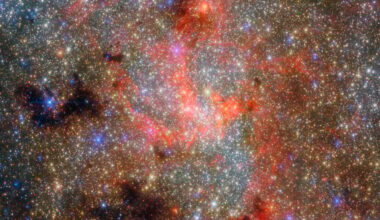
NASA’s James Webb Space Telescope detected water molecules and freshly produced silicate dust around a dying star seen just 0.55 light-years in projection from the Milky Way’s central black hole—showing that surprisingly fragile material can form and survive within the Galaxy’s radiation-drenched central environment.
The James Webb Space Telescope did not photograph water droplets or watch rocky grains condense beside the Milky…