
The scientists behind the new assessment, published in the journal Frontiers in Science, reviewed the evidence for five of the most widely discussed polar geoengineering ideas.
All fail to meet basic criteria for their feasibility and potential environmental risks, they say.
One such suggestion is releasing tiny, reflective particles called aerosols high into the atmosphere to cool the planet.
This often attracts attention among online conspiracy theorists, who falsely claim that condensation trails in the sky – water vapour created from aircraft jet engines – is evidence of sinister large-scale geoengineering today.
But many scientists have more legitimate concerns, including disruption to weather patterns around the world.
With those potential knock-on effects, that also raises the question of who decides to use it – especially in the Arctic and Antarctic, where governance is not straightforward.
If a country were to deploy geoengineering against the wishes of others, it could “increase geopolitical tensions in polar regions”, according to Dr Valerie Masson-Delmotte, senior scientist at the Université Paris Saclay in France.
Another fear is that while some of the ideas may be theoretically possible, the enormous costs and time to scale-up mean they are extremely unlikely to make a difference, according to the review.
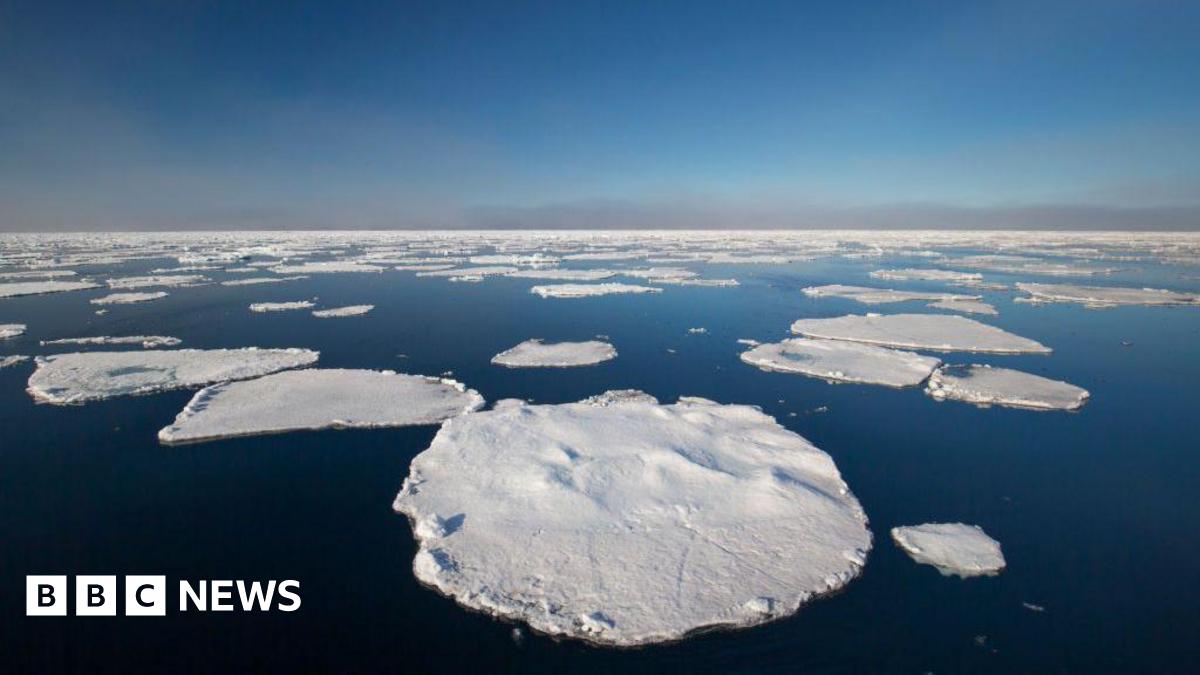
One idea BBC News recently looked at was a plan to pump seawater over the surface of Arctic sea-ice in winter to thicken it, giving the ice a better chance to survive the summer.
But to cover 10% of the Arctic could require about 10 million seawater pumps, one estimate suggests.
A more fundamental concern is that these types of projects could create the illusion of an alternative to cutting humanity’s emissions of planet-warming gases.
“If they are promoted… then they are a distraction because to some people they will be a solution to the climate crisis that doesn’t require decarbonising,” said Prof Siegert.
“Of course that would not be true and that’s why we think they can be potentially damaging.”