
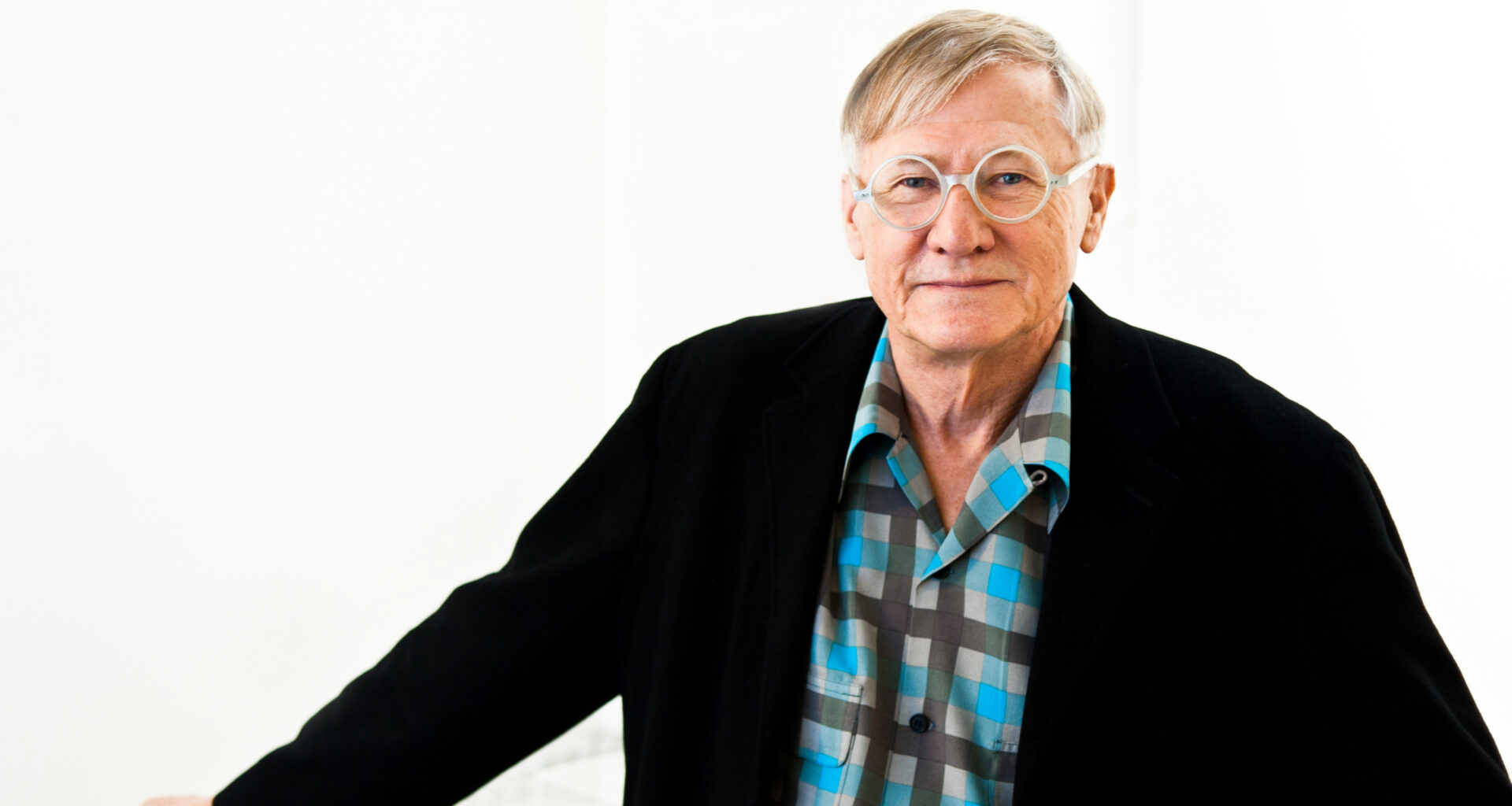
The ‘extraordinary innovative’ architect played a key role in British architecture over the past half a century.
His other famous completed works include the British Pavilion for the Seville Expo 1992 and the Western Morning News HQ & Print in Plymouth.
After working with Terry Farrell for 15 years, Grimshaw set up his own practice in 1980 (then Nicholas Grimshaw & Partners, later Grimshaw Architects). He designed projects around the world – from factories for Herman Miller, to flats in Camden Town and a spa in historic Bath.
Today, the company employs more than 650 staff and has offices in Los Angeles, New York, London, Doha, Dubai, Kuala Lumpur, Melbourne and Sydney.
In a statement released today (15 September), the practice described Grimshaw as a ‘man of invention and ideas’ who would be ‘remembered for his endless curiosity about how things are made and his commitment to the craft of architecture and building’.
The firm added: ‘With this pragmatic creativity, Nick had an extraordinary ability to convince others that daring ideas were possible.’
Grimshaw was knighted in 2002 for his services to architecture, and served as president of the Royal Academy from 2004 to 2011 and lectured extensively around the world.
On learning that he was about to receive the Royal Gold Medal in 2018, Grimshaw said: ‘My life – and that of the practice – has always been involved in experiment and in ideas, particularly around sustainability; I have always felt we should use the technology of the age we live in for the improvement of mankind.’
He stepped down as practice chair in 2019, aged 79, and was succeeded by long-term colleague Andrew Whalley, the company’s deputy chairman.
Whalley said: ‘From the very first day I arrived at the practice in 1986, I felt the warmth and generosity of Nick’s leadership. The lack of hierarchy in the studio, shaped by his amiable and open personality, was its true strength.
‘It created a collegiate spirit, a place where people genuinely enjoyed working together, supporting one another, and finding the tenacity to deliver some of the most complex buildings.
‘His architecture was never about surface or fashion, but always about structure, craft and purpose – about creating buildings that endure because they are both useful and uplifting and, in Nick’s words, “bring some kind of joy”.’
In 2022, Grimshaw set up the Grimshaw Foundation – a ‘logical extension of his passion for creativity and its inherent power to unlock opportunities’, which has gone on to support more than 500 under-represented young people to ‘develop practical skills, confidence and curiosity, and to see creative careers as realistic and achievable’.
He is survived by his wife, Lavinia, and daughters Chloe and Isabel.
The practice added: ‘They were all very much part of his professional life, and our condolences are with his family today.’
Royal Gold Medal citation by Simon Allford
I have known Nick Grimshaw since I worked for him in the early 1980s. At this time, the practice was well established and known for its pursuit of a particular way of seeing and making buildings. The practice then was only a dozen people but its modus operandi – that has facilitated its growth into a major international practice – was already well established.
The focus then as now was on how buildings should be designed from the outset to respond for the need to change over time in use. The preoccupation was how plan and section could define use, structure and detail to allow for this change. Nick always understood that the life of a building begins once the architect’s engagement ends.
Nick’s particular view on the world thus combines an interest in architecture at the scale of infrastructure, with construction and detail. His focus is on how the technology of new and, wherever appropriate, old materials can work to make an architecture that engages in size (form and silhouettes), detail (celebrating the maker’s mark), energy performance, and long-term capacity for adaptive use. It is this breadth of interest that has made his work both distinguished and of importance to architectural discourse.
The relevance of Nick’s personal response to the challenges of making architecture in the modern era is demonstrated by the fact that his practice has now designed and delivered key projects around the world, all at very different scales and for very different client groups.
Nick’s influence on the profession also extends beyond his work as a practitioner. He has chaired numerous national and international juries for both competitions and awards. He has lectured extensively and around the world, examined and taught widely and is a past president of both the Architectural Association and the Royal Academy.
In this latter role, he played a key part in garnering the support of painters, sculptors and printmakers, as well of course as the architects, in creating a new facility for, amongst other things, the permanent display of architecture in the new extension of the Royal Academy at Burlington Gardens.
It is for the reasons listed in the supporting documentation, following my nomination of Nick Grimshaw, I have been able to garner the support of seven Gold Medallists three of whom are also Pritzker Prize winners from both the UK and abroad and a host of other leading architects, artists, writers, critics and clients.
See more work by Grimshaw in the AJ Buildings Library