
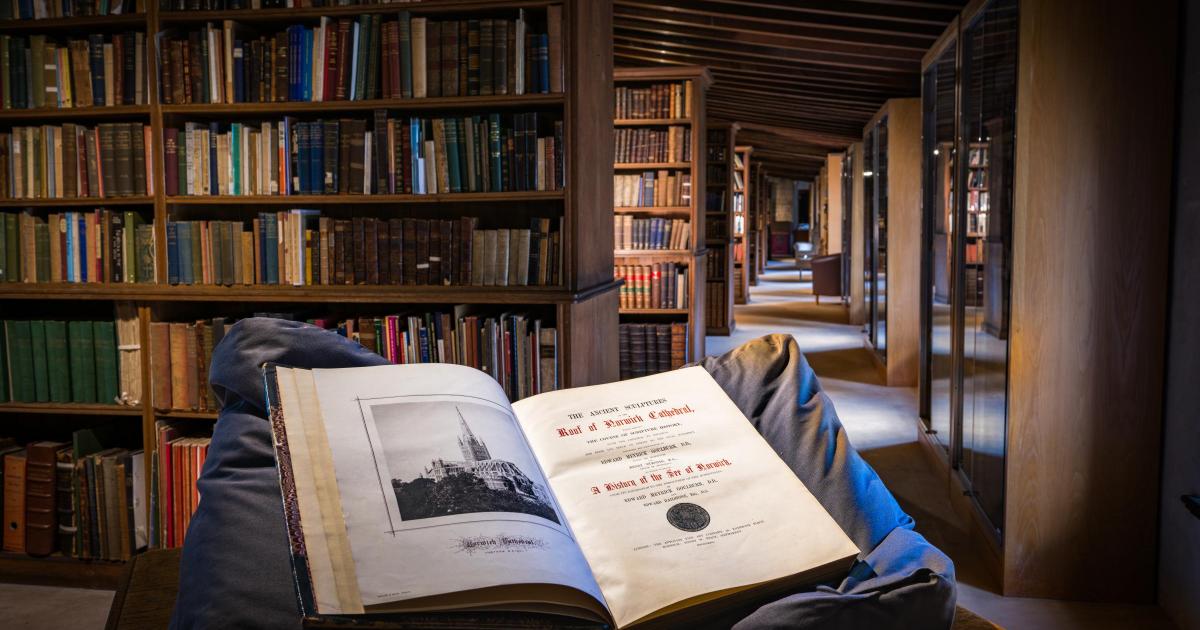
There’s been a collection of books on the site since the cathedral and monastery were founded way back in 1096.
There are around 25,000 volumes in its theological collection. And the historic collection is home to 8,000 ancient texts, which date back as far as the 15th century.
The library buildings date back at least 700 years, and have been adapted over the centuries as their uses have changed.
It has been located above the South Walk of the cloister since 1913 and was expanded in the early 2000s. To enable people to enjoy the collection, the library is open to the public three days a week – and on September 19, as part of Heritage Open Days, there will be guided tours of the library to learn about its architectural history, and a selection of books from the collections will be on display.
Librarian Gudrun Warren with the oldest book in Norwich Cathedral library, about to celebrate its 550th birthday. Photograph: Norwich Cathedral/Bill Smith The oldest printed book in the library is from 1474 – less than 20 years after the invention of the moveable type printing press – a copy of The Divine Institutes by Lactantius, who was writing in around the 4th century.
In addition to theological texts, the cathedral library is also home to a large collection of important local books – including a three-volume first edition of the Paston Letters, a collection of correspondence between the prominent Norfolk family which gives a glimpse into life during the Wars of the Roses and the early Tudor period.
Since 2003, librarian and curator Dr Gudrun Warren has been custodian of the cathedral’s collection – and as well as preserving the important collection for future generations, conservation and keeping the books in their current condition, it is also important to her that they are accessible for visitors to enjoy.
‘I’m keen that books aren’t just museum artefacts, that they are available for use,’ she says.
‘We regularly hold exhibitions, which is a way of encouraging people to realise that these books are real books, they’re not just spines on the shelf.’
Historic books in Norwich Cathedral library. Photograph: Bill Smith/Norwich Cathedral A whole world opens up when you leaf through the books. In some, handwritten dedications or annotations give a sense of the lives of their previous owners.
Gudrun highlights two books, which have recently featured in an exhibition curated by one of the library’s team of volunteers.
Her Book showcased books that were known to have been owned by women, written by women or – as is the case for these two books – been printed by women.
‘One of my volunteers has turned out to have a real skill at putting together exhibitions,’ says Gudrun.
‘There seems to have been a particular moment in printing history when women could get into being printers, usually either because they were the daughter of a printer or because they married a printer. And particularly if they married a printer and then the husband died, she would be allowed to carry on the printing company in her own right and potentially in her own name unless and until she remarried.’
Theanthråopikou seu De vita Jesu Christi was printed by Elizabeth Purslowe, who was active from 1632-1646. She had a successful career after the death of her husband, George, and printed more than 160 titles. She joined with the printer Anne Griffin, who printed another book which featured in the exhibition, in the printing syndicate Eliot’s Court Press.
Historic books in Norwich Cathedral library. Photograph: Bill Smith/Norwich Cathedral There’s a Norwich link to the book, as it was collected by Richard Montagu, who was Bishop of Norwich from 1638 to his death in 1641 and is buried in Norwich Cathedral, near the High Altar.
Another example in the collection is a Greek lexicon by John Harmar which was printed by Anne Griffin in London in 1637 and sold by Joyce Norton. She was a prolific 17th century London printer and the widow of the well-established printer Edward Griffin and joined in the printing syndicate Eliot’s Court Press with Elizabeth Purslowe.
‘There was some very prestigious printing being done by women,’ says Gudrun.
‘When Charlotte was doing the research for this exhibition she thought at first she was going to have maybe a couple of books, and then suddenly realised there’s a whole load of stuff in this collection that we didn’t know about,’ she says.
‘It’s a wonderful example of how when we’re doing work to put together an exhibition we can end up learning more about our own collection as well as hopefully putting something out for other people to learn.’
Dean Goulburn’s History of Norwich Cathedral, the first publication to display and analyse the historiated bosses. Photograph: Norwich Cathedral/Bill Smith One book in the collection gives a fascinating insight into the cathedral’s own history: The Ancient Sculptures in the Roof of Norwich Cathedral by Edward Meyrick Goulburn and Henry Symonds, which was published in 1876. An added interest is its inscription, to a lay clerk to mark 50 years service as a member of the choir.
‘Edward Meyrick Goulburn was Dean of Norwich from 1866 to 1887 and he worked with Henry Symonds, who was a canon here as well. They were both very interested in the history of the cathedral,’ says Gudrun.
‘It was written at the time when the bosses were being rediscovered and it’s really interesting that this seems to be the first sizeable thing that’s written about them.’
Another book which Gudrun finds particularly interesting is a very early book – a copy of the New Testament translated by William Tyndale. It has simple binding and is illustrated throughout.
‘The very earliest printing of his work was 500 years ago,’ she says. ‘Our copy is from 1549. You can use books to tell you something about their history, and in terms of their size, how they were expected to be used. This is very small, so therefore expected to be used personally. But when it was very first printed in 1526 it would have been illegal in this country. It was before you were allowed to have the bible in the vernacular, so the early copies would have been printed small to make them easier to smuggle.
Historic books in Norwich Cathedral library. Photograph: Bill Smith/Norwich Cathedral ‘Tyndale’s New Testament is certainly very much the core of the translation that was then used in the 1611 King James Bible, so it’s got that legacy. It’s also got the legacy that Henry VIII allowed the printing of the Bible in English within three years of Tyndale being executed for heresy and one of the charges was having produced the Bible in English.’
Discover more fascinating stories from the collection from 2.30-4pm on Friday September 19 as part of Heritage Open Days (admission free). There will be short tours at 2.45pm and 3.15pm.
The library is on the first floor of the cloister near the Refectory, at the same end as the lift. Usual library opening times are 10am-4pm, Tuesdays-Thursdays. Contact library@cathedral.org.uk and 01603 218443.