

No one should be surprised that there is a crisis in our universities. In 2023, a parliamentary inquiry warned that the ‘current system of funding higher education [was] not sustainable and [would] lead to growing issues in the coming years’.
They were right. In recent weeks lecturers, students and unions have told the AJ that architecture departments have already started to suffer, dogged by stagnating admissions and growing financial pressures that have given rise to redundancies and strike action.
There is a distinct sense of panic around UK universities, as all but the top-tier institutions frantically tighten their belts. In March, the University and College Union (UCU) reported that more than 5,000 job losses were expected in the sector. With a further £238 million of cuts in prospect and major deficits on universities’ books, the UCU said it feared a further 5,000 positions were at risk.
Early this month, in an unprecedented move, it was announced the first ‘super university’ in the country will be formed from a merger of the University of Greenwich and the University of Kent. Both institutions are at pains to stress that this decision was not made under financial duress. But, given that Kent posted a £6.3 million deficit in its 2024 accounts and Greenwich began a restructuring programme involving redundancies earlier this year, it is inevitable some will leap to that conclusion.
With higher education ‘on its knees’, as the UCU describes the situation, concerns have been raised that courses such as architecture, which require more than just the presence of a professor in a classroom, may be in a particularly vulnerable position when heads start to roll.
Morale is increasingly low; the system is failing everyone
Established architecture courses at universities such as Newcastle, Greenwich and Sheffield have been fighting this year to divert the cuts into other areas and away from frontline teaching. But fears persist that strikes and collective bargaining may only deliver a stay of execution if the underlying flaws of the system are not addressed.
Laura Mark, who taught at a number of architecture schools across the country before leaving academia this summer, says that ‘universities in the UK are broken’.
She points to a failing funding model that relies on inflated fees from international students to subsidise homegrown students, a wellspring that may not be as reliable as previously thought as the government cracks down on immigration. The UK saw a dip in foreign students coming to this country to study in 2024 and, even though there are signs that suggest the numbers may be recovering, this caused a ripple of panic, with universities rethinking their investment strategies.
Mark continues: ‘Architecture schools have been badly hit by this. But there is also a refusal to accept the inevitable. As universities cut more and more, architecture courses will suffer. It has already started at some of what we might consider the best architecture schools in the UK.’
Indeed, having a powerful reputation as a preeminent department has not saved Newcastle, for example, from becoming embroiled in industrial action that saw staff take to the picket lines. As a result of the strike, all compulsory redundancies were taken off the table – at least for this round of cuts.
Matt Perry, UCU chair at Newcastle University, told the AJ that at least a third of UK universities had seen job losses over the past year. Under his watch, what could have been a gutting of staff was kept to a minimum at his university. However, he remains concerned for the future of higher education. He says: ‘We’ve got a wave of unprecedented job losses in higher education and it’s because the funding model doesn’t work anymore.’
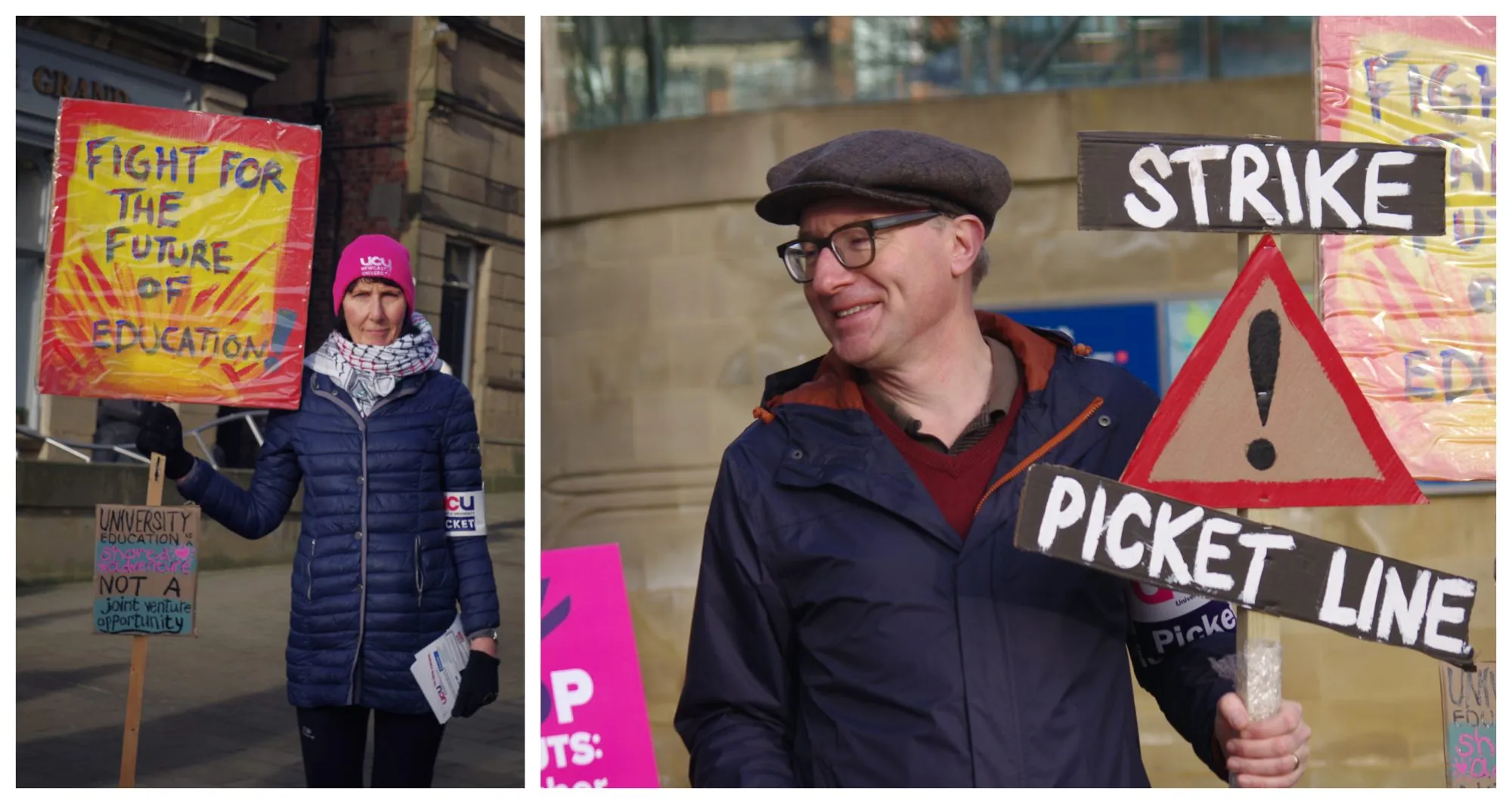
On strike at Newcastle University. As a result of the action, all compulsory redundancies were taken off the table
Students have paid the same price for tuition fees (£9,250) since the rate was frozen in 2011. This is set to rise, but only marginally (£285), this month. As Perry explains, universities turned towards international students to bolster their coffers, an approach which initially led to a period of artificial prosperity, when universities poured investment into new campus buildings and student halls.
But the good times have recently come to an abrupt halt and, without the option to raise domestic fees, and an uncertain pool of foreign talent – many of whom prioritise London universities at the expense of others – the situation has become increasingly alarming. Perry warns that further cuts and even universities going bankrupt could be likely unless the sector corrects its course soon, and that ‘architecture won’t be safe from that threat’.
There has been a rapid expansion in the number of accredited architecture schools and courses over the past 10 years, from 38 in 2014 to 63 today. Is there room in the current market for all of them? Recent data from regulator the Office for Students revealed that 44 per cent of higher education providers are currently operating at a financial deficit, a proportion that has climbed year-on-year since 2021.
It’s a shit time to be a student, or an early career researcher or a studio tutor
In June AA director Ingrid Schroder wrote in the AJ: ‘Clearly, we are all trying to square the same circle and the squeeze on [staffing, property, IT, HR and student aid costs] can’t produce the kind of savings needed to sustain many schools of architecture. Short of a dilution of the professional curriculum, there isn’t much left to trim.’ She claimed that incremental reductions in the number of staff would only result in small savings and that the ‘resentment and anxiety produced’ would be ‘disproportionate to their value’.
This uncertainty is, unsurprisingly, translating into a worsening experience for those working in architecture departments, as well as for the next generation of architects studying there. ‘It’s a shit time to be a student, or an early career researcher or a studio tutor,’ Mark fumes. ‘Jobs at the lower levels of academia are becoming increasingly scarce. Morale is increasingly low; the system is failing everyone.’
Alan Jones, professor of practice and education at Queen’s University Belfast and a past-president of the RIBA, points to a disproportionate focus on research and ballooning overheads, as well as the stagnation in overseas student numbers, to explain the current parlous state of higher education. He says: ‘To address the decline in UK student numbers and depreciating levels of funding, many universities have structured their operations, investment in estate, finances, etcetera, on an increasing intake of higher fee-paying international students, but the number of international students is reducing. Many institutions have prioritised research, while the reality is that the majority of funding comes through the education of students.
‘In addition, following the USA model of universities expanding their leadership, managerial, and administrative staff (to more than 50 per cent) and associated processes is increasing overheads, and that necessitates reductions in teaching staff, tutors and physical resources at the coalface of educating students.’
Jones argues that this situation could be helped by having lecture-based modules taught online across a number of institutions. Also, the government could return architecture to the same band of funding as engineering – a move that would reflect the post-Grenfell technical and professional demands on education and the profession, securing around £100 million more annually.
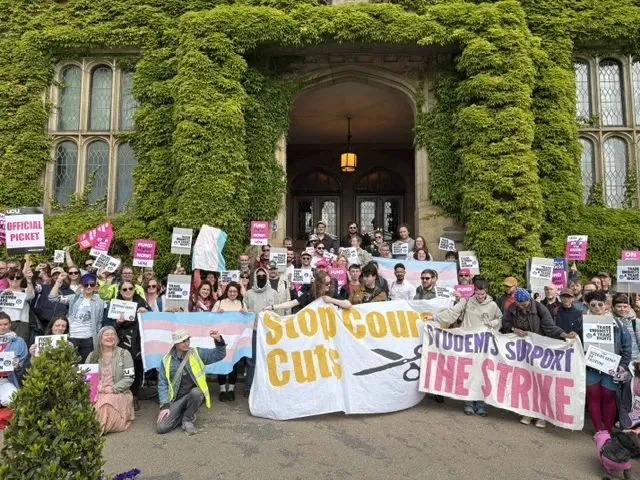
A protest a Sheffield University
Though universities insist the cuts won’t impact students, Newcastle University has already paid out almost £2.5 million to more than 10,000 students for disruption to their learning caused by the industrial action between March and June. A student at the University of Sheffield, who does not wish to be named, says: ‘One thing that did definitely impact us was the strike action. Picketing across the Arts Tower meant we missed out on in-person studio time, with tutors offering online tutorials, or meetings with their students in other buildings around Sheffield.’
The Sheffield student reports having to take lectures in parks instead of in the studios they were paying for, as well as having to organise a fight with other students against the possibility of having final reviews held online, rather than in person. They also voice frustration at the university’s decision to axe a number of courses, including dual architecture with landscaping/engineering master’s qualifications, a situation which now forces those taking the undergraduate versions to change their plans. Some students have reportedly even been advised not to take their planned placement year in industry, simply to ensure that their course will still exist when they return.
At the University of Greenwich, students have been ‘kept in the dark’ about what the ‘chaotic, untransparent and disrespectful’ restructuring of the architecture department would mean for them, according to a former Greenwich tutor. Meanwhile, an insider reported that three senior members of the School of Design, including academic portfolio lead in architecture Simon Herron, and senior lecturer Susanne Isa, had been suspended with immediate effect in July in the wake of staff protests against the restructure programme. Greenwich University declined to comment on the suspension or the circumstances, the insider said.
Often perceived as a ‘resource intensive’ course, tutors were worried that the scale of cuts risked ‘ignoring the realities of course delivery and the duty of care that architectural educators owe to their students’. Those bringing together Greenwich and Kent under an umbrella institution known as the South East University Group may have deliberately kept the move under wraps. Keeping tutors out of the picture about the future of their employer and position cannot, however, have been good for staff morale or the experience of students.
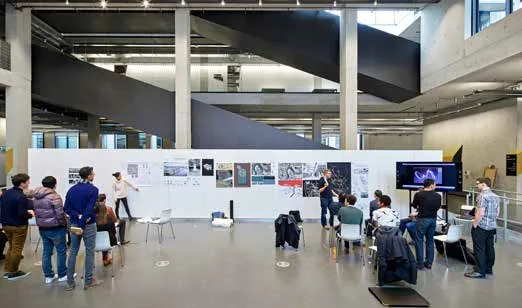
Architecture studio at Greenwich University
Yet University of Kent director of architecture studies Peter Wislocki says he was ‘neither surprised nor concerned, at this point, about being kept in the dark’. He adds: ‘Whether the “super university” is ultimately successful remains to be seen, but the initiative is a logical response to market forces.’
In contrast to his soon-to-be colleagues at Greenwich, Wislocki paints a more optimistic picture of university life. He reports ‘record numbers’ of undergraduates for the coming year, with the school ‘doing well, recruiting strongly and achieving more than satisfactory outcomes, albeit in very challenging and occasionally stressful circumstances’.
While this may be true as far the architecture department is concerned, the bigger picture for the university seems bleaker. A source inside Greenwich claims that a crisis-level financial situation was the real trigger for what some have called a ‘hostile takeover’ by Greenwich. Kent has seen a slew of job cuts, even winding down entire courses, over the past 12 months and has posted deficits for the past three years in a row.
The University of Kent was approached for comment. Newcastle University said in a statement: ‘This summer, the university achieved its £20 million target of salary savings in full and without the need for compulsory redundancies through a combination of voluntary severance, redeployments and a range of other mitigating measures.
‘We offered students compensation for missed teaching due to industrial action, which is in line with the latest directions to the sector from the Office for Students.
‘Funds that were saved from unpaid salaries due to industrial action were redirected towards the compensation scheme. For each student, the offer was based on the number of modules that have been impacted and the tuition fee paid.
‘This is an immensely challenging time for universities across the UK and we recognise that this has been a difficult period for both staff and students. Supporting them is our top priority and we remain committed to constructive dialogue with our unions.’
While the University of Sheffield said: ‘Like all universities, we regularly review our courses to ensure they meet the needs of students, industry and professions, and we often make changes to reflect this.
‘Any student registered on a course at the school of architecture and landscape that will be no longer offered going forward, are able to continue on through their programme in the normal way, including those students who opt to take an industrial placement year
‘The school also acted to mitigate and replace any learning and teaching affected by previous industrial action for these students.’
The university added: ‘We are still offering postgraduate courses in these fields, and have also seen an increase in undergraduate numbers for this year’s entry, and we look forward to welcoming those new students to the school very shortly.’
So perhaps a rosier future ahead.
And it is reassuring that among the doomsaying, some architecture departments seem to be weathering the storm. The University of Manchester’s numbers, for instance, continue to be ‘very healthy’.
What is abundantly clear is that, until the underlying financial crisis is resolved, it will continue to have rippling adverse effects on university staff, students and the next generation of architects.