
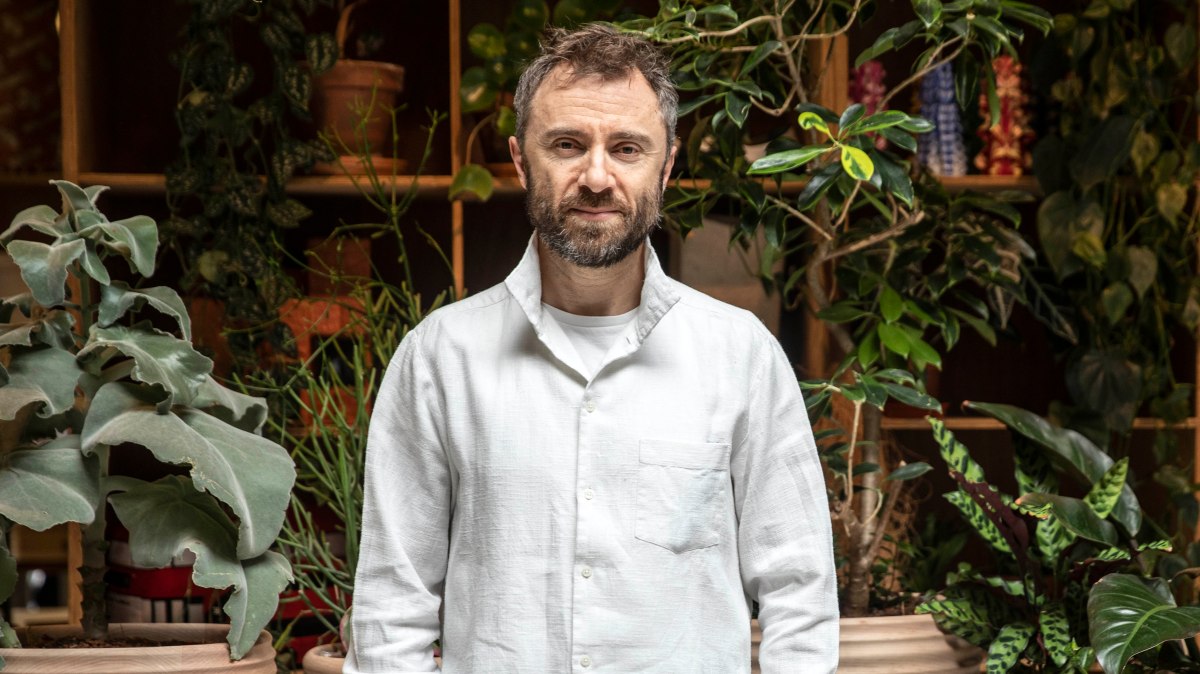
In his trademark baggy trousers and pullover, Thomas Heatherwick, 55, has just cycled back from his £1.3 billion reimagining of London’s grandest exhibition centre at Olympia, Kensington. The trouble with Olympia, he says, is that, “It’s like the lights were off. Unless you’re going to the cyber security show, [or] the pet food show, with a plastic badge swinging around your neck, it’s dead to you.”
The place failed the test that Heatherwick — quoting his friend Tim Smit, cofounder of the Eden Project in Cornwall — describes as: “‘Would you go there on a date?’ It’s a good lens for all public space. Would someone go there just to be there … without having to have a badge around your neck?”
He thinks most modern places fail this test. Ninety-nine per cent of the newer bits in any city are simply “boring”, he reckons. Over the past century, a “quiet, global catastrophe” of characterless buildings has left people cold, unhappy and disconnected, he argues in his international Humanise campaign.

Heatherwick’s £1.3 billion masterplan for Olympia, west London
WE ARE NARRATIVE
Up in his first-floor office, over steaming apple pie in enamel bowls, Heatherwick tells me, his gesticulating hands twirling like windmills: “As humans I think we are thirsty for places to come together.” We thought the internet “was this great democratising thing that would allow us to see each other more than ever. But actually it didn’t. The algorithms divided us. People just aligned with each other. It quite often turned toxic. When you’re physically with someone, even if you disagree, there’s a civility because you’re more likely to see that other person’s humanity.”
The digital revolution means, “You can work from home, study from home, shop from home, be entertained at home,” he says. “How amazing. But the shadow of that is we’ve had an epidemic of loneliness.”
In the past, “You had to go to work, you had to go to a shop, and you had to go to university,” he continues. “The streets were alive because we all definitely knew we needed them. Now we need them in a different way. It’s the only place we actually see each other.”
Physical places “feel more important than ever”, he reasons. “We have to deliberately design them to bring us together.”
Heatherwick races through all this in the first eight minutes of our interview. Then he takes a breath. “Sorry to go blasting off,” he says.

Heatherwick’s Little Island, a public park on the Hudson River in New York City
ALAMY
He has a point, though. His message feels particularly prescient with Keir Starmer’s announcement of the building of 12 new towns as he attempts to re-establish his authority with a revival of the postwar building boom.
• Keir Starmer wants to reclaim patriotic values by building 12 new towns
The key question for the next wave of new towns, according to Heatherwick, is: “Would you feel the ‘go there on a date’ factor?”
For the 32 new towns built after the Second World War and now home to almost three million people, mostly the answer is “no”. Their construction was the most ambitious town-building programme ever undertaken in the UK. Yet only 4 per cent of residents describe their town as “nice”, according to an independent survey of 1,000 people living in the towns for the Humanise campaign.
“Only 4 per cent,” Heatherwick says. “It’s shocking, shocking.”
In fact, many surveyed residents spontaneously described their new towns as “boring”, “ugly” and “run-down”.
“To make a new town, you need cultural confidence,” Heatherwick says. “Most people do things the same as everyone else, thinking they’re being original, but actually being the same. Cultural confidence is needed to make something wholehearted. That’s missing now. It’s been missing for quite a long time.”
He explains: “In projects that we work on, one of the things you’re trying to do is make places more particular. You don’t look for the samenesses, you look for the quirks.”
Take Milton Keynes, England’s most successful postwar new town. (It is soon to be “renewed” as one of Labour’s next 12 new towns, the government announced on Sunday.) Heatherwick vividly remembers his father taking him there, aged 11, to see an exhibition on the homes of the future. “There was a house like a pyramid, harnessing the sun, and they were very seriously trying to look at how something could work better,” he says. “But when I went back 20 years later, those houses were just subsumed into mediocrity. It was interesting how uninfluential singular projects were.”

Milton Keynes, founded in 1967, is set to be “renewed” as part of Labour’s plans for 12 new towns
ALAMY
• Forget the concrete cows. Why Milton Keynes is a success, 50 years on
The designer, who had set up his own studio aged 24, returned to Milton Keynes in the early 2000s to advise on its masterplan as lead artist. “Milton Keynes is famous for its phenomenal grid [of streets],” he says. “But there were people who wanted to just turn it into ordinary curvy roads. We wanted to lean into, ‘Let’s make this the squarest city in the world.’”
Other cities try to set themselves apart by commissioning single landmark buildings, he adds. “Our logic was, don’t follow [that] pattern.” Milton Keynes needed more car parking, so Heatherwick made an “impassioned plea” to build four of the “world’s best car parks” framing the city.
Those car parks were never built and Heatherwick’s tenure in Milton Keynes was short-lived. But his studio — which now employs more than 250 people — has gone on to design an undulating neighbourhood in Tokyo and parts of the acclaimed regeneration of King’s Cross. Here, two once derelict Victorian coal warehouses seem to kiss one another above a vibrant shopping district, near his 330m-long tree-topped “landscraper” (longer than the Shard is tall) where Google will open its London headquarters next year.
Heatherwick’s manifesto has been captured in a 500-page Penguin book (now available in 11 languages) and a BBC Radio 4 series (now in its second season). Yet his critics point out a sense of “do as I say, not as I do”. They cite his expensive Routemaster buses, discontinued to cut costs (and dogged by passenger complaints of being too hot inside), London’s scrapped garden bridge and his New York honeycomb tower, Vessel, which was shut for years after several suicides.
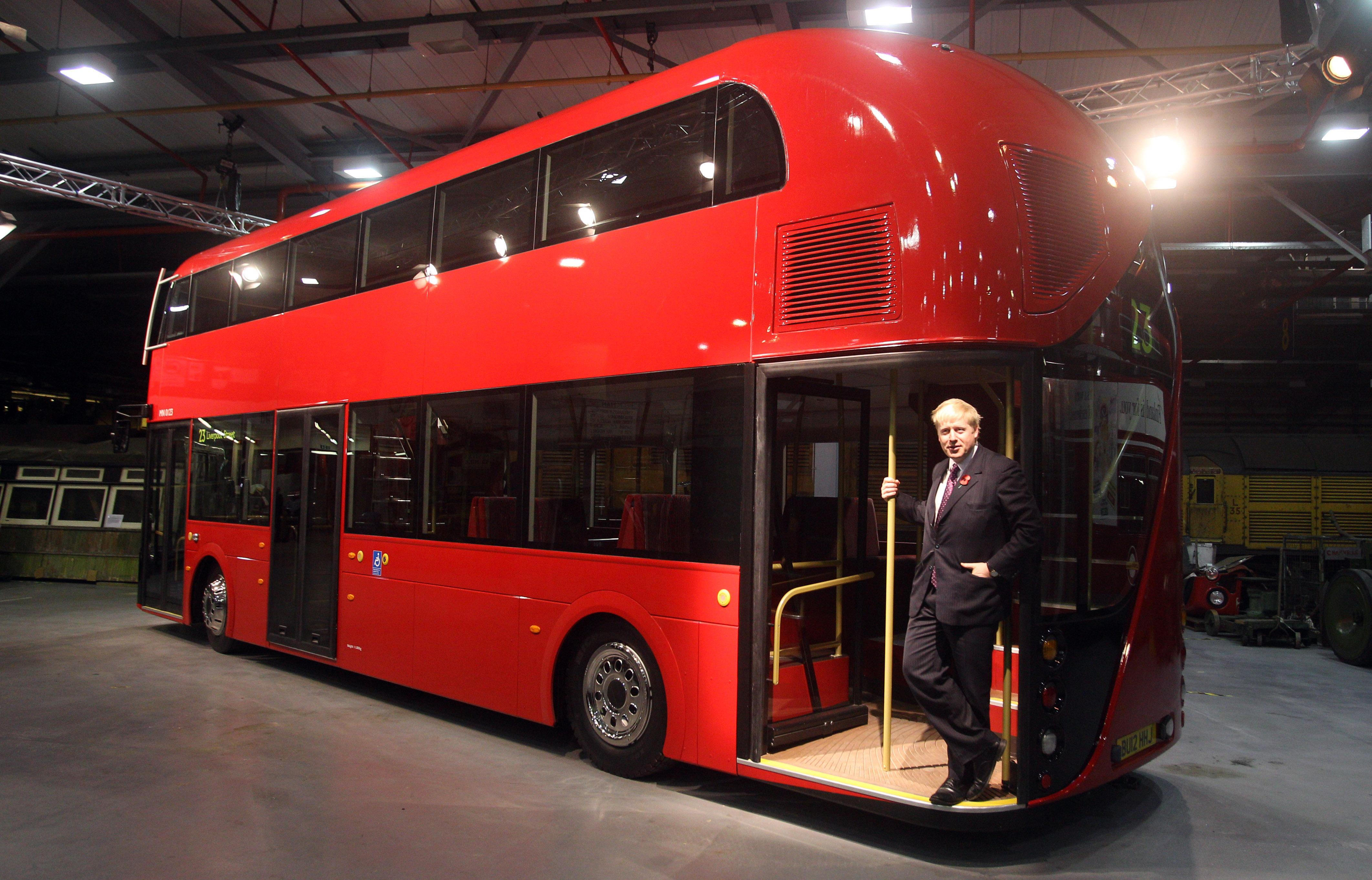
Boris Johnson, then London Mayor, unveiled Heatherwick’s redesigned Routemaster bus in 2010
ALAMY
To this, Heatherwick says: “Well, I’d like to see anyone who hasn’t learnt lots of lessons in a 30-year career. My shoulders are broad enough.” Tellingly, his flops are displayed as prominently as his successes in his studio.
Heatherwick has “consistently tried to make places that engage people”, he adds. “I don’t think I’m controversial. A lot of what we’re doing is based on common sense. It’s more controversial to make more and more soulless places that don’t connect with people.”
Has Heatherwick talked to the government about new towns? Shortly before the election last year, Angela Rayner, who became housing secretary, visited his studio, he admits.
Yet when Labour announced its next wave of new towns, the party promoted it with images of Edwardian-style mansion blocks and leafy streets of period-type townhouses. Should new towns look old to be liked?
The Humanise campaign polled the public via Instagram with three imaginary streets created by Heatherwick’s studio:
Only 1 per cent of online respondents preferred the standard modern street with its bland, could-be-anywhere design (option 1). It’s the sort of street that architects would describe as “clean lines, subtle, honest, functional”, Heatherwick declares. “All words that are apparently flattering. But actually, they’re shorthand for boring.”
Over a third (36 per cent) voted for a curvy, playful street design described as “humanising” (option 2), while two-thirds (63 per cent) favoured a street that closely matches Labour’s period-style vision for new towns (option 3).
Heatherwick is not opposed to historic designs. His own home in north London was designed by Ben Pentreath, the celebrated traditionalist designer of more than 1,000 homes in Poundbury, the King’s neoclassical town in Dorset.

The centre of Poundbury, the King’s neoclassical planned town in Dorset
ALAMY
When I put this to Heatherwick, he says: “I know Ben and he’s actually not obsessed with old-fashioned things.” Rather than faking the past, Pentreath is “borrowing from a language that’s been around and that works” at a functional and a human level.
So what does Heatherwick make of Poundbury, upheld by many as a model for the next new towns? “Everybody laughed at the King when he first suggested [Poundbury],” he says. “The architectural world turned its nose up massively. The same kinds of architectural critics who originally lampooned it, now suddenly are doing much more nuanced articles about it. How can you argue against somewhere many people really love? I don’t think we have to copy the past, but there’s lots of valuable lessons in Poundbury.”
• Villagers in King Charles’s utopia revolt over trees scheme
Chief among them is this: listen to what the public likes. “People are not stupid,” he says. “It’s wrong to treat society as if there’s the smart ones and the stupid ones who don’t understand. We have been making stupid places by thinking they’re somehow sophisticated. People are never going to say, ‘Please build me a boring place!’ They’re going to say, ‘Make somewhere that speaks to me, that tells us something about our time. Make somewhere that’s interesting.”
According to Heatherwick, most modern buildings are the architectural equivalent of fast food. They lack the “nutrition” of “visual complexity” that draws the human eye.
Fixing this is not about a style debate, he adds. “We need to be more style-agnostic.” Places could use “old-fashioned”, “modern” or “futuristic” languages to be interesting, he says.
Boring places get knocked down faster, he argues. With concrete accounting for 8 per cent of post-industrial carbon emissions, this is bad for the climate emergency.
“It’s this dirty secret in our construction industry that the average age of a commercial building in the UK is only 40 years. So I would have been killed 15 years ago if I was a commercial building,” the 55-year-old says.
To succeed, new towns need to go beyond the “spreadsheet mindset” of “how many homes, how dense, how high, how much” to how they make people feel. “Making a new town should be an amazing, uplifting, inspiring thing,” he says. “We should want to all go and visit these new towns and wish we could live there too. But we don’t really want to go to Runcorn and Stevenage.”

Heatherwick’s Olympic cauldron at the London Games in 2012
GETTY IMAGES
Given the chance, would he design a new town? “I would love to convene that, absolutely,” he says. It would be “a bit like when Danny Boyle convened the opening ceremony for the London Olympics”.
That culminated in Heatherwick’s flaming cauldron — Milton Keynes had better watch out.
Labour’s 12 recommended new town locations
• A standalone settlement in Adlington, Cheshire East
• A corridor of connected development in South Gloucestershire, across Brabazon and the West Innovation Arc
• An expanded development bringing together Chase Park and Crews Hill in Enfield
• Redevelopment of the former airbase at Heyford Park in Cherwell
• Urban development in the Southbank area of Leeds
• Inner-city development and densification in Manchester, Victoria North
• A standalone settlement in Marlcombe, East Devon
• A “renewed town” in Milton Keynes; reinvigorating the city centre and expanding to the north and east
• Densified development in Plymouth; evolving Britain’s Ocean City
• A new settlement in Tempsford, Bedfordshire
• The creation of a riverside settlement in Thamesmead, Greenwich
• Expanded development at Worcestershire Parkway, Wychavon
Source: gov.uk