
Several local groups are applying for a stretch of shallow water at the gardens, commonly used by paddlers, to become a designated bathing site.
The application is led by For Love of Water, a Downton-based community interest company, with support from Extinction Rebellion, Salisbury Transition City, Wiltshire Wildlife Trust and the New Sarum Women’s Institute, among others.
If their application is successful, it means the site would be subject to Environment Agency monitoring between May and September.
The water quality would be given a status, ranging from ‘excellent’ to ‘poor’, which would be displayed on signage next to the stretch of river.
The designated bathing area would be between two footbridges in Queen Elizabeth Gardens(Image: Newsquest)
This, they argue, will bring action to tackle sources of pollution and greater accountability, and empower the public to make safe paddling choices.
The application must be submitted to DEFRA, the government’s Department for Environment, Food and Rural Affairs, by the end of September.
The bathing water could be officially designated within two years.
FLOW gained the support of the landowner, Salisbury City Council, in July.
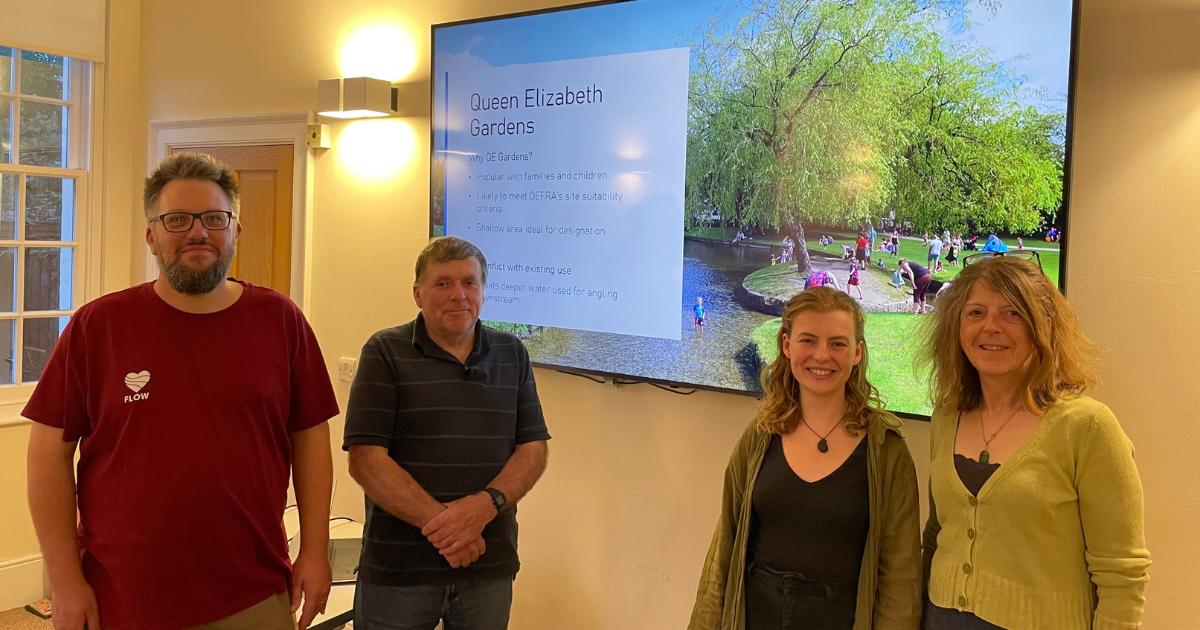
A public consultation with a survey is ongoing until October 10. An information evening was held at Quaker Meeting House on Tuesday (September 29).
The event consisted of a short presentation followed by a Q&A.
Paddlers at a designated inland bathing water at Fordingbridge Recreation Ground(Image: For Love of Water)
Maddie Crabb, director and senior environmental consultant at FLOW, led the presentation.
She said: “There is a big community of users of this river. I’m one of them. There has definitely been a rise in people using the river, especially since lockdown.
“Rivers in the UK are failing to meet their statutory targets. In chemical status, all rivers in the UK fail. Only 14 per cent achieve ‘good’ ecological status.
“We are quite lucky that the Avon is doing quite a bit better than a lot of rivers in the UK, but we would expect that – it’s a nationally and internationally protected river.
“It should be in excellent condition.
“There will be no changes to the physical site. The only change there will be is a sign saying it’s a designated bathing site with the rating.
“We are not trying to make it an even more popular spot, and we’re trying to not have conflict with other users [such as anglers or canoeists].”
The quality of the water at Queen Elizabeth Gardens has been tested weekly since June, funded by conservation charity Surfers Against Sewage.
Mike d’Apice, who is supporting the application, has carried out the sampling using the same methods deployed by the Environment Agency.
The results, which measure the amount of E. coli and intestinal enterococci in the water, suggest the site is in line for a ‘poor’ classification.
The harmful bacteria is unlikely to come from the nearest continuous sewage discharge in Amesbury because of the ‘fast breakdown time’.
Ms Crabb said: “This is most likely coming from misconnections in Salisbury city centre. That’s what makes the most sense.
“There might be an issue in Salisbury city centre, and it would be good for that to be followed up on.”
FLOW is already involved in an official bathing area in Fordingbridge, which was designated in May 2024 and rated ‘poor’ in November.
Founder Adam Ellis said the classification “opened up a lot of funding” to combat pollution and provide real-time information for swimmers.
Wessex Water is now investigating the levels of bacteria found in Fordingbridge and upstream to trace and fix pollution sources.
The consultation was held at Quaker Meeting House(Image: Newsquest)
An artificial intelligence-driven app is being developed to provide live updates for river users on the condition of the water before they take a dip.
“That’s a really big outcome,” Mr Ellis said.
“It’s not something Wessex Water had to do, but they have decided to do it. It has really driven improvements.”
One attendee, John Pitt-Brooke, said it would be a shame if the signage showing water quality led to the river being used less.
He said: “I often bring my grandchildren to paddle there. It is very good that the water should be as clean as possible and that everyone should have good information about it.
“It is an amenity that brings a great deal of joy to many people, and long may that continue.”