
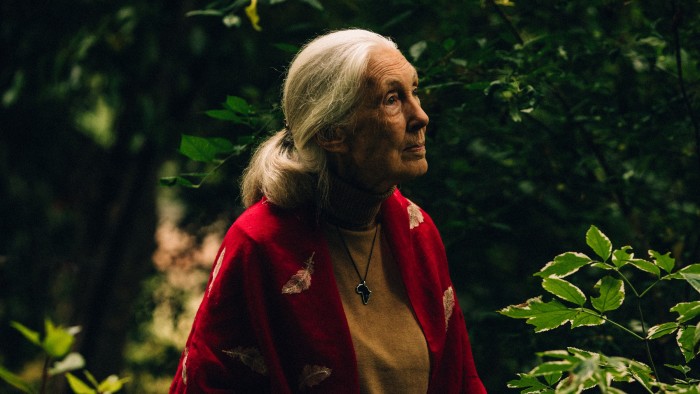
When I was preparing to write a profile of Dr Jane Goodall, I never expected it to become a tribute. Goodall died at the age of 91 on 1 October. She was in Los Angeles as part of a North American speaking tour; the week before she had been in New York City, a keynote speaker at an event occurring alongside the United Nations General Assembly’s annual session. She maintained a daunting calendar, often travelling some 250 days a year to share her message of environmental conservation and social activism.
When we met in July, I asked what gave her the drive and the capacity for such a gruelling schedule. She spoke of her deep love of nature and animals, and what she felt was the urgent call to preserve them: “I’m going to fight for that until I take my last breath.”
She was speaking from the book-lined drawing room of The Birches, her childhood home in Bournemouth, a charming red-brick built in 1872 and kept by her sister and niece. “I truly feel I am coming home,” she said of her fondness for the house, which she left in 1953 to attend secretarial college in London. “My favourite tree, up which I used to spend hours and hours, and read, and do my homework, is still there.” She was happy to be back in the English coastal town – not that she would let herself be too distracted. “I don’t go into town – what for? I hate shopping!” she laughed incredulously.
 Goodall at the Bournemouth National Science Society’s museum © Robbie Lawrence
She was wearing her typical uniform – an olive-coloured safari jacket, her white hair pulled back in a ponytail – and surrounded by pictures of family. There was also an illustration of David Greybeard, the chimpanzee who would be so pivotal to her research in Gombe, Tanzania. We were speaking about the 65th anniversary of her arrival in Gombe and the pioneering research programme that has since become vital in the field of ethology. Her work in illuminating the use of tools by chimpanzees in the ’60s was considered so groundbreaking that, as her friend and fellow field researcher Dr Anthony Collins put it, “she abolished the barrier between man and animal”. A centre being built in Africa, bearing her name and intended to carry on her legacy, is set to open next year.
“I feel I get help from somewhere, whatever that great spiritual power is,” she said of her mission. And she wasn’t scared of the future. “When you die, it is either the end of everything – you are gone, snuffed out, finished, or there is something. I happen to believe there is something – so I can’t think of a more exciting adventure than finding out what the something is.”

Over the decades, Goodall became a global icon: a Dame Commander of the Order of the British Empire, United Nations Messenger of Peace, a bestselling author many times over and the subject of numerous documentaries (a new BBC series is said to be in the works for 2026). Her podcast series, The Jane Goodall Hopecast, which ran for 34 episodes, included guests ranging from Margaret Atwood to US senator Cory Booker. Yet she was always very clear that fame was a means to an end.
 Goodall in Gombe Stream National Park, Tanzania, as seen here in the 1965 US TV documentary Miss Goodall and the Wild Chimpanzees © 1965 CBS Photo Archive
“I’m not that icon out there,” she said in July, in her diffident, soft-spoken manner. “But I realised it can help the mission – the mission to make the world a better place.” There were, she added, “two Janes. This one who is talking to you now, just me, sitting here rather weary… And then there’s the other Jane, known by everyone.”
Born Valerie Jane Morris-Goodall in 1934, she was a carefree child. She had pet tortoises, clambered up trees – “Beech” and “Nooky” – and was mad about dogs. At 12, she founded her own junior naturalists’ organisation, the Alligator Club, and as a teenager was raising money to care for animals. It was her neighbours’ pet dog that taught her, against the prevailing scientific logic, the lessons she would later apply to chimpanzees. “I was told by learned professors, ‘You can’t talk about them having personality, mind, emotion, because those things are unique to humans.’ Well, that dog had taught me that that was rubbish. You can’t share your life with any animal and not know that we are not the only sentient beings.”
 The late conservationist Jane Goodall © Robbie Lawrence
She was fascinated with Hugh Lofting’s Dr Dolittle, Kipling’s The Jungle Book and Edgar Rice Burroughs’ serial starring Tarzan of the Apes – fantastical tales of jungle living, side by side with wild animals (copies of these were still in the Bournemouth house). Around the age of eight, the young Jane let it be known to her family she planned to go to the forests of Africa; an offer from a former classmate to stay on a family farm outside Nairobi allowed her, at 23, to realise her childhood dream.
Three years later she would arrive in Gombe and her life would change again. She met Louis Leakey, the brilliant paleoanthropologist, in Nairobi and was hired to study the wild chimpanzees. “The first day after we’d put up our tents,” she said, “I had time by myself to climb up a slope opposite to the camp and sit there. I saw a baboon troop and a monkey, and it was like, ‘This is it.’”
 Goodall observing a field of baboons, 1974 © Fotos International/Getty Images
Within four months, in November 1960, after many solitary hours spent watching from afar, she was permitted by one chimpanzee, David Greybeard – so named for his streak of white facial hair – to get close enough to observe him stripping leaves from a twig, then inserting it into a termite mound and twisting it around before pulling it out and eating the insects that had latched onto it. It was a discovery of great significance. Leakey famously cabled back to Gombe: “Now we must redefine ‘tool’, redefine ‘man’, or accept chimpanzees as humans.” Goodall would go on to observe chimpanzees eating meat and engaging in acts of violence towards each other, all radical discoveries that would reshape human understanding of animal behaviour.

The span of her life and work will be presented in Dr Jane’s Dream: The Goodall Centre of Hope, a cultural and educational centre located in Arusha, a popular safari staging ground at the crossroads of Mt Kilimanjaro and the Serengeti National Park. After years of planning, the centre – whose design involved African artisans and former Walt Disney Imagineers – is now complete. There will be exhibits dedicated to Goodall’s early days in Gombe – including “a replica of the ex-army tent that mum and I shared” – alongside others focusing on chimp behaviour and animal intelligence. The space interweaves personal history with her wider manifesto: Dr Jane’s Dream aims to be more than a museum or archive, instead positioning itself as a hub for future generations to continue Goodall’s work.
 Goodall with a chimpanzee in the Gombe National Park in Tanzania, 1972 © Bettmann Archive
“The centre is truly about education and hope,” says Saifuddin Khanbhai, a philanthropist and jewellery entrepreneur who donated the site on which it is being built. Khanbhai founded the Arusha Cultural Heritage Centre, located on five acres, in 1994 to promote African culture and its preservation. Dr Jane’s Dream will sit alongside several buildings and workshops already on the grounds. “I think it is our duty to promote her legacy,” says Khanbhai. “We need her message, her work to be encompassed in a place.”
Recent political developments have only added a sense of urgency to the work of the non-profit organisations that must now operate without Goodall as their global figurehead. JGI – the Jane Goodall Institute, founded in 1977 – operates 26 chapters globally. In February, as part of the Trump administration’s wider move to reduce USAID’s footprint globally, JGI Tanzania received an official termination letter from the US government. It rescinded a five-year award totalling $29.5mn in grant money. For Alice Macharia, JGI’s director of Africa programmes, the loss of funding “has led to a significant reduction in the scale of implementation of our integrated community-led conservation and development efforts” (among them TACARE, which seeks to help residents of the local villages that dot the shoreline of Lake Tanganyika).
 Goodall at the Bournemouth Natural Science Society’s museum © Robbie Lawrence
Goodall was clear-eyed about the coming dangers. “I see nature being destroyed all around the world,” she said. “I have three grandchildren [Goodall married twice, and had one son], and what we are doing is stealing our children’s future… We still haven’t learned to treat animals with respect.”
Recommended

Yet she remained undaunted. “I guess I’m obstinate,” she said. “In these times today, with what’s going on in the world, we must not give up, and instead fight harder for truth and justice. If you lose hope, then we are doomed.” Her message for those who would listen was clear: “You must not give up. You must do your bit.”
All we can do now is take heed. Goodall has done as much as she can. “Does it sound weird if I say to you I think I was put on this planet with a mission?” she asked, her eyes twinkling. Her message of hope stayed bright until the end.