
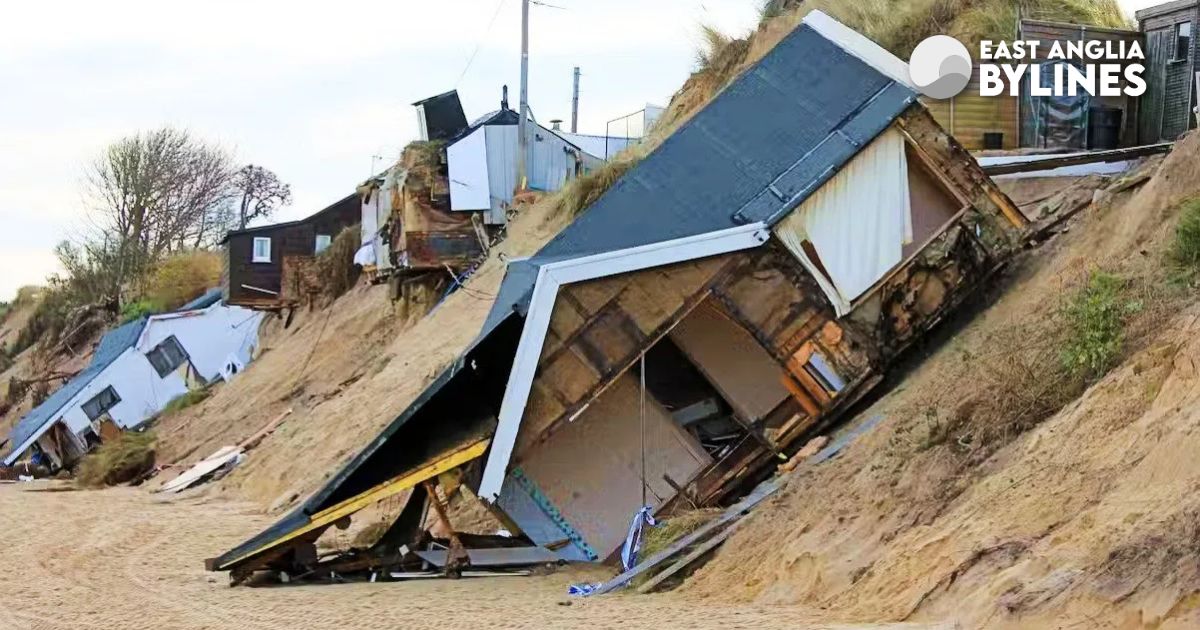
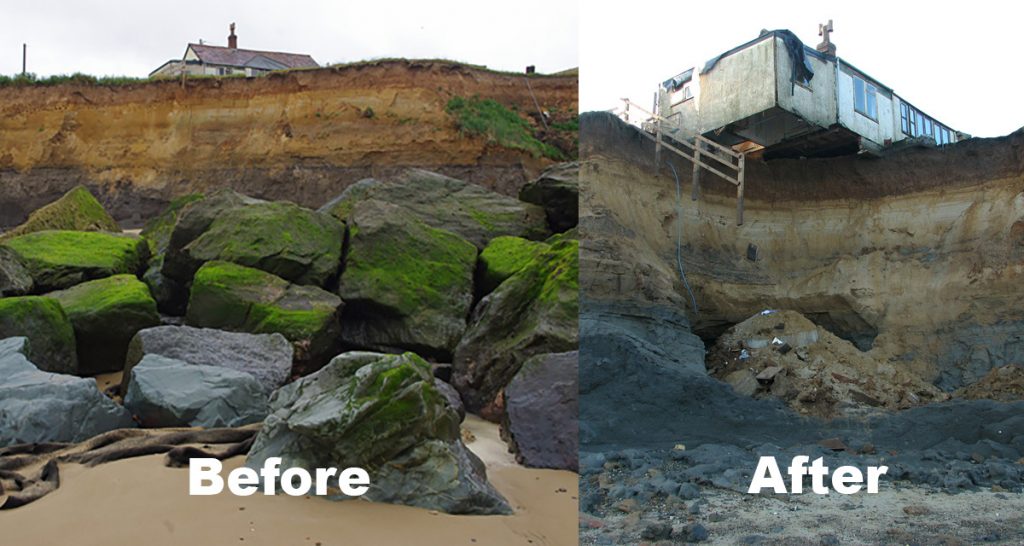
Sea defences along Norfolk’s most vulnerable stretch of coastline will have to be removed because they pose a health and safety risk. Officials say the structures installed to protect Hemsby pose a danger as people who climb on them may fall in gaps and get trapped or get caught out by the tide. They have also questioned the effectiveness of the defences and say waves can still crash over the top or around the side.
The move is a fresh blow for the village, which has lost 25 homes to the sea since 2013, and locals have described their removal as a “kick in the teeth”. Engineers have been carrying out studies of the structures around the village on behalf of Great Yarmouth Borough Council.
Among the defences they are now calling for the removal of is an emergency rock berm installed by the council in 2023, as well as others put in place by homeowners trying to protect the village. In a report, they have highlighted the health and safety implications, including the dangers of steel bars protruding from many of them.
They also say some defences may be protecting a small number of properties directly behind them but are speeding up erosion either side of the installations. They warn that reconfiguring or moving the existing sea defences is likely to have limited benefits. However, some material, such as the rock berm, may be moved to protect different parts of the beach, such as the beach access ramp.
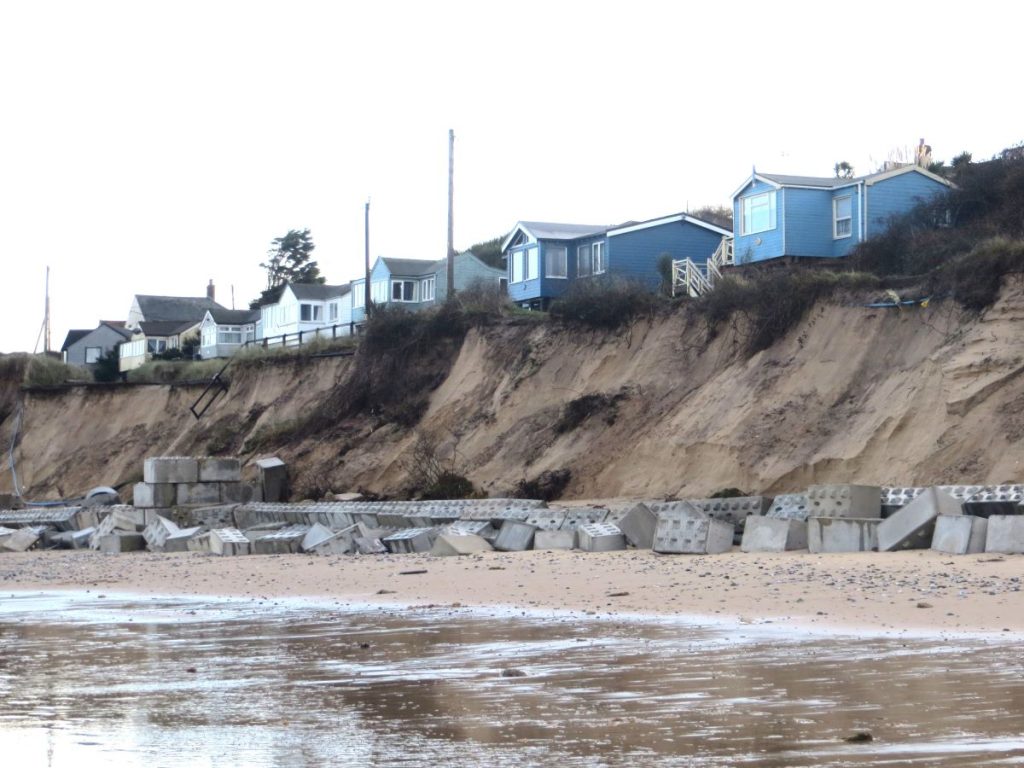 Houses on cliff edge at Hemsby. photo Stephen McNairWhen protection becomes too costly
New sea defences have also been ruled out due to the huge £20m cost for installing a rock berm nearly a mile long. The council also says such a structure would risk destroying Hemsby’s tourism trade, worth £100m a year, as it would cover much of the sandy beach where thousands of tourists flock each summer.
Natasha Hayes, a director at Great Yarmouth Borough Council, said: “The council is highly empathetic of the people whose homes are at risk. But the defences are not preventing coastal erosion. Waves are going straight over the top or around the side and are washing away the cliff. This is the fastest eroding stretch of coastline in Europe and we have recently lost a metre and a half of beach.”
The removal of the sea defences has been described as a “kick in the teeth” for residents and sparked calls for homeowners to be compensated. Ian Brennan, who previously led the Save Hemsby Campaign, said: “A decision to do nothing is still a decision. They should be compensating people who have lost their homes.”
Officials have identified 30 homes that are currently at risk and are working towards finding a plan to relocate and financially support people likely to lose their homes to coastal erosion. This includes securing planning rights for land which could be used to build rollback properties.
The warning from the sea
In December 2023, after high tides and heavy rain, the only road to a cluster of Hemsby homes collapsed, cutting off 35 houses. The residents then received what must be one of the most chilling letters ever sent by a local authority: emergency services, it said, would no longer attend if they were in danger.
As Stephen McNair reported at the time, the message was blunt: if you live on an unstable cliff above the beach, “the climate crisis is here, and you are on your own.” Residents were urged to remove oil tanks, gas cylinders and septic tanks before their homes toppled over the edge. The council could offer a small demolition grant, but not the means to rebuild.
This is the grim new reality of coastal life in east Norfolk, where rising seas, unpredictable weather, and soft geology combine to make the region’s cliffs the fastest eroding in Europe.
 Why the cliffs keep falling
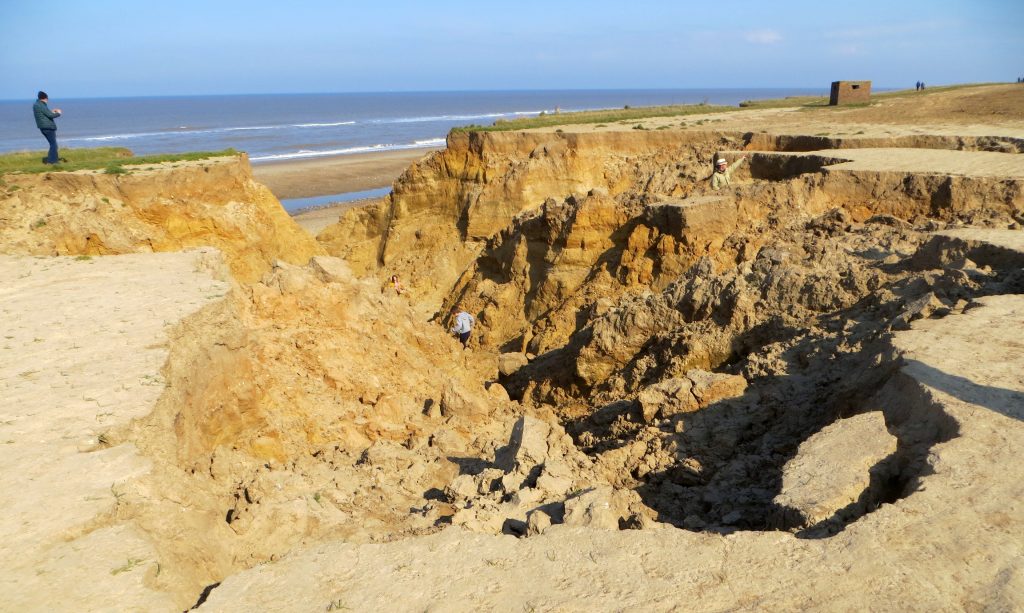
The cliffs along much of Norfolk and Suffolk’s coastline are made of soft sands, silts, and clays – materials easily eaten away from below when storm surges coincide with high tides, and from above by heavy rainfall. The erosion is not only relentless but interconnected: when one community defends its stretch of coast, the disruption of sediment flow often accelerates erosion further down the shoreline.
As McNair observed, without human intervention, the sea naturally carries eroded material south, replenishing beaches that protect towns like Great Yarmouth. But when defences block this process, they can make neighbouring areas more vulnerable. Residents in Winterton, for example, believe new protections at Horsey have hastened the loss of their dunes.
The limits of defence
At Happisburgh, engineers have repeatedly rebuilt sea walls and ramps only for them to be destroyed within months. Each fix buys a little time at great expense: the “sandscaping” project at Bacton, which dumped two million tonnes of sand to protect a gas terminal, cost £20m and may delay erosion there by 15 years.
The economic calculus is harsh. Building a permanent barrier at Hemsby would cost as much as Bacton’s entire project, without the same strategic value. Councils are left weighing community heartbreak against fiscal reality.
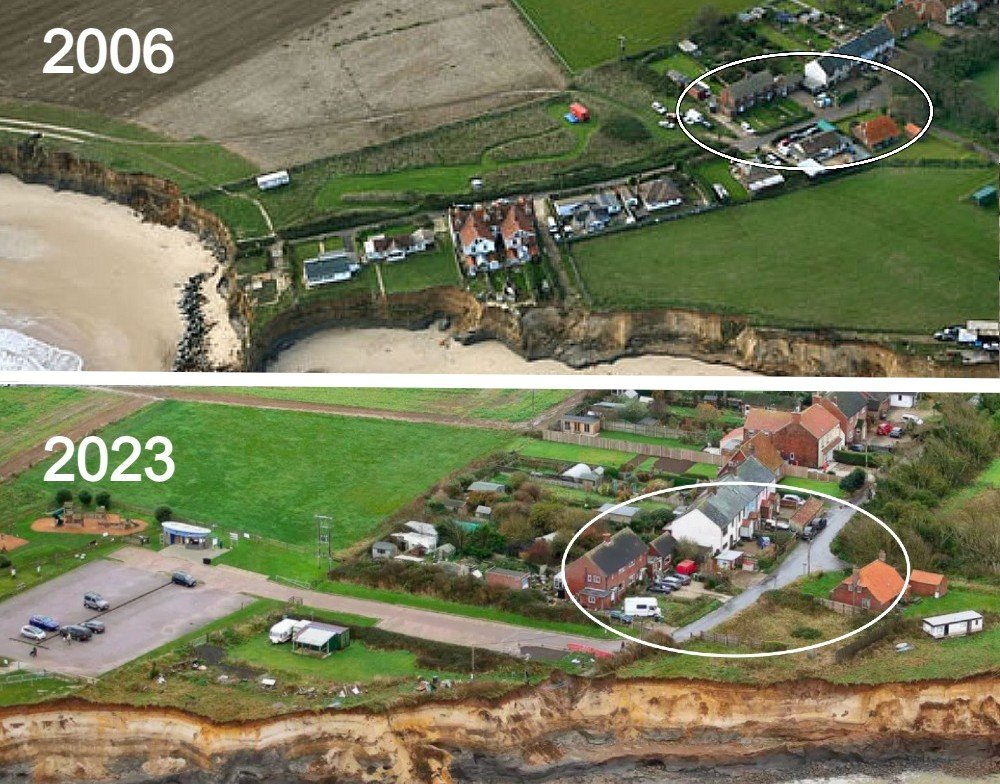 Aerial views of Happisburgh show the extent of coastal erosion over the last 17 years.Planning for loss
North Norfolk’s Shoreline Management Plan sets out how this coastline will be managed – or surrendered – over the next century. It divides the coast into policy zones: major towns like Sheringham, Cromer, and Great Yarmouth will be protected at least until 2105. Others, like Mundesley and Winterton, are guaranteed protection only until 2055. Between them lie “managed realignment” and “no intervention” zones – where erosion will be allowed to proceed naturally.
When the plan was approved in 2012, it forecast that fewer than five properties would be lost near Hemsby by 2025. That target has already been exceeded several times over, and the next projection – to lose 55 homes by 2055 – now looks wildly optimistic.
The government’s £6m Coastwise programme, launched by Defra and the Environment Agency, aims to help communities “plan for and manage the transition”. But as McNair noted, it offers no compensation for individuals who lose their homes. Its own report concedes that “it is unrealistic and unsustainable to continue to protect large parts of the North Norfolk coast.”
 The human cost of retreat
That realism may be inevitable, but it leaves deep scars. Many of Hemsby’s residents have lived there for generations. Others bought homes in good faith, trusting official assurances that they had decades of safety. Climate change has shattered those predictions, turning decades into years.
McNair called Hemsby’s story “a shocking reminder that climate change is real.” It still is. For the people watching their gardens crumble into the surf, it’s not an abstract warning – it’s the ground beneath their feet, disappearing one storm at a time.
This piece is based on an article by LDRS.
More from East Anglia Bylines
 Download the Bylines app to get our content straight to your phone!