
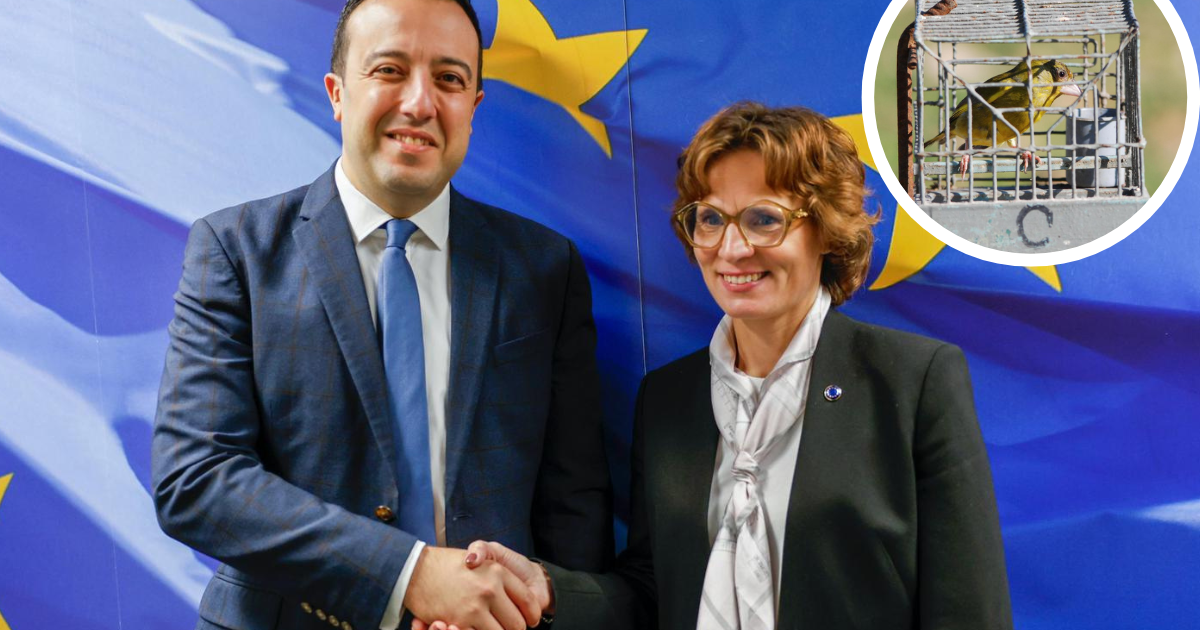
The minister responsible for hunting and trapping has told the EU’s environment commissioner that Malta’s “fine-tuning” of finch trapping laws was enough to comply with an EU court judgment against Malta.
Clint Camilleri met European Environment Commissioner Jessika Roswall on Wednesday to discuss the “research” derogation on seven species of wild finches, days before the government reopens the “catch and release” programme.
In the past few years, the government opened the season around October 20.
“The minister referred to the court’s 2024 ruling on the scientific research derogation, which acknowledged the precision of Malta’s legislative framework but found that the accompanying declaration lacked sufficient justification,” a ministry spokesperson said.
The minister told the commissioner that rules and enforcement measures, which have since been put in place, ensure that Malta is compliant with EU law, and he invited the European Commissioner to a fact-finding mission.
In September, the European court ruled against Malta’s finch trapping regime, saying the project did not establish a genuine research purpose and could not be justified.
But during Wednesday’s meeting, the minister argued the ruling meant that Malta had only needed to provide more robust reasoning behind the finch trapping for the “research” programme to comply with EU laws.
Camilleri said the last legal notice did just that when the finch season for autumn was opened, a few weeks after the European court’s ruling.
Compared to the legislation published in 2023, last year’s finch trapping rules went into more detail, explaining the thought process behind the programme and the rules of procedure.
E-NGOs in Malta insist that research is only a guise to maintain trapping practices in Malta. They say trappers often do not release finches back into the wild.
Malta was given a few years to ban finch trapping when it joined the EU in 2004.
It did so by 2009, although enforcement against the practice was weak.
In 2014, the government made finch trapping legal again, banking on a provision in the Birds Directive that allowed the capture of protected birds in “small numbers”.
However, the government then lost a court case raised by the European Commission.
In 2020, the government said it was allowing the trapping of seven species of wild finches, claiming the EU directive allowed the practice “for the purposes of research and teaching, re-population, and re-introduction and for the breeding necessary for these purposes”.
Hunters were allowed to catch the birds, ring them, and re-release them as part of the “study”.
The European Commission disagreed, saying Malta’s argument was a “cover-up” to continue the practice of trapping as a hobby. It subsequently launched a new court case against the government.
On Wednesday, Camilleri’s spokesperson said Malta was committed to upholding the decisions of the Court of Justice of the European Union, adding that following the 2018 judgment on traditional finch trapping, “Malta repealed the previous framework and discontinued the practice”.
The “catch and release” programme for finches was a response to a “scientific data gap identified by the court,” the spokesperson said.
“Malta introduced a new legislative framework under a separate derogation, strictly for research purposes. This initiative is generating robust ecological data, including a significant increase in foreign ring recoveries using the clap-net system, in certain species, surpassing historical benchmarks.”
‘Data collectors under strict supervision’
The ministry spokesperson said that the EU court’s judgment last year did not outright exclude citizen science initiatives and so legislation “was fine-tuned to include detailed reasoning, aligning fully with the ruling”.
Camilleri’s spokesperson insisted that “data collectors” whose job is to trap and release finches were under strict supervision, with enforcement measures in place that prevent illegal activity.
The government’s spokesperson said EU Commissioner Roswall welcomed continued dialogue with the Maltese authorities, and said the Commission was open to engagement in order to ensure full compliance with EU law.
Camilleri thanked Commissioner Roswall for the “constructive meeting”, and reiterated his intention to maintain an open dialogue with the European Commission.
He said further technical-level discussions can result in collaborative solutions to serve mutual interests effectively.
Camilleri added that his top priority was the protection of the interests of the Maltese and Gozitan people, and to ensure that Malta is not treated differently from other member states.