
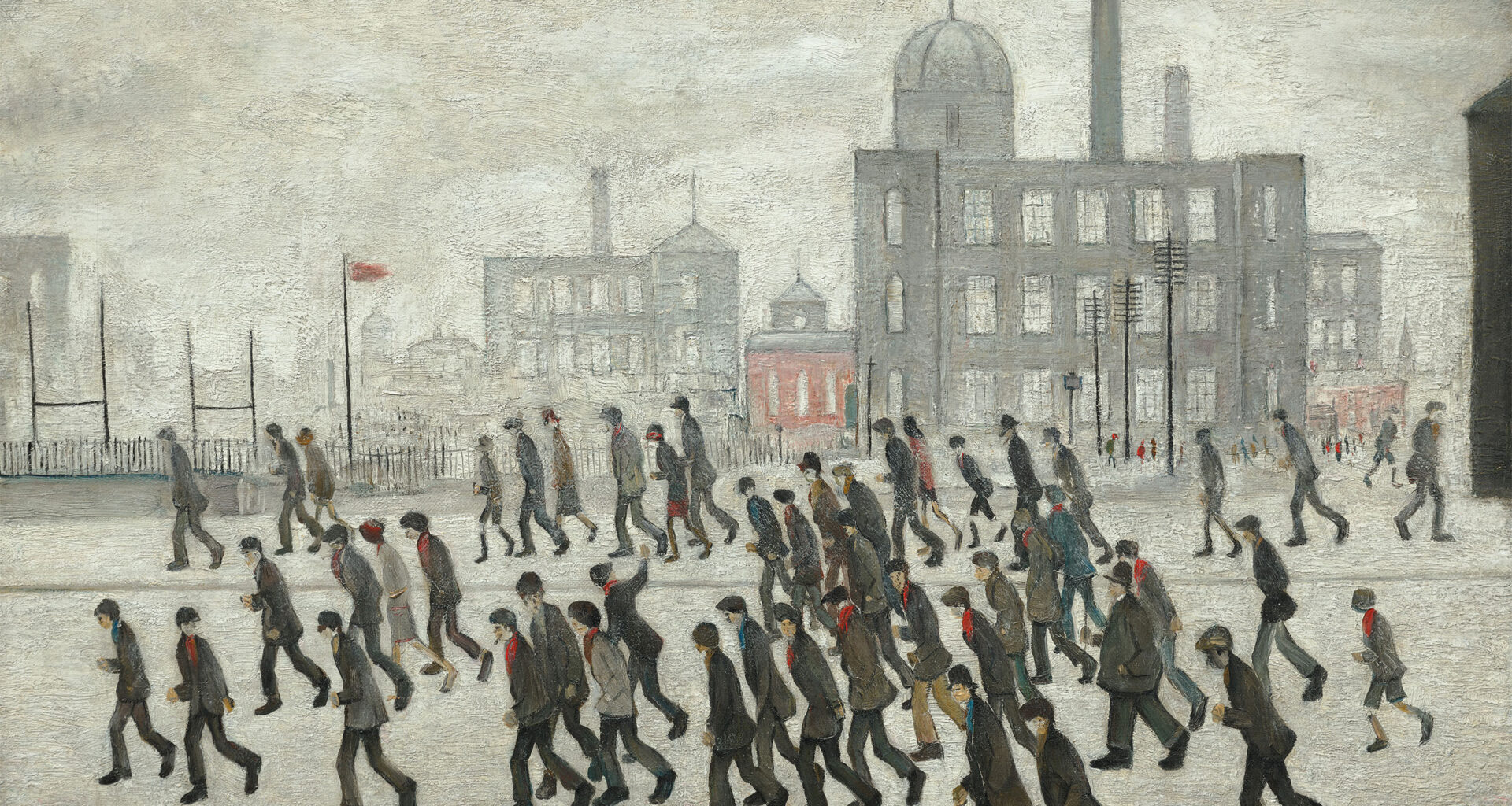
‘My ambition,’ Lowry once said, ‘was to put the industrial scene on the map, because nobody [before] had done it seriously.’ For Lowry, that scene specifically meant the urban landscape of Lancashire in north-west England, which he inhabited his entire life: one synonymous with terraced houses, mills and factories. In many celebrated paintings — for example, Going to Work — he captured workers pouring in and out of such factories.
The typical working week lasted five-and-a-half days, ending at noon on Saturday. After an hour or so’s refreshment in the pub, the workers headed to watch a sports match (football or rugby league in the winter, cricket in the summer). In Lowry’s part of England, sports stadiums were commonly found close to industrial buildings — and such is the case in Going to the Match.
It’s clearly a windy day: the aforementioned red flag is blowing hard, as is black smoke from the chimney stack above the large mill. The wind blows into the faces of the match-goers, but they press forward unflinchingly regardless. Lowry conveys the allure that the game has for these people, and the communal sense of purpose it gives them at the end of a hard week at work.
In sporting crowds the artist found a subject that would engage him across most of his career. Interestingly, however, Going to the Match is one of only two known paintings he did of a crowd for a rugby league game. He painted the other, a smaller work entitled Coming from the Match, in 1959.
Whether the context was professional or recreational, Lowry was a master at capturing people moving en masse. In the picture coming to auction, all the men are capped, some with their hands in their jacket pockets. One walks with a stick, one beckons a friend, and another has a cigarette in his mouth.
A boy in shorts hurries along at the rear, presumably keen to catch up with an adult family member who will buy him his ticket to the match.
Bourton-on-the-Water (1947)
Two years after painting Going to the Match, Lowry was commissioned to provide the illustrations for a book written by his friend Harold Timperley and published by Jonathan Cape. A Cotswold Book was a guide to the affluent Cotswolds area of southern England. Lowry produced 12 drawings for it, depicting local places of interest.
He was enchanted, among other things, by the honey-coloured stone of the buildings — so much so that he returned to the area in the late 1940s for what he called several ‘very good’ visits. ‘The villages are… quaint,’ he wrote in a letter at that time to fellow artist David Carr. ‘The buildings are mostly of stone, [which] is very warm — I noticed that at once, as quite different from the stone in Lancashire… which is cold and hard and bleak.’
He produced five known oil paintings on these visits — one of which, Stow-on-the-Wold, was sold at Christie’s in London in 2011.
Another, Bourton-on-the-Water, features in the Modern British and Irish Art Evening Sale on 22 October. It captures the eponymous Cotswolds village, widely regarded as one of the most picturesque in Britain.