

On Tuesday (28 October), the US president informed the group of independent architects and designers on the Commission of Fine Arts that their positions were ‘terminated, effectively immediately’, the Washington Post reported.
The commissioners were: Bruce Redman Becker, of Becker + Becker architecture; Peter D Cook, designer principle at HGA Architects & Engineers; William J Lenihan, principal and partner of Tevebaugh Architecture.
Other members include landscape architect Lisa E Delplace and urban planners Justin Garrett Moore and vice-chair Hazel Ruth Edward. The commission’s chair, Billie Tsien, resigned ahead of Trump’s inauguration in January.
Established in 1910, the Commission of Fine Arts advises the federal government on plans for memorials, monuments and new or renovated government buildings. However, though commenting on ‘matters of design and aesthetics’, the commission does not have powers of approval over projects.
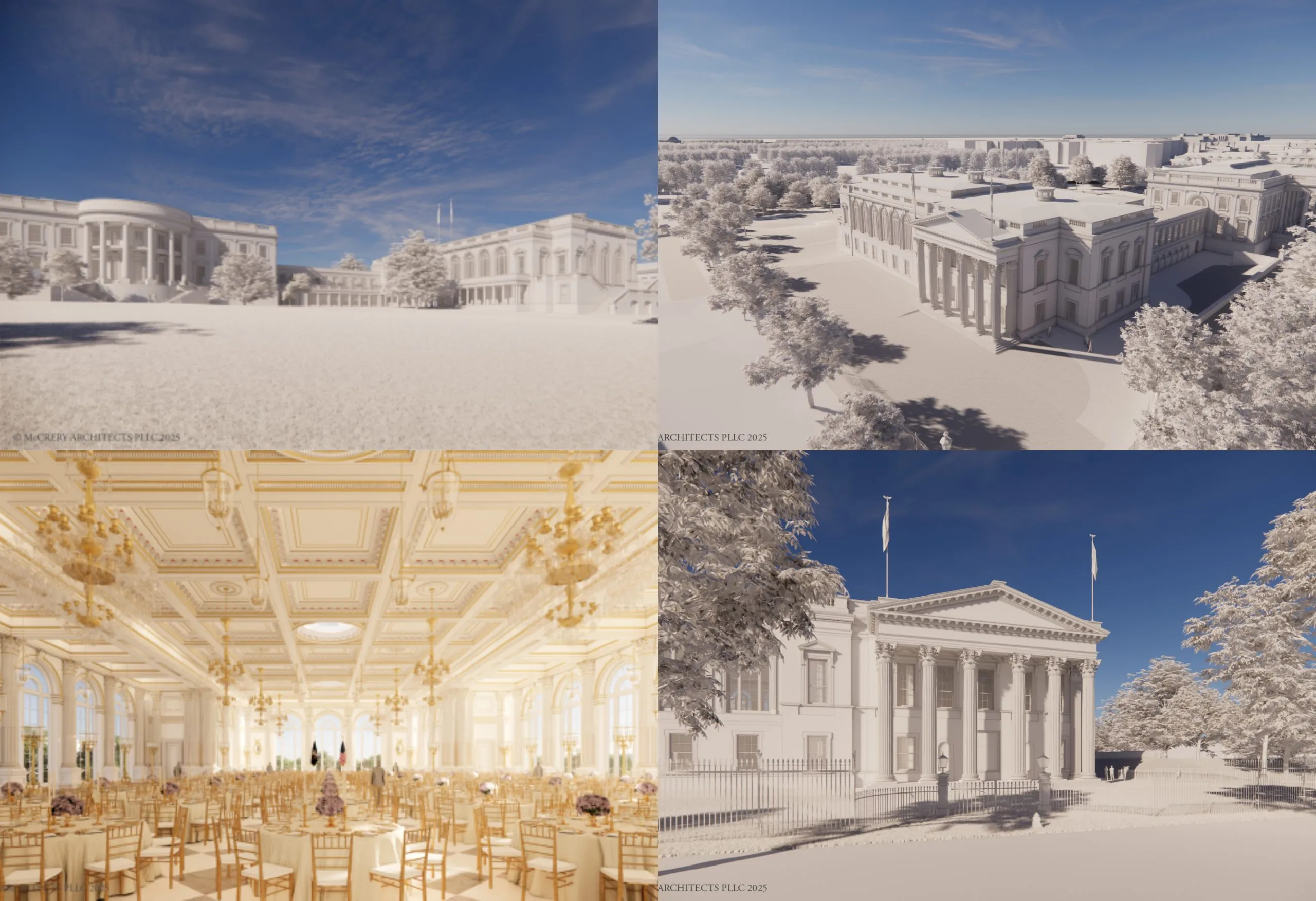
White House images of the new ballroom
It remains unclear if the fired commissioners had been consulted on plans to demolish some of the east wing of the White House to deliver a Trump-backed $250 million ballroom, which is now under construction, or the recently announced plans for a monumental arch in Washington DC.
An anonymous White House official was quoted by the Washington Post as saying that ‘all necessary agencies and entities who need to review the [ballroom] project’ were being consulted.
The White House has said the ballroom is a ‘much-needed and exquisite addition’, designed by Neoclassical architecture practice McCrery Architects, working with AECOM. Once built, it will offer 8,300m² of grand ballroom in Neoclassical style, the White House says.
Earlier this month, Trump unveiled his vision for a monumental arch near the Lincoln Memorial, reportedly based on the the Arc de Triomphe in Paris. The US president showed a model of the proposed arch adorned with a golden figure and two American eagles. A timeframe for construction of the arch is unclear.
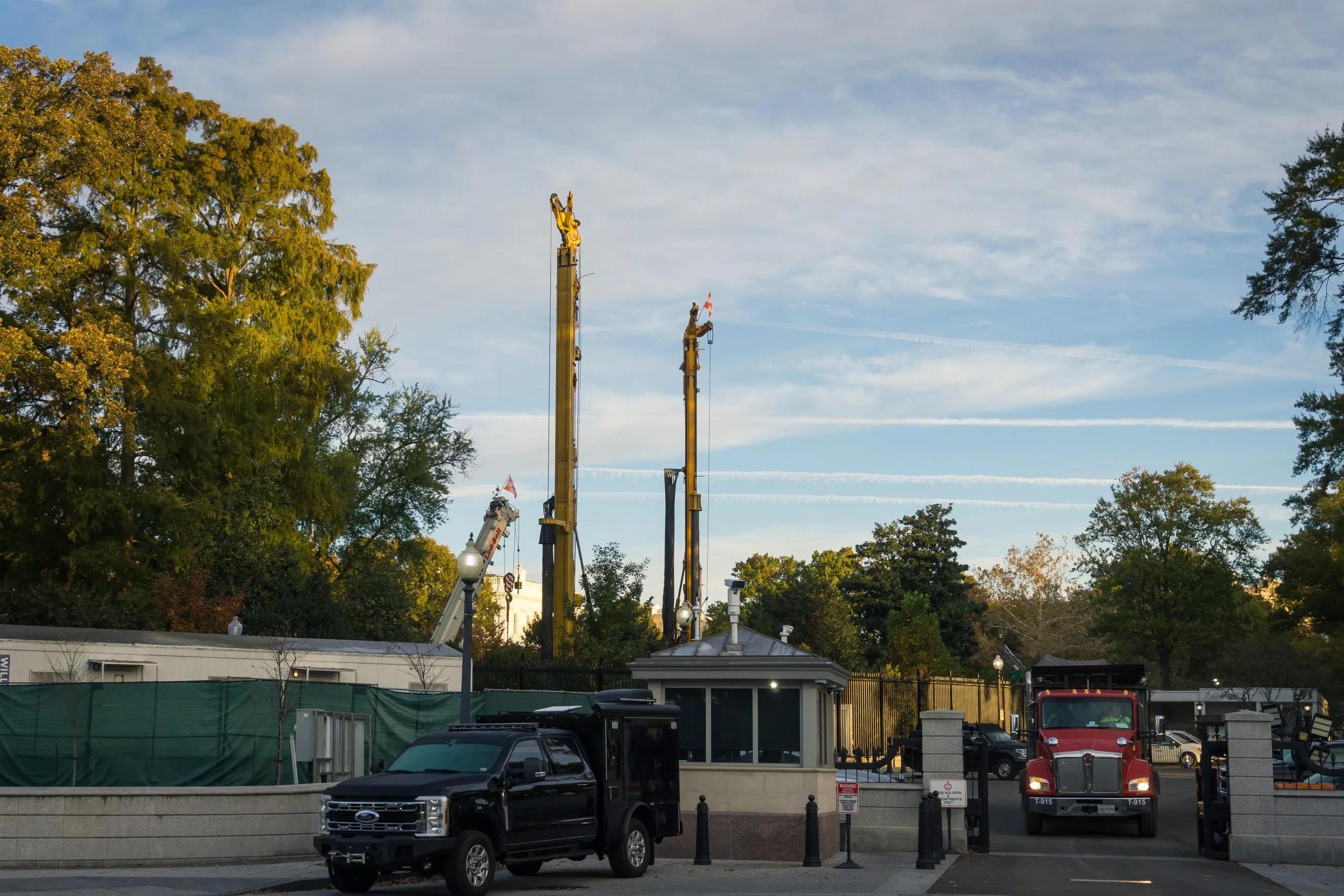
A dump truck leaves the White House east wing (October 2025)
In January, Trump demanded all new federal public buildings respect ‘traditional and classical architectural heritage’ as one of his first moves as the new US president.
His executive order, Promoting Beautiful Federal Civic Architecture, was one of almost 100 issued by Trump in his first day in the White House, which included formal written notification of the US’s official withdrawal from the Paris Agreement on Climate Change.
The American Institute for Architects (AIA) previously said it was ‘extremely concerned’ about any revisions ‘that remove control from local communities, mandate official federal design preferences, or otherwise hinder design freedom’.
The organisation said: ‘[Our] members believe the design of federal buildings must first be responsive to the people and communities who will use those buildings.
‘Our federal buildings across the country must reflect America’s wealth of culture, rich traditions and unique geographic regions. AIA has strong concerns that mandating architecture styles stifles innovation and harms local communities.’
Promoting Beautiful Federal Civic Architecture
The executive order in full, dated 20 January 2025
I hereby direct the Administrator of the General Services Administration (GSA), in consultation with the Assistant to the President for Domestic Policy and the heads of departments and agencies of the United States where necessary, to submit to me within 60 days recommendations to advance the policy that Federal public buildings should be visually identifiable as civic buildings and respect regional, traditional, and classical architectural heritage in order to uplift and beautify public spaces and ennoble the United States and our system of self-government.
Such recommendations shall consider appropriate revisions to the Guiding Principles for Federal Architecture and procedures for incorporating community input into Federal building design selections.
If, before such recommendations are submitted, the Administrator of the General Services Administration proposes to approve a design for a new Federal public building that diverges from the policy set forth in this memorandum, the Administrator shall notify me, through the Assistant to the President for Domestic Policy, not less than 30 days before the General Services Administration could reject such design without incurring substantial expenditures. Such notification shall set forth the reasons the Administrator proposes to approve such design.