
Nov 1, 2025
IndexBox has just published a new report: United Kingdom – Needle Roller Bearings – Market Analysis, Forecast, Size, Trends And Insights.
The UK needle roller bearing market experienced a significant contraction in 2024, with consumption falling to 382 tons and market value to $9.9M, continuing a multi-year decline from 2013 peaks. Despite this recent performance, the market is forecast for a slight recovery, with volume projected to reach 431 tons and value to reach $13M by 2035. The UK is heavily reliant on imports, which also fell sharply to 424 tons in 2024, with Germany, the United States, and Mexico being the leading sources by value. Domestic production is modest and also declined in 2024, while exports dropped to 115 tons. A notable trend is the high and growing import price, which reached $45,093 per ton in 2024, indicating a potential shift towards higher-value products.
Key Findings
UK market consumption and value have declined significantly since 2013 peaksA slight market recovery is forecast, with volume to reach 431 tons and value $13M by 2035The UK is a net importer, with imports falling to 424 tons, primarily sourced from Germany and the USDomestic production is limited, falling to 73 tons in 2024Import and export prices are high and rising, indicating a focus on higher-value bearingsMarket Forecast
Driven by rising demand for needle roller bearing in the UK, the market is expected to start an upward consumption trend over the next decade. The performance of the market is forecast to increase slightly, with an anticipated CAGR of +1.1% for the period from 2024 to 2035, which is projected to bring the market volume to 431 tons by the end of 2035.
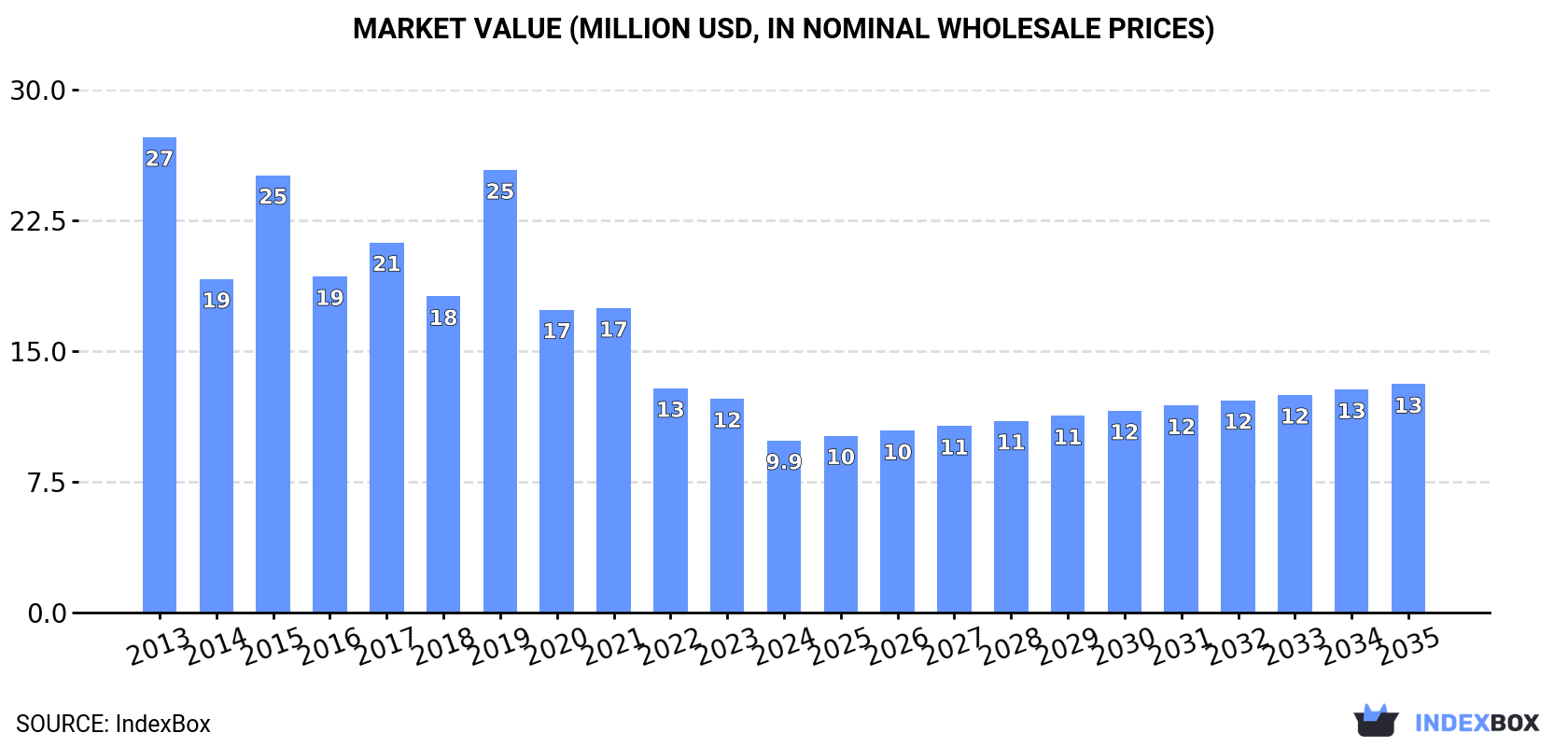
In value terms, the market is forecast to increase with an anticipated CAGR of +2.6% for the period from 2024 to 2035, which is projected to bring the market value to $13M (in nominal wholesale prices) by the end of 2035.
 ConsumptionUnited Kingdom’s Consumption of Needle Roller Bearings
For the fifth consecutive year, the UK recorded decline in consumption of needle roller bearings, which decreased by -24.6% to 382 tons in 2024. In general, consumption saw a deep slump. Over the period under review, consumption attained the peak volume at 1.2K tons in 2013; however, from 2014 to 2024, consumption remained at a lower figure.
The size of the needle roller bearing market in the UK contracted rapidly to $9.9M in 2024, waning by -19.5% against the previous year. This figure reflects the total revenues of producers and importers (excluding logistics costs, retail marketing costs, and retailers’ margins, which will be included in the final consumer price). Overall, consumption saw a drastic downturn. Over the period under review, the market hit record highs at $27M in 2013; however, from 2014 to 2024, consumption remained at a lower figure.
ProductionUnited Kingdom’s Production of Needle Roller Bearings
In 2024, production of needle roller bearings in the UK fell to 73 tons, which is down by -14.1% against 2023 figures. In general, production, however, recorded significant growth. The most prominent rate of growth was recorded in 2017 when the production volume increased by 193% against the previous year. As a result, production reached the peak volume of 113 tons. From 2018 to 2024, production growth remained at a lower figure.
In value terms, needle roller bearing production dropped modestly to $3.2M in 2024 estimated in export price. Overall, production, however, enjoyed a prominent increase. The most prominent rate of growth was recorded in 2017 with an increase of 178%. As a result, production reached the peak level of $5.1M. From 2018 to 2024, production growth failed to regain momentum.
ImportsUnited Kingdom’s Imports of Needle Roller Bearings
For the fifth year in a row, the UK recorded decline in purchases abroad of needle roller bearings, which decreased by -26.9% to 424 tons in 2024. Overall, imports saw a abrupt downturn. The most prominent rate of growth was recorded in 2019 when imports increased by 44%. The UK imports peaked at 1.4K tons in 2015; however, from 2016 to 2024, imports stood at a somewhat lower figure.
In value terms, needle roller bearing imports fell to $19M in 2024. Over the period under review, imports showed a perceptible contraction. The most prominent rate of growth was recorded in 2021 with an increase of 25%. Over the period under review, imports attained the maximum at $31M in 2013; however, from 2014 to 2024, imports stood at a somewhat lower figure.
Imports By Country
The purchases of the three major importers of needle roller bearings, namely the United States, Germany and Mexico, represented more than third of total import. Nigeria (2.9K tons), China (2.6K tons), Brazil (2K tons), Japan (2K tons), South Korea (2K tons), the Czech Republic (1.6K tons), Thailand (1.6K tons), Indonesia (0.8K tons) and France (1.2K tons) held a relatively small share of total imports.
From 2013 to 2024, the biggest increases were recorded for Nigeria (with a CAGR of +46.7%), while purchases for the other leaders experienced more modest paces of growth.
In value terms, the largest needle roller bearing importing markets into the UK were Germany ($178M), the United States ($175M) and Mexico ($151M), together accounting for 37% of total imports. China, South Korea, Japan, Brazil, Thailand, France, the Czech Republic, Indonesia and Nigeria lagged somewhat behind, together accounting for a further 26%.
Nigeria, with a CAGR of +28.1%, saw the highest rates of growth with regard to the value of imports, in terms of the main importing countries over the period under review, while purchases for the other leaders experienced more modest paces of growth.
Import Prices By Country
The import price in the UK stood at $45,093 per ton in 2024, increasing by 28% against the previous year. In general, the import price enjoyed a strong increase. The pace of growth appeared the most rapid in 2021 when the import price increased by 32% against the previous year. Over the period under review, import prices hit record highs in 2024 and is expected to retain growth in the immediate term.
There were significant differences in the average prices amongst the major importing countries. In 2024, amid the top importers, the country with the highest price was China ($37,527 per ton), while Nigeria ($1,279 per ton) was amongst the lowest.
From 2013 to 2024, the most notable rate of growth in terms of prices was attained by Mexico (+7.5%), while the other leaders experienced more modest paces of growth.
ExportsUnited Kingdom’s Exports of Needle Roller Bearings
In 2024, shipments abroad of needle roller bearings decreased by -27.4% to 115 tons, falling for the second consecutive year after two years of growth. In general, exports, however, saw a relatively flat trend pattern. The pace of growth appeared the most rapid in 2014 when exports increased by 69% against the previous year. Over the period under review, the exports reached the maximum at 232 tons in 2022; however, from 2023 to 2024, the exports failed to regain momentum.
In value terms, needle roller bearing exports dropped to $5M in 2024. Overall, exports continue to indicate a noticeable contraction. The most prominent rate of growth was recorded in 2014 with an increase of 78% against the previous year. As a result, the exports attained the peak of $13M. From 2015 to 2024, the growth of the exports remained at a lower figure.
Exports By Country
In 2024, China (18K tons) represented the main exporter of needle roller bearings, committing 29% of total exports. It was distantly followed by Japan (7.1K tons), Slovakia (7.1K tons), Germany (6.5K tons) and Thailand (5.8K tons), together achieving a 44% share of total exports. France (2.4K tons), South Korea (2.1K tons), the Netherlands (1.7K tons), the United States (1.5K tons), the Czech Republic (1.5K tons) and Romania (0.4K tons) held a relatively small share of total exports.
From 2013 to 2024, average annual rates of growth with regard to needle roller bearing exports from China stood at +13.7%. At the same time, Thailand (+36.6%), the Czech Republic (+11.3%), the Netherlands (+7.4%), South Korea (+4.5%) and Slovakia (+1.1%) displayed positive paces of growth. Moreover, Thailand emerged as the fastest-growing exporter exported in the world, with a CAGR of +36.6% from 2013-2024. By contrast, the United States (-1.1%), Japan (-2.3%), Germany (-2.7%), France (-3.3%) and Romania (-12.6%) illustrated a downward trend over the same period. From 2013 to 2024, the share of China and Thailand increased by +19 and +9.2 percentage points, respectively. The shares of the other countries remained relatively stable throughout the analyzed period.
In value terms, Germany ($255M), China ($248M) and Japan ($188M) constituted the countries with the highest levels of exports in 2024, together comprising 51% of total exports. The United States, Slovakia, France, South Korea, the Netherlands, the Czech Republic, Thailand and Romania lagged somewhat behind, together comprising a further 35%.
In terms of the main exporting countries, Thailand, with a CAGR of +7.8%, saw the highest rates of growth with regard to the value of exports, over the period under review, while shipments for the other leaders experienced more modest paces of growth.
Export Prices By Country
In 2024, the export price in the UK amounted to $43,192 per ton, jumping by 24% against the previous year. Over the period under review, the export price, however, continues to indicate a perceptible setback. Over the period under review, the export prices attained the peak figure at $66,148 per ton in 2014; however, from 2015 to 2024, the export prices stood at a somewhat lower figure.
There were significant differences in the average prices amongst the major exporting countries. In 2024, amid the top suppliers, the country with the highest price was the United States ($98,202 per ton), while Thailand ($3,605 per ton) was amongst the lowest.
From 2013 to 2024, the most notable rate of growth in terms of prices was attained by the United States (+6.6%), while the other leaders experienced more modest paces of growth.