
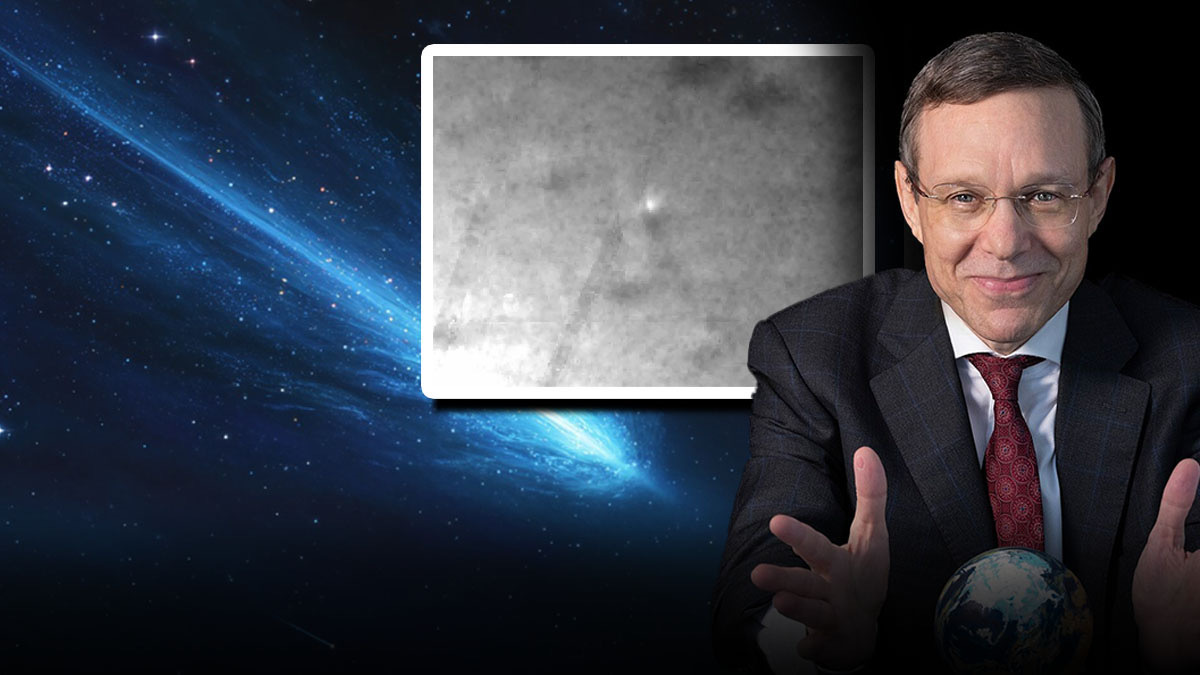
The ‘black swan event’ day (October 29 and 30) is over, as speculated by Professor Avi Loeb, the Harvard astrophysicist. Earlier the theoretical physicist had remarked about 3I/ATLAS’s peculiar trajectory around the sun, which will make it oblivious to the observers on Earth. He, among many others, had been apprehensive about the true nature of the anomalous comet, flagging at least eight anomalies. One of the litmus tests to ascertain whether the interstellar interloper had any element of extraterrestrial intelligence would be its acceleration on the day of its perihelion.
Avi Loeb, in his latest blog reports
By the date of its perihelion, 3I/ATLAS displayed the first evidence of a non-gravitational acceleration. The report (accessible here) was filed by Davide Farnoccia, a navigation engineer at NASA’s Jet Propulsion Laboratory in Pasadena who received his PhD in Mathematics from the Galileo Galilei School of Graduate Studies at the University of Pisa, Italy.
He further remarks,
The non-gravitational acceleration was measured at the perihelion distance of 1.36 times the Earth-Sun separation (defined as an astronomical unit or `au’), equivalent to 203 million kilometers. It had two components in the orbital plane of 3I/ATLAS:
What else? Dr Loeb states
The non-gravitational acceleration might be the technological signature of an internal engine. This might also explain the report on 3I/ATLAS getting bluer than the Sun
For a natural comet, this blue color is very surprising. Dust is expected to redden the scattered sunlight, and the surface of 3I/ATLAS is expected to be ~20 times colder than the 5,800 degrees Kelvin at the photosphere of the Sun, resulting in it having a redder color than the Sun. The blue appearance at perihelion is a ninth anomaly in the list of unexpected properties of 3I/ATLAS
Despite the skepticism, Avi Loeb remains optimist about one last chance for the earthlings to take more than a peek at the interstellar visitor
On December 19, 2025, 3I/ATLAS will arrive closest to Earth at a separation of 269 million kilometers, when hundreds of ground-based telescopes as well as the Hubble and Webb space telescopes will have the best opportunity to observe it.
See Also: 3I/Atlas An Alien Craft? Prof Michio Kaku Says Interstellar Object May Be Extraterritorial Visitors
Cover: Patrik Gawande / Mashable India