
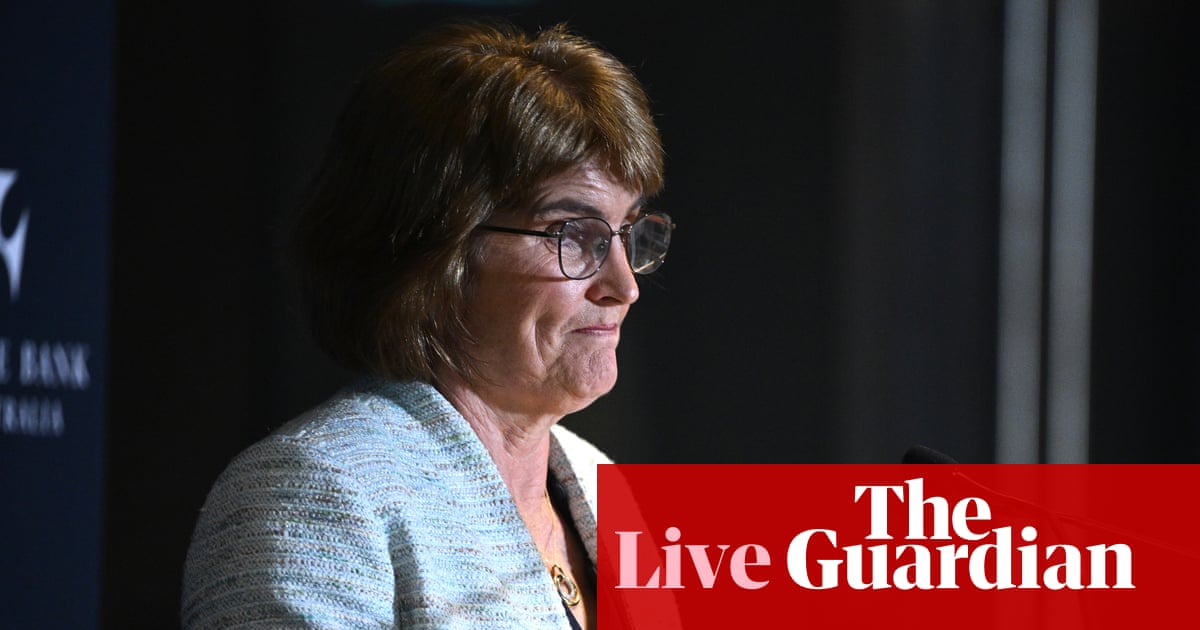
RBA board did not consider rate cut, governor says
Michele Bullock said the RBA did not consider cutting the cash rate this time round.
We basically just talked about holding and the reasons to hold, and then discussed strategy moving out, depending on what way.
What I think I highlighted in my opening statement … was that unemployment went up a little bit more than we expected, but so did inflation, so we’re being a little bit cautious here.
Updated at 00.22 EST
Key events
Show key events only
Please turn on JavaScript to use this feature
Three-hour solar subsidy will help ‘absolutely everyone’, minister says
The climate change and energy minister, Chris Bowen, was on ABC’s Afternoon Briefing a short time ago speaking about the government’s announcement to consumers will get access to three hours of free electricity in the middle of the day from July next year.
Asked if the free subsidy will bring down prices across the board, Bowen said:
Obviously it will help those Australians who are in a position to take it up. Think about someone working from home who is at home in the middle of the day and can put on the washing machine and dishwasher knowing it is free, or a retired pensioner couple, or people with apps who set their appliances to work in the middle of the day. But also the rest of us … moving the load to when power is the cheapest, that helps absolutely everyone.
It is only because of our transition that we are able to do this because there is so much solar in the system … That is a challenge to the operator in some regards, having so much energy in the middle of the day. But it is a massive opportunity if you can shift a percentage of stuff that would happen in the night-time.
Chris Bowen. Photograph: Lukas Coch/AAPShare
Updated at 00.30 EST
Better for RBA board to change its mind than ‘stick to its guns’, Bullock says
Bullock said the RBA is not “wedded religiously to a particular path” on interest rates:
What we are trying to do is very actively analyse the data as it comes through. We’re not backward looking. We take the data that we’ve got, we use that as a starting point, and then we attempt to forecast, using our models, using our judgment about what the outlook might look like.
I would have thought, quite frankly, that it would be worse for the bank to stick to its guns rather than change its mind in the face of new information.
Updated at 00.19 EST
Bullock: ‘Anything’s possible’ as to where rates go in future
Asked if it’s possible interest rates could go up or down in the future, Bullock said: “Anything’s possible.”
She continued:
All I would say is that I think we’re at the right spot we need to be at the moment, and we can respond where the risks arise.
So if the risks turn out to be on the downside, which some people have suggested on the employment side, we’re able to respond. Likewise, if the risks are on the upside, we’re able to respond. But I think at the moment, we think we’re where we need to be.
Michele Bullock. Photograph: Dan Himbrechts/AAPShare
Updated at 00.31 EST
RBA still chasing inflation target of 2.5%, Bullock says
Bullock said that the RBA is still targeting 2.5% as the official inflation target:
The board is very definitely targeting 2.5%. Just below three is not good enough for the board.
And I think again, when you take those inflation forecasts at face value with the one more interest rate cut in there, what that’s telling you is that it’s really an interesting question about whether there’s many more rate cuts left to come.
The bank’s updated forecasts, predicated on market bets of a cut by the end of 2026, show core and headline inflation were no longer expected to gradually return to 2.5%, the middle of the RBA’s preferred range, but instead bump up then drop back to 2.6% by the end of 2027.
Updated at 00.00 EST
Unemployment should stay ‘reasonably stable’: Bullock
Bullock said that the RBA expects that the unemployment rate will remain “reasonably stable from here on in”.
Asked by a reporter if there was any risks of stagflation, she said:
I think, at the moment, we’re still confident that inflation is going to come down, and we’ve got employment at a pretty good place.
Updated at 23.50 EST
RBA board did not consider rate cut, governor says
Michele Bullock said the RBA did not consider cutting the cash rate this time round.
We basically just talked about holding and the reasons to hold, and then discussed strategy moving out, depending on what way.
What I think I highlighted in my opening statement … was that unemployment went up a little bit more than we expected, but so did inflation, so we’re being a little bit cautious here.
Updated at 00.22 EST
RBA governor says ‘temporary factors’ behind higher inflation not expected to continue
The RBA governor, Michele Bullock, is speaking now about the bank’s decision to leave the official interest rate on hold.
Bullock said:
Inflation in the September quarter was higher than we were expecting in our previous forecasts.
We think some of this was driven by temporary factors such as travel costs, council rates and fuel, and we don’t expect some of these to continue. We are, however, taking signal from stronger price increases that may suggest more inflationary pressure in the economy than we thought before.
In particular, the cost of new dwellings and market services both increased by more than expected, and inflation in these components tends to be more persistent at the same time, the unemployment rate has gone up.
Updated at 23.38 EST
Question time ends
Tim Wilson tries again to get a question in, but Albanese stares him off and ends question time for the day.
Not before Jason Clare gave his best impression of a race commentator during a dixer on the 20% Hecs debt discount.
The race that stops the nation has been run and won and there are a few lucky winners across the country. But in the next few weeks there won’t just be a few winners, there’ll be millions of them. And that’s ‘cause we’re cutting student debt by 20%.
Updated at 00.21 EST
Clare O’Neil pushes back on claim regional areas not getting fair share of housing funding
Andrew Gee is up again with a second question, but not before Tim Wilson tries to get in with one of his own at the dispatch box. But Milton Dick tells him to sit down.
Gee tells the housing minister his electorate and other country communities are not getting their fair share of national housing funding.
The housing minister, Clare O’Neil, says the housing programs have an “important regional dimension”.
The home ownership statistics in your part of the world are looking pretty good, I think there’s about 1,300 people in the member for Calare’s electorate who have got into first home ownership with our backing.
O’Neil says she’d be “pleased” to talk to Gee and his community further.
Clare O’Neil. Photograph: Lukas Coch/AAPShare
Updated at 23.31 EST
Albanese asked whether help-to-buy scheme will push house prices up
Liberal MP Mary Aldred is up next – and goes on the attack on housing. Housing prices grew at a faster rate in September than at any other time in the last two years, and she says the government’s help-to-buy scheme will “push house prices up by 6.6% in 2026 for several years after that”, while interest rates didn’t go down today.
Anthony Albanese tests Aldred and says she should write to all her constituents who are eligible for the help-to-buy scheme.
He then goes down a familiar path, criticising the opposition for not having a housing minister, saying, “Apparently, up to 2022 everything was hunky dory”.
The opposition stands up on a point of relevance, but Milton Dick says the question was broad, and tells Albanese to remain relevant. Albanese says:
Before May 2022 there were houses being built everywhere, there were social homes and people were getting into public housing. Rentals apparently were coming down under them. It’s all nonsense because it’s all about supply. And what we have done is concentrate on supply.
Updated at 23.23 EST