
Unlock the Editor’s Digest for free
Roula Khalaf, Editor of the FT, selects her favourite stories in this weekly newsletter.
An ancient philosophical thought experiment, known as the Ship of Theseus, raises some relevant questions for our robotic times.
What happens when all the components of Theseus’s ship are gradually replaced over time? Is the rebuilt boat, containing none of its original parts, still the ship of Theseus? Or is it something different? Much wine was doubtless drunk in philosophical symposia contesting the point.
A similar conundrum is true of human identity. All the cells we are born with will be replaced many times over during our lives. But we do not believe our identity changes. So what is the essence of our identity? Is it our visible, mutable wetware, which is constantly being replaced? Or is it our invisible, mostly immutable software — our genetic code — which instructs our cells how to reproduce themselves?
Blaise Agüera y Arcas, a vice-president of Google and founder of its research team Paradigms of Intelligence, has clear answers to such questions. As a programmer, he naturally believes that the human code is most important. And code can be reproduced in many different substrates, no matter whether carbon or silicon-based. In essence, life is computational.
This echoes the views of two great pioneers of the computer age, Alan Turing and John von Neumann, who can both be described as “functionalists.” If you urgently needed a kidney transplant, you would not care whether it was made of living matter or carbon nanotubes as long as it functioned in the way you wanted. “Seen this way, a living organism is a composition of functions. Which means that it is, itself, a function!”
This line of reasoning takes Agüera y Arcas to some interesting places when it comes to AI. Just as an algorithm can run on any kind of computer, so intelligence can “run” on many different substrates, he argues. The essence of intelligence is computation. That implies that a sufficiently powerful computer can just as readily implement intelligence as humans can; all it takes is the right code and enough computing power. “Few mainstream authors claim that AI is ‘real’ intelligence. I do,” he writes.
Agüera y Arcas’s book is a mammoth investigation into the computational basis of life and a fascinating exploration of the nature of intelligence. Spanning 4bn years of biology and evolution, philosophy, neuroscience, physics, cybernetics and the transformer technology that underpins the latest advances in generative AI, he ventures boldly across several domains. Experts in all those fields may cavil at some of his conclusions and find his reductionist conclusions jarring. But his book is entertaining and thought-provoking all the same. The author demands a lot of the reader in following his many digressions into tangential fields without losing the thread of his argument. But the effort is worth the while.
One of the most unhelpful ways of thinking about AI, he suggests, is the way that so many in the tech industry do today. This divides AI into three categories: artificial narrow intelligence, or the ability to perform discrete tasks, such as playing chess or reading handwriting; artificial general intelligence, when AI matches humans across all cognitive tasks; and superintelligence, when AI outstrips human intelligence and evolves in ways we will not be able to comprehend. “There’s something arbitrary, bordering on absurd, about pundits arguing over the precise timing of when this exponential climb really ‘counts’ or ‘will count’ as AGI,” he writes. “And who cares anyway?”
Instead, Agüera y Arcas argues, we should envision a world of multiple intelligences, similar to what already exists in the natural world. Some of the more intriguing sections of the book involve his descriptions of the ingenuity of different species in applying intelligence.
For example, tiny Portia spiders, smaller than 1cm in size, have developed highly intelligent hunting strategies by spoofing their prey, planning crafty attacks and masterfully executing them — often via indirect routes — over the course of an hour. That suggests they have a quite sophisticated model of how their world works and can anticipate their prey’s actions.

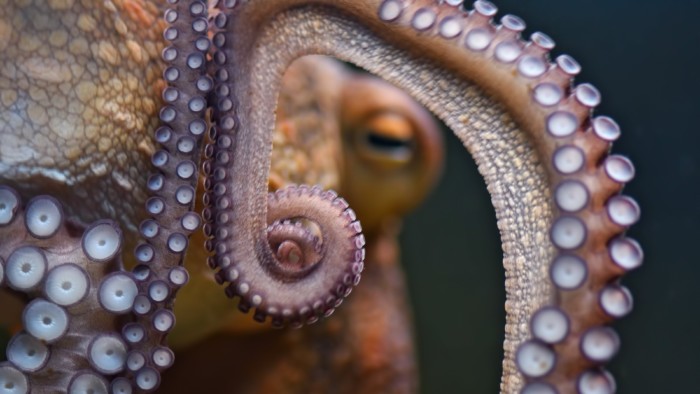
Even more remarkable are octopuses, which distribute a lot of intelligence and some autonomy to their extremities. Agüera y Arcas suggests they are best regarded as “a tightly knit community of eight arms” sharing a common pair of eyes. In at least one species, octopuses can bite off one of their arms, which can then attack a predator, allowing the rest of the animal to escape. A new arm then regrows over the next 130 days or so.
These examples from the natural world are a foretaste of the many different types of machine intelligence that will evolve in future. Some machine intelligences will be very simple systems performing very basic functions. Others will be extraordinarily powerful in particular domains. This loss of human exceptionalism when it comes to higher intelligence will unnerve many. But the prospect delights Agüera y Arcas.
“If we believe life and intelligence are precious seeds, destined to bloom here and there in the universe, then spread and effloresce, we should ultimately expect our light cone to be populated by aliens of every description,” he writes.
For the moment, it is hard to envisage such a world. But given the rate of the progress in AI, we had better start trying to do so.
What is Intelligence? Lessons from AI about Evolution, Computing, and Minds by Blaise Agüera y Arcas MIT Press $36.95, 624 pages
John Thornhill is the FT’s innovation editor
Join our online book group on Facebook at FT Books Café and follow FT Weekend on Instagram, Bluesky and X