
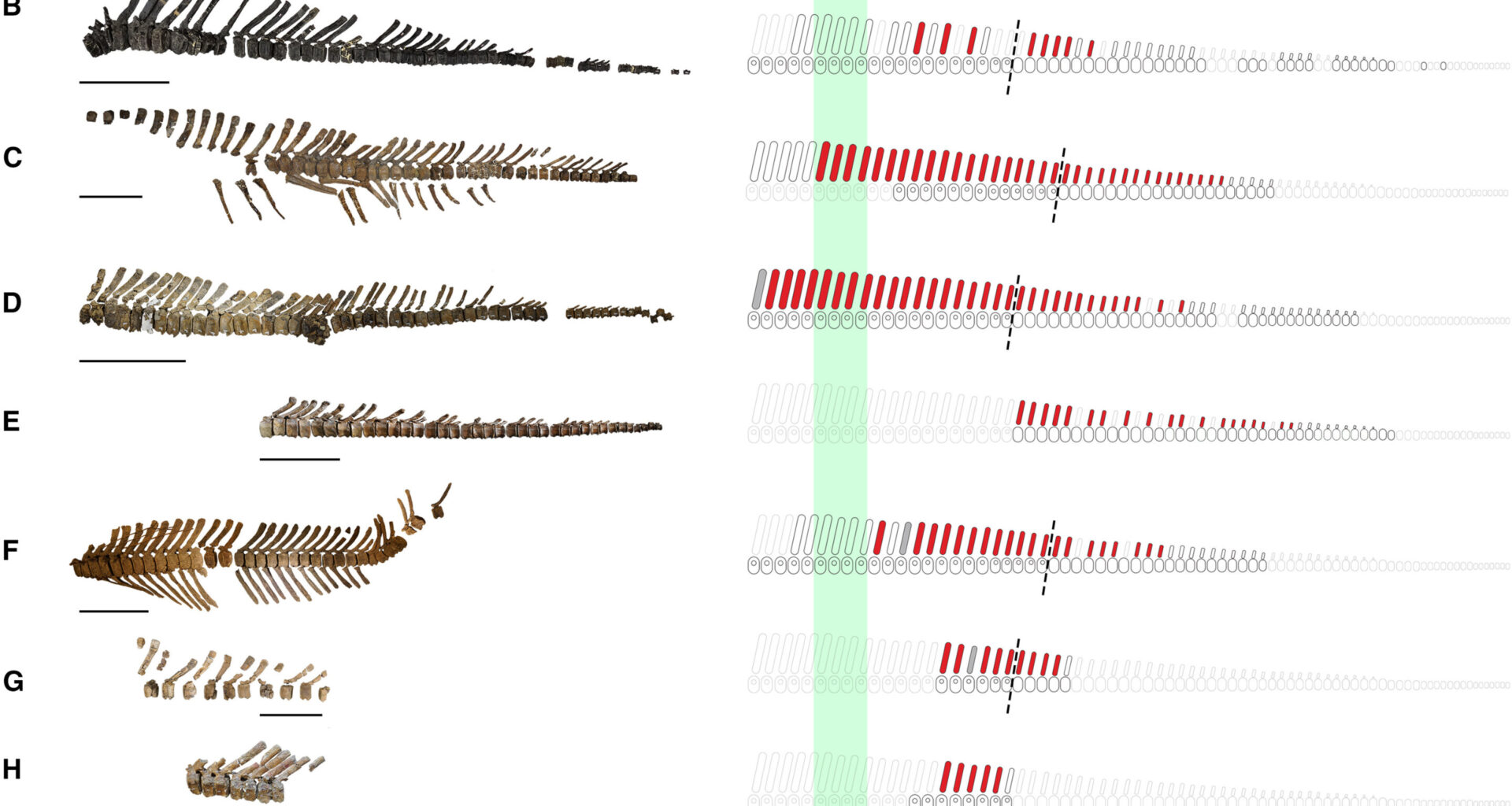
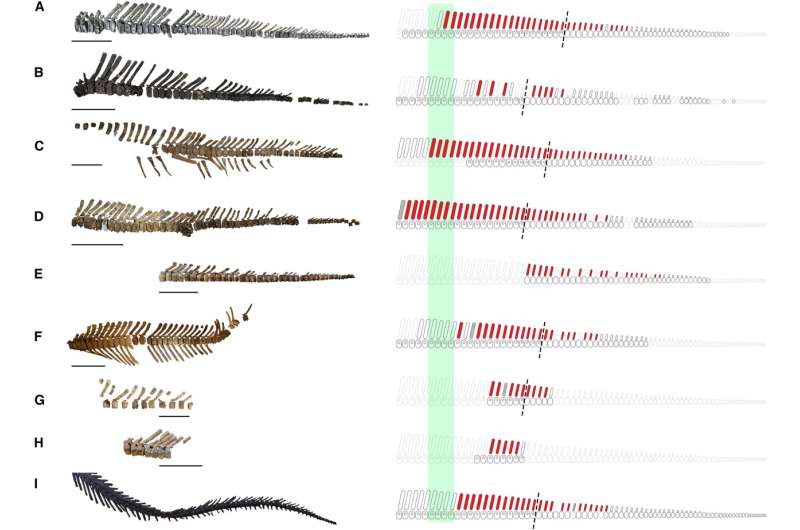
Hadrosaurid tails and location of pathologies in relation to the cloacal region. Credit: iScience (2025). DOI: 10.1016/j.isci.2025.113739
Paleontologists have long wrestled with the challenge of identifying the genders of dinosaurs from the fossils they leave behind. Once the soft tissues like reproductive organs have decayed away, distinguishing a male from a female is nearly impossible and has fueled many debates. But there may be a simple way to solve this mystery, at least for one group of dinosaurs.
A new study published in the journal iScience suggests that traumatic injuries sustained during mating could be the key to determining dinosaur sex.
Analyzing the evidence
Hadrosaurid dinosaurs, commonly known as duck-billed dinosaurs because of their wide, flat snouts, are a group of dinosaurs that lived in the Cretaceous Period. Many fossils of the long, bony spikes in the middle section of their tails show evidence of healed fractures. But what caused these breaks?
Over the years, debates have raged from accidental trampling to intraspecific fighting. To settle this, researchers led by Dr. Filippo Bertozzo from the Royal Belgian Institute of Natural Sciences set out to find the answer, and in doing so, may have discovered a way to identify female individuals.
The research team analyzed 551 neural spines from hadrosaurid fossils from museum collections across North America, Europe and Asia, spanning different time periods. This confirmed that the recurring injury pattern was consistent across species and locations. Then they built 3D models of tail bones from the Edmontosaurus dinosaur (one of the most completely preserved hadrosaurids) and used computer simulations to determine which kind of forces could have caused the breaks seen in the fossils.
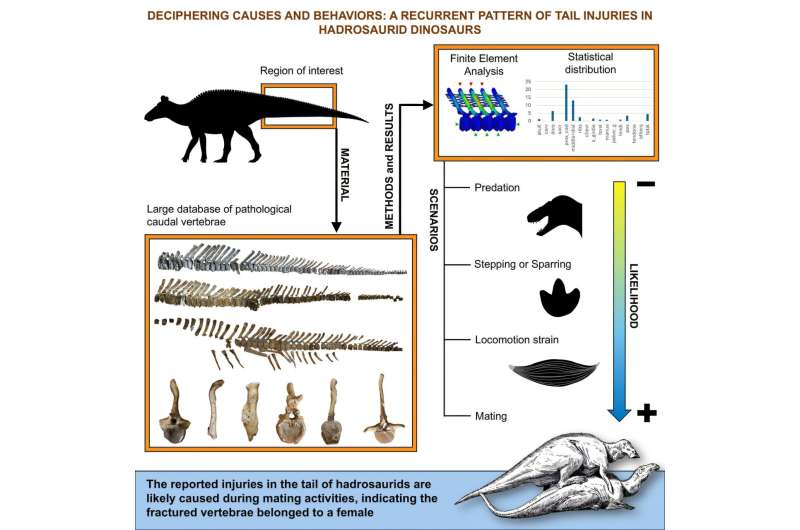
Graphical abstract. Credit: iScience (2025). DOI: 10.1016/j.isci.2025.113739
Ruling out the usual suspects
The only force that matched the injuries was a diagonal weight pressing down on the top of the tail at an angle of between 30 and 60 degrees. The team ruled out other causes like trampling and fighting, as these would have caused different types of injuries. For example, if predation were the cause, you would see tooth marks on the bones, but they are not present.
The scientists concluded that mating was the most likely cause of the injuries for several reasons. The diagonal force simulated by the computer matches the weight of a mounting male pressing down on a female’s tail at the point where the cloaca is estimated to have been. Additionally, nearly all the fossils were from adult specimens, indicating the trauma was caused by adult-like behavior, such as mating.
“These potential mating injuries may represent the first indirect evidence of sexual behavior in non-avian dinosaurs, and a novel approach to recognize female individuals,” commented the researchers.
If this work is correct, science could have a new way of identifying female dinosaurs across many other species.
Written for you by our author Paul Arnold, edited by Gaby Clark, and fact-checked and reviewed by Robert Egan—this article is the result of careful human work. We rely on readers like you to keep independent science journalism alive.
If this reporting matters to you,
please consider a donation (especially monthly).
You’ll get an ad-free account as a thank-you.
More information:
Filippo Bertozzo et al, Deciphering causes and behaviors: A recurrent pattern of tail injuries in hadrosaurid dinosaurs, iScience (2025). DOI: 10.1016/j.isci.2025.113739
© 2025 Science X Network
Citation:
Mating injuries may give us a new way of identifying dinosaur genders (2025, November 5)
retrieved 6 November 2025
from https://phys.org/news/2025-11-injuries-dinosaur-genders.html
This document is subject to copyright. Apart from any fair dealing for the purpose of private study or research, no
part may be reproduced without the written permission. The content is provided for information purposes only.