

Nov 8, 2025
IndexBox has just published a new report: United Kingdom – Wood Pellets And Other Agglomerates – Market Analysis, Forecast, Size, Trends and Insights.
The UK market for wood pellets and other agglomerates experienced significant growth in 2024, with consumption volume increasing by 41% to 10M tons and market value rising 39% to $2.2B, ending a two-year decline. Wood pellets dominate the market, constituting 96% of consumption. The market is heavily import-dependent, with imports surging 46% to 9.4M tons, primarily from the United States (75% share). Domestic production remains relatively flat at 678K tons. Looking ahead, the market is forecast to expand at a CAGR of +0.6% in volume and +0.7% in value from 2024 to 2035, reaching 11M tons and $2.3B respectively by 2035.
Key Findings
UK market consumption surged 41% to 10M tons in 2024, valued at $2.2BMarket forecast shows modest growth with a +0.6% volume CAGR to 2035Imports dominate supply, with the US providing 75% of 9.4M tons importedDomestic production is minimal and stagnant at 678K tonsWood pellets constitute 96% of consumption, dwarfing other agglomeratesMarket Forecast
Driven by increasing demand for wood pellets and other agglomerates in the UK, the market is expected to continue an upward consumption trend over the next decade. Market performance is forecast to decelerate, expanding with an anticipated CAGR of +0.6% for the period from 2024 to 2035, which is projected to bring the market volume to 11M tons by the end of 2035.
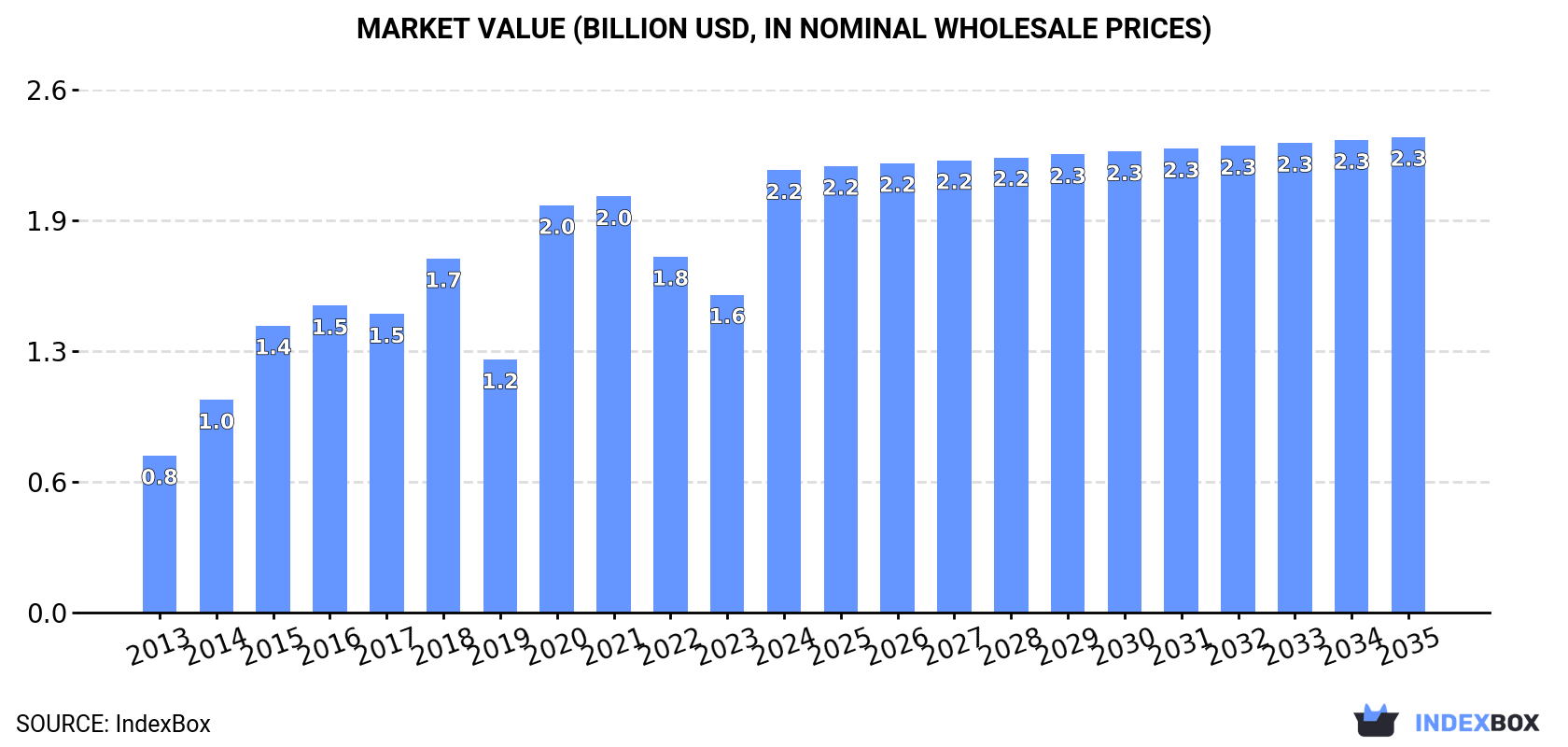
In value terms, the market is forecast to increase with an anticipated CAGR of +0.7% for the period from 2024 to 2035, which is projected to bring the market value to $2.3B (in nominal wholesale prices) by the end of 2035.
 ConsumptionUnited Kingdom’s Consumption of Wood Pellets And Other Agglomerates
In 2024, after two years of decline, there was significant growth in consumption of wood pellets and other agglomerates, when its volume increased by 41% to 10M tons. In general, consumption recorded a resilient increase. Over the period under review, consumption hit record highs in 2024 and is expected to retain growth in the immediate term.
The size of the market for wood pellets and other agglomerates in the UK surged to $2.2B in 2024, rising by 39% against the previous year. This figure reflects the total revenues of producers and importers (excluding logistics costs, retail marketing costs, and retailers’ margins, which will be included in the final consumer price). Over the period under review, consumption saw a buoyant expansion. Over the period under review, the market attained the maximum level in 2024 and is expected to retain growth in the near future.
Consumption By Type
Wood pellets (9.6M tons) constituted the product with the largest volume of consumption, accounting for 96% of total volume. Moreover, wood pellets exceeded the figures recorded for the second-largest type, other agglomerates (368K tons), more than tenfold.
From 2013 to 2024, the average annual rate of growth in terms of the volume of wood pellets consumption totaled +9.3%.
In value terms, wood pellets ($2.1B) led the market, alone. The second position in the ranking was taken by other agglomerates ($33M).
From 2013 to 2024, the average annual growth rate of the value of wood pellets market stood at +10.0%.
ProductionUnited Kingdom’s Production of Wood Pellets And Other Agglomerates
Wood pellets and other agglomerates production in the UK totaled 678K tons in 2024, remaining constant against the previous year. Over the period under review, production showed a relatively flat trend pattern. The growth pace was the most rapid in 2014 when the production volume increased by 8.7%. As a result, production reached the peak volume of 696K tons. From 2015 to 2024, production growth failed to regain momentum.
In value terms, wood pellets and other agglomerates production fell markedly to $90M in 2024 estimated in export price. Overall, production recorded a strong expansion. The growth pace was the most rapid in 2018 when the production volume increased by 97%. Wood pellets and other agglomerates production peaked at $253M in 2022; however, from 2023 to 2024, production remained at a lower figure.
Production By Type
Other agglomerates (358K tons) and wood pellets (320K tons) were the main products of wood pellets and other agglomerates production in the UK.
From 2013 to 2024, the most notable rate of growth in terms of production, amongst the key produced products, was attained by wood pellets (with a CAGR of +0.5%).
In value terms, wood pellets ($92M) led the market, alone. The second position in the ranking was taken by other agglomerates ($30M).
From 2013 to 2024, the average annual growth rate of the value of wood pellets production totaled +6.1%.
ImportsUnited Kingdom’s Imports of Wood Pellets And Other Agglomerates
In 2024, purchases abroad of wood pellets and other agglomerates increased by 46% to 9.4M tons for the first time since 2021, thus ending a two-year declining trend. Over the period under review, imports recorded strong growth. The growth pace was the most rapid in 2020 when imports increased by 170% against the previous year. Over the period under review, imports hit record highs in 2024 and are likely to continue growth in the immediate term.
In value terms, wood pellets and other agglomerates imports surged to $2.1B in 2024. In general, imports showed buoyant growth. The growth pace was the most rapid in 2014 with an increase of 39% against the previous year. Imports peaked in 2024 and are likely to continue growth in the immediate term.
Imports By Country
In 2024, the United States (7M tons) constituted the largest supplier of wood pellets and other agglomerates to the UK, with a 75% share of total imports. Moreover, wood pellets and other agglomerates imports from the United States exceeded the figures recorded by the second-largest supplier, Latvia (943K tons), sevenfold. Canada (866K tons) ranked third in terms of total imports with a 9.2% share.
From 2013 to 2024, the average annual growth rate of volume from the United States amounted to +14.6%. The remaining supplying countries recorded the following average annual rates of imports growth: Latvia (+17.2% per year) and Canada (-4.7% per year).
In value terms, the United States ($1.6B) constituted the largest supplier of wood pellets and other agglomerates to the UK, comprising 75% of total imports. The second position in the ranking was held by Latvia ($201M), with a 9.4% share of total imports. It was followed by Canada, with an 8.7% share.
From 2013 to 2024, the average annual growth rate of value from the United States stood at +16.9%. The remaining supplying countries recorded the following average annual rates of imports growth: Latvia (+19.6% per year) and Canada (-3.8% per year).
Imports By Type
In 2024, wood pellets (9.3M tons) was the main type of wood pellets and other agglomerates supplied to the UK, accounting for a 99% share of total imports. It was followed by other agglomerates (54K tons), with a 0.6% share of total imports.
From 2013 to 2024, the average annual rate of growth in terms of the volume of wood pellets imports stood at +9.5%.
In value terms, wood pellets ($2.1B) constituted the largest type of wood pellets and other agglomerates supplied to the UK, comprising 99% of total imports. The second position in the ranking was taken by other agglomerates ($29M), with a 1.3% share of total imports.
From 2013 to 2024, the average annual growth rate of the value of wood pellets imports totaled +11.4%.
Import Prices By Type
The average import price for wood pellets and other agglomerates stood at $229 per ton in 2024, with a decrease of -6.2% against the previous year. In general, the import price, however, saw mild growth. The pace of growth was the most pronounced in 2019 when the average import price increased by 166%. As a result, import price attained the peak level of $496 per ton. From 2020 to 2024, the average import prices remained at a somewhat lower figure.
Prices varied noticeably by the product type; the product with the highest price was other agglomerates ($532 per ton), while the price for wood pellets stood at $227 per ton.
From 2013 to 2024, the most notable rate of growth in terms of prices was attained by wood pellets (+1.7%).
Import Prices By Country
The average import price for wood pellets and other agglomerates stood at $229 per ton in 2024, shrinking by -6.2% against the previous year. Overall, the import price, however, continues to indicate a modest expansion. The most prominent rate of growth was recorded in 2019 an increase of 166%. As a result, import price attained the peak level of $496 per ton. From 2020 to 2024, the average import prices remained at a somewhat lower figure.
Average prices varied somewhat amongst the major supplying countries. In 2024, amid the top importers, the highest price was recorded for prices from Estonia ($293 per ton) and the United States ($228 per ton), while the price for Latvia ($213 per ton) and Canada ($215 per ton) were amongst the lowest.
From 2013 to 2024, the most notable rate of growth in terms of prices was attained by Estonia (+4.6%), while the prices for the other major suppliers experienced more modest paces of growth.
ExportsUnited Kingdom’s Exports of Wood Pellets And Other Agglomerates
In 2024, exports of wood pellets and other agglomerates from the UK surged to 58K tons, increasing by 138% against the year before. Over the period under review, exports, however, continue to indicate a deep downturn. The pace of growth appeared the most rapid in 2022 when exports increased by 244%. The exports peaked at 401K tons in 2014; however, from 2015 to 2024, the exports remained at a lower figure.
In value terms, wood pellets and other agglomerates exports stood at $7.7M in 2024. Overall, exports, however, showed a deep contraction. The pace of growth appeared the most rapid in 2022 when exports increased by 466%. The exports peaked at $27M in 2014; however, from 2015 to 2024, the exports remained at a lower figure.
Exports By Country
Ireland (7.7K tons) was the main destination for wood pellets and other agglomerates exports from the UK, accounting for a 13% share of total exports. Moreover, wood pellets and other agglomerates exports to Ireland exceeded the volume sent to the second major destination, Latvia (1.4K tons), sixfold. Sweden (1.3K tons) ranked third in terms of total exports with a 2.3% share.
From 2013 to 2024, the average annual rate of growth in terms of volume to Ireland amounted to -1.8%. Exports to the other major destinations recorded the following average annual rates of exports growth: Latvia (+86.9% per year) and Sweden (-24.5% per year).
In value terms, Ireland ($1.2M) remains the key foreign market for wood pellets and other agglomerates exports from the UK, comprising 16% of total exports. The second position in the ranking was held by Latvia ($290K), with a 3.8% share of total exports. It was followed by Sweden, with a 2.6% share.
From 2013 to 2024, the average annual rate of growth in terms of value to Ireland totaled -4.0%. Exports to the other major destinations recorded the following average annual rates of exports growth: Latvia (+52.8% per year) and Sweden (-24.2% per year).
Exports By Type
Other agglomerates (44K tons) was the largest type of wood pellets and other agglomerates exported from the UK, with a 75% share of total exports. Moreover, other agglomerates exceeded the volume of the second product type, wood pellets (15K tons), threefold.
From 2013 to 2024, the average annual growth rate of the volume of other agglomerates exports stood at -10.6%.
In value terms, wood pellets ($5.8M) remains the largest type of wood pellets and other agglomerates exported from the UK, comprising 75% of total exports. The second position in the ranking was held by other agglomerates ($1.9M), with a 25% share of total exports.
From 2013 to 2024, the average annual growth rate of the value of wood pellets exports stood at -2.9%.
Export Prices By Type
In 2024, the average export price for wood pellets and other agglomerates amounted to $132 per ton, shrinking by -57.6% against the previous year. Overall, the export price, however, recorded strong growth. The most prominent rate of growth was recorded in 2018 when the average export price increased by 99%. The export price peaked at $369 per ton in 2022; however, from 2023 to 2024, the export prices failed to regain momentum.
There were significant differences in the average prices for the major types of exported product. In 2024, the product with the highest price was wood pellets ($390 per ton), while the average price for exports of other agglomerates stood at $44 per ton.
From 2013 to 2024, the most notable rate of growth in terms of prices was recorded for the following types: wood pellets (+15.3%).
Export Prices By Country
In 2024, the average export price for wood pellets and other agglomerates amounted to $132 per ton, dropping by -57.6% against the previous year. In general, the export price, however, saw a buoyant expansion. The pace of growth appeared the most rapid in 2018 when the average export price increased by 99% against the previous year. The export price peaked at $369 per ton in 2022; however, from 2023 to 2024, the export prices stood at a somewhat lower figure.
Prices varied noticeably by country of destination: amid the top suppliers, the country with the highest price was Poland ($592 per ton), while the average price for exports to Belgium ($109 per ton) was amongst the lowest.
From 2013 to 2024, the most notable rate of growth in terms of prices was recorded for supplies to France (+13.0%), while the prices for the other major destinations experienced more modest paces of growth.