
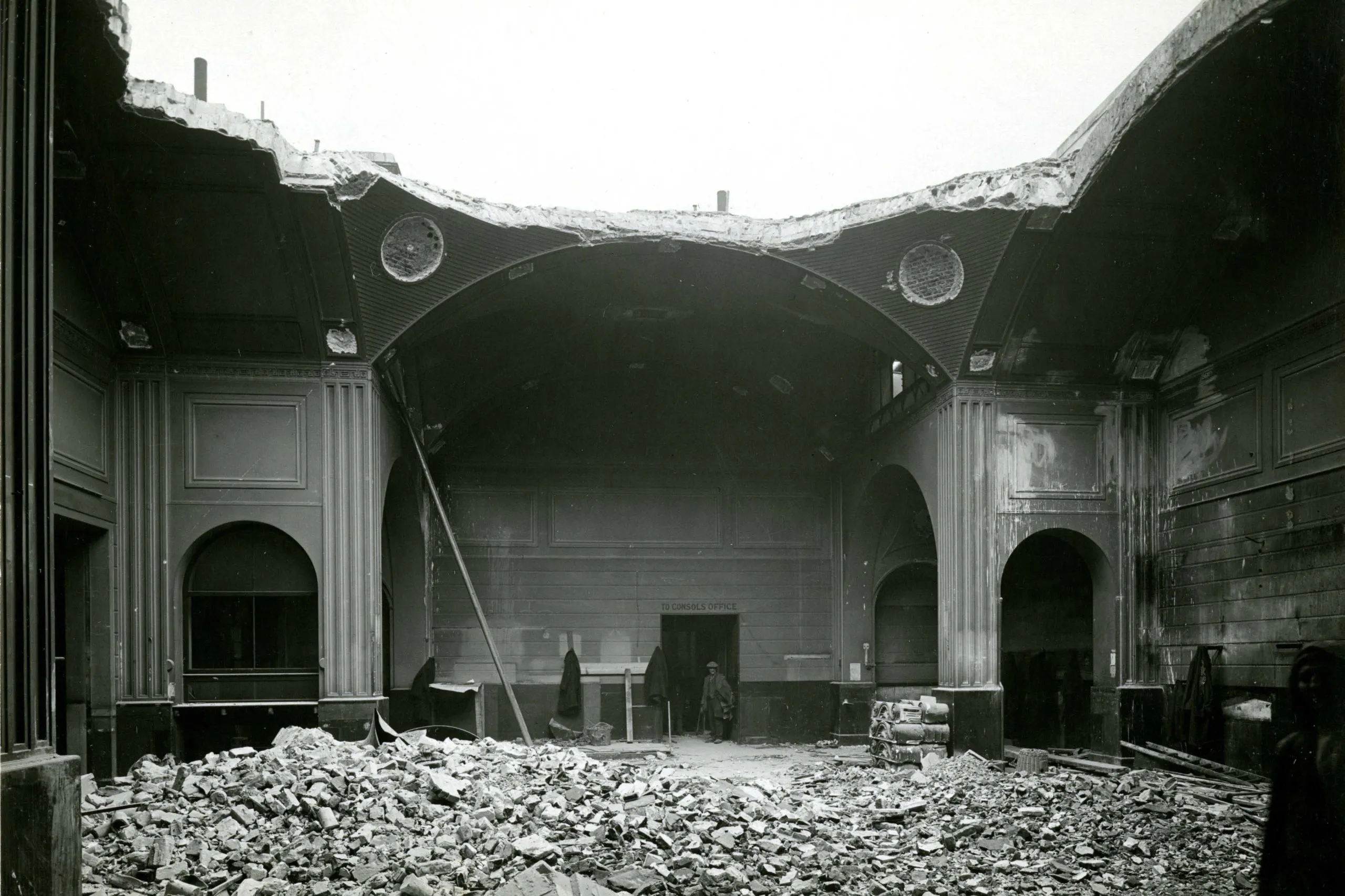
Demolition of Soane’s Bank Stock Office, 1925. Photo: Bank of England Museum
Never one to mince words, Niklaus Pevsner was moved to describe the reconstruction of the Bank of England by Herbert Baker, entailing the demolition of John Soane’s historic building, as ‘the greatest architectural crime to befall the City of London in the 20th century’.
Between 1925 and 1939, the Old Lady of Threadneedle Street was utterly transformed through Baker’s expansive remodelling to contrive ‘a sense of permanence in progress’ as Baker described it, and root the bank at the heart of British imperial power. Today, it safeguards the nation’s gold reserves; sequestered in its subterranean vaults are 400,000 bars of gold, worth over £200 billion.
To mark the centenary of the reconstruction, a new exhibition within the bank’s permanent museum sets out to illuminate the scope of Baker’s designs. The Bank of England was founded in 1694 and originally billeted in Mercers’ Hall, evolving in scale and form, weathering wars, riots, a Jacobite plot and the South Sea Bubble.
Soane’s iteration, designed incrementally between 1788 and 1828 and widely considered his supreme achievement, was a Neoclassical symphony of domes, courtyards and an imposing central rotunda, all protectively enclosed by a blank screen wall wrapped around the site. It even featured on the reverse of the English one pound note in the late 1920s; ironically, just as it was being demolished.
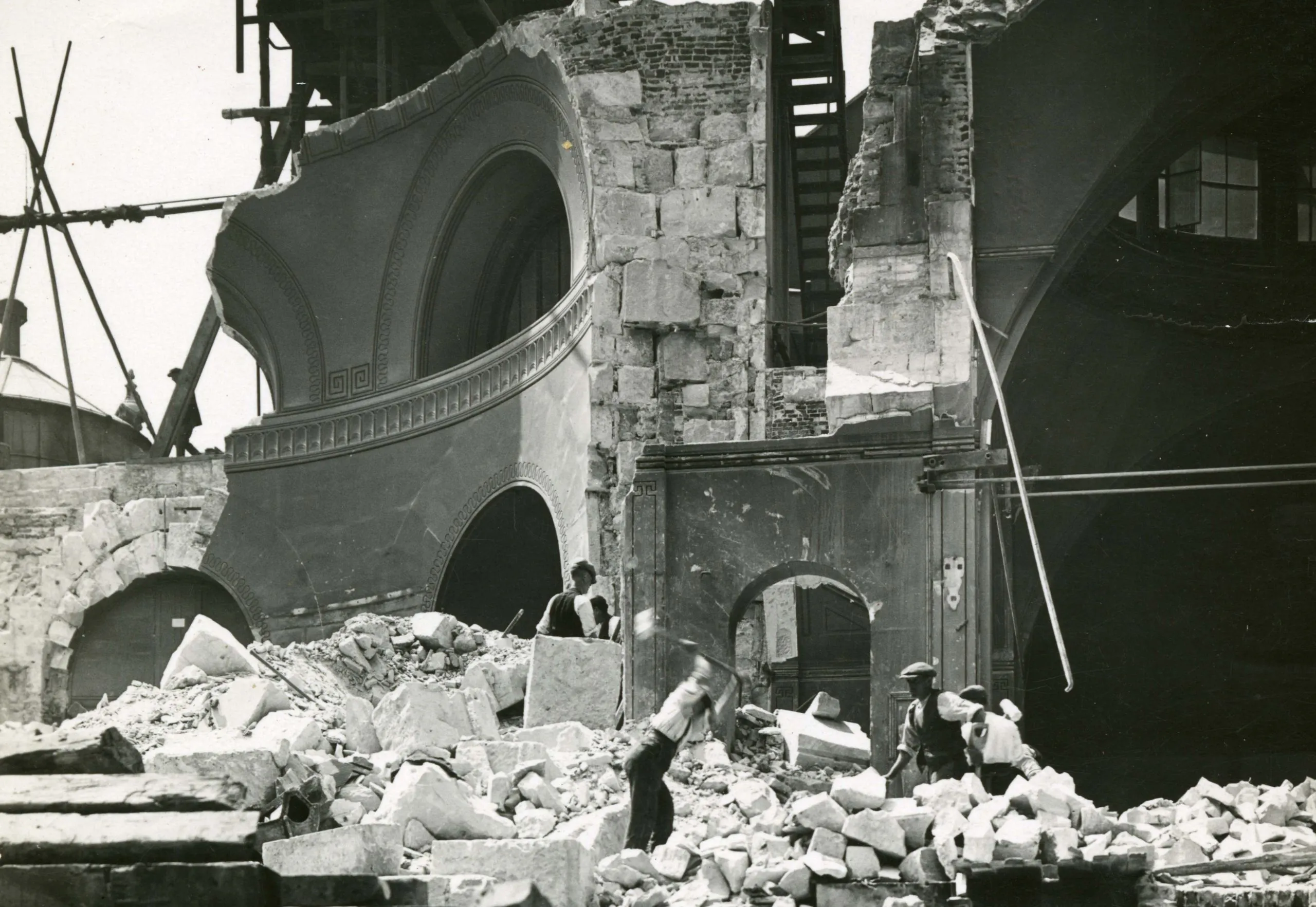
Demolition of the Rotunda, 1925. Photo: Bank of England Museum
Joseph Gandy’s famous 1830 imagining of the Bank of England in ruins, conceived as an Arcadian tableau bathed in golden light, could never have anticipated the actual destruction wrought a century later. Soane’s architecture was put to the sword, essentially in the interests of functional expediency, as the bank sought to house more staff in more modern working conditions. Some Soanian ‘paraphrasing’ is apparent in certain interiors, but the present bank is very much Baker’s work.
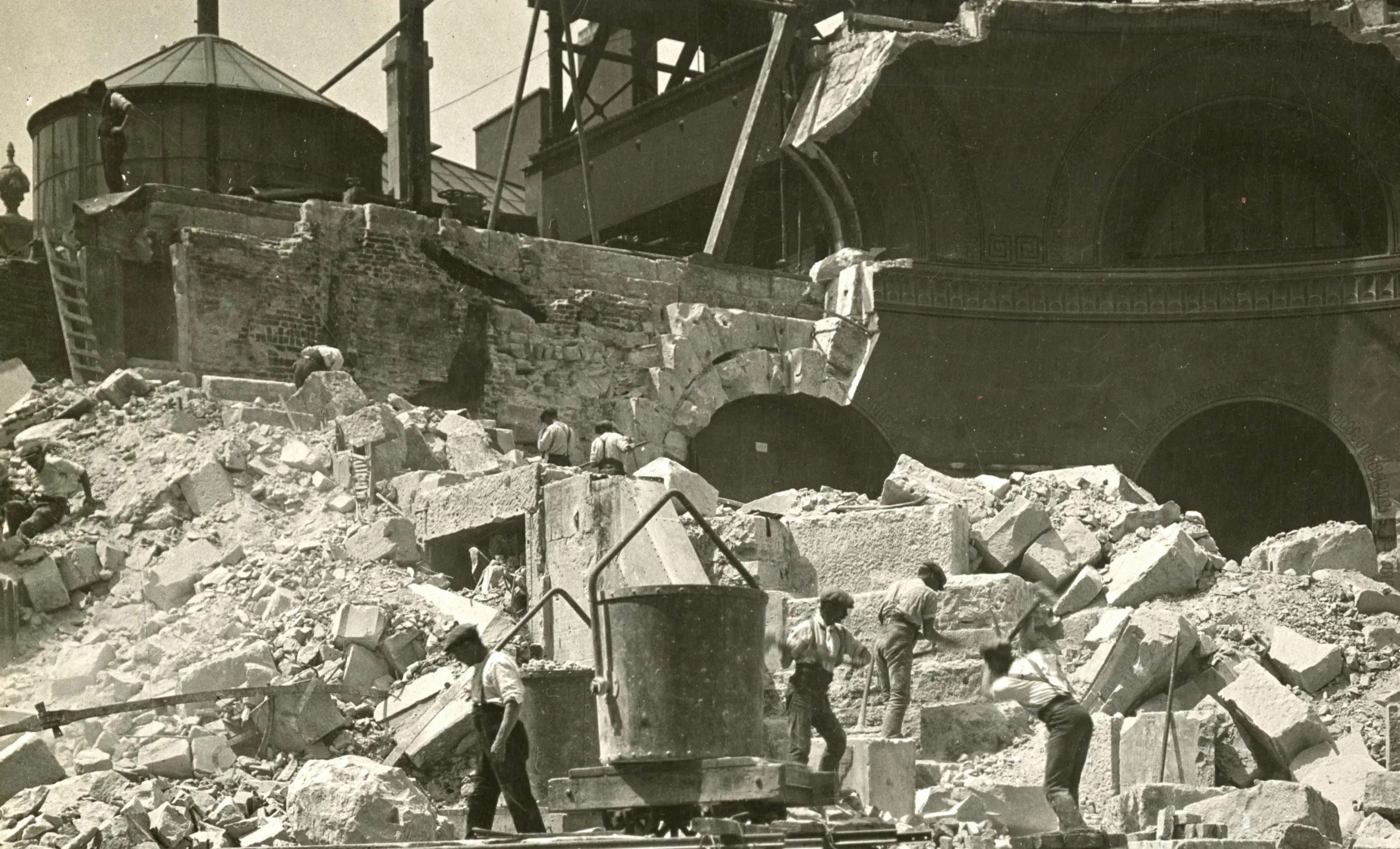
Demolition of the Rotunda, 1925. Photo: Bank of England Museum
An Edwardian mastodon who bestrode the interwar era, Baker appealed to the English institutional mindset, despite having never built a bank nor being familiar with the City of London. Prone to scooping up prestigious jobs, his career was initially impelled by the egregious imperialist and mining magnate Cecil Rhodes, whom he first met in 1892 on a visit to South Africa. For a time, Baker was South Africa’s pre-eminent architect, designing its seat of government in Pretoria, before going on to work with Edwin Lutyens in New Delhi.
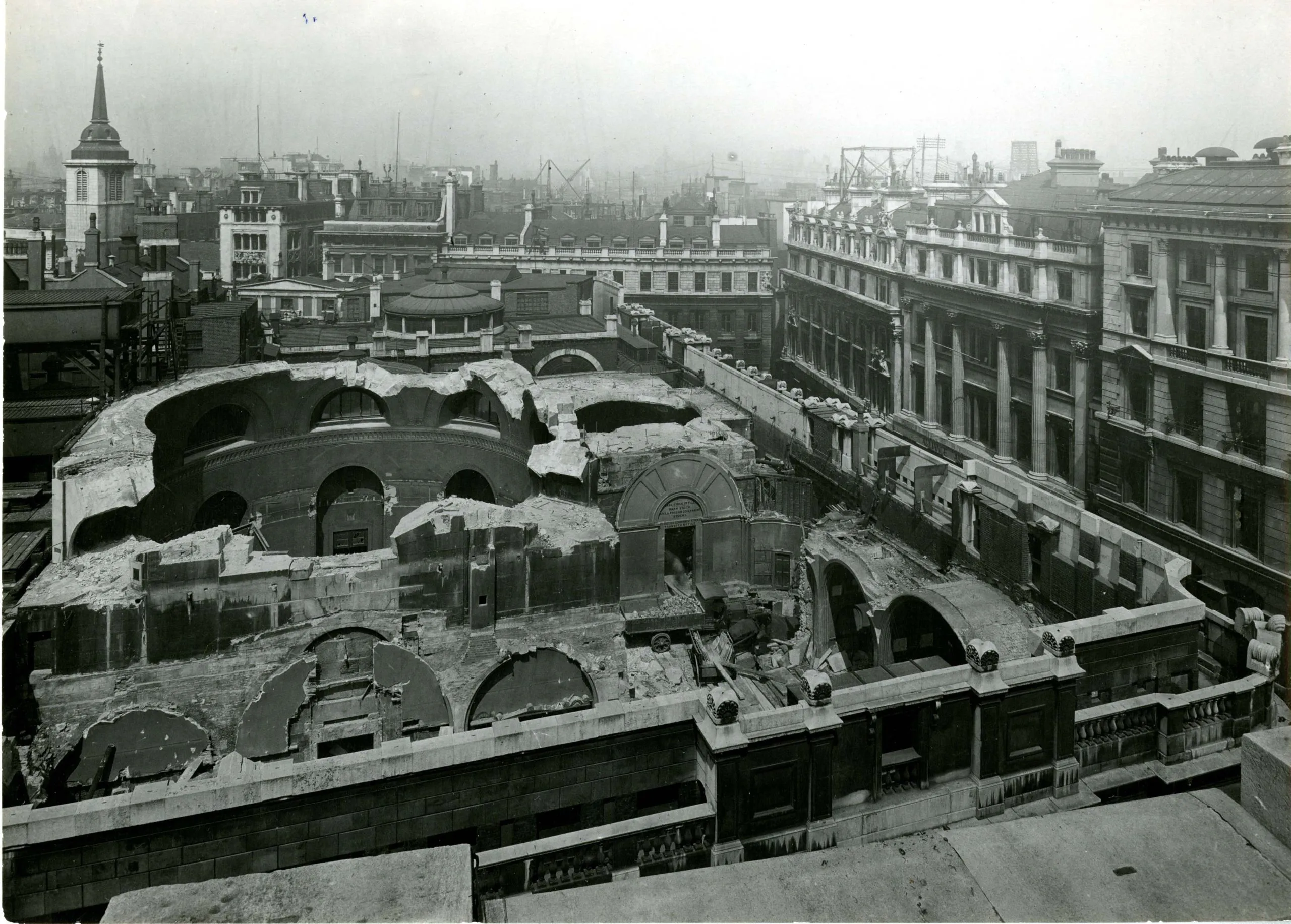
Demolition of John Soane’s Rotunda, 1920s. Photo: Bank of England Museum
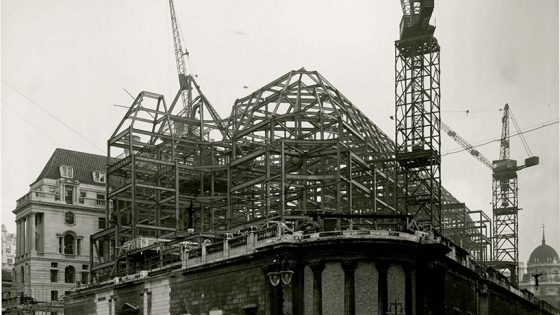
Charged with stamping imperial authority on the fiscal and physical world, Baker’s Bank is an architecture parlante of Brobdingnagian bombast. Construction photographs of the time show its steel frame squatting like a Cubist toad above the line of Soane’s screen wall, the only element to be retained – an early exercise in façadism.
With a focus on sculpture and decoration as much as architecture, the exhibition sees the bank through the prism of a gesamtkunstwerk, teasing out the flourishes and folderols that strive to enliven this most stolid of buildings.
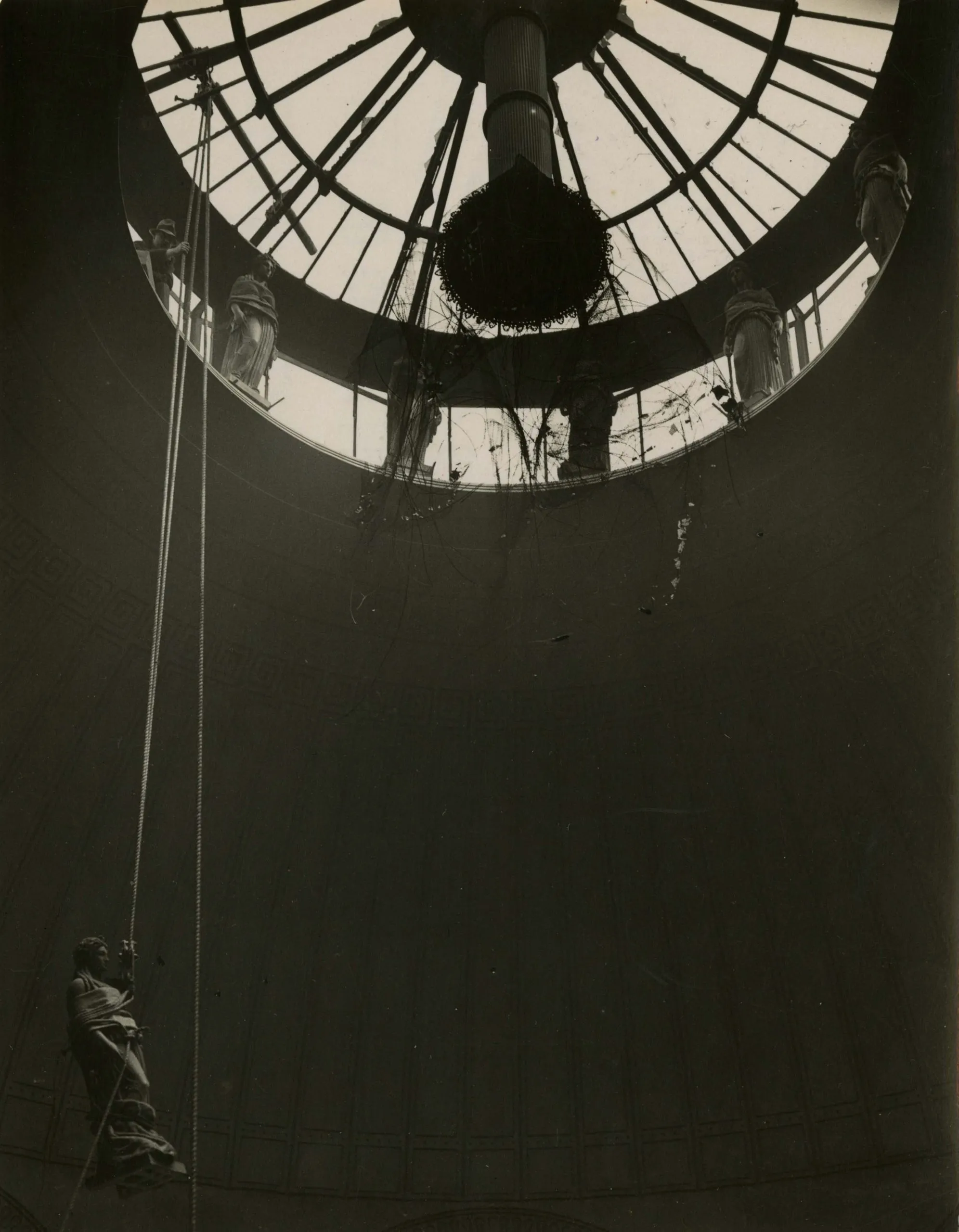
Caryatids being lowered from lantern window during demolition work. Photographed by Humphry & Vera Joel, 1920s. Photo: Bank of England Museum
But even the folderols feel somewhat leaden. Sculptor Charles Wheeler was responsible for the muscular telamons (male caryatids) lined up across the Threadneedle Street façade like a row of table footballers. Wheeler also designed the gilded sculpture of Aerial, which bears an irresistible resemblance to the gleaming mascot on the bonnet of a home counties Jag. It remains poised balletically on the dome at the junction of Lothbury and Princes Street, the so-called ‘Tivoli Corner’, derived from the Temple of Vesta at Tivoli, a particular favourite of Soane’s.
Mosaic floors on the theme of British monetary history were devised by Baker and Russian bohemian Boris Anrep, a mosaicist who lurked on the fringes of the Bloomsbury Group. These are richly delightful in their way, but as the exhibition recounts, it was not all plain sailing. Baker’s sketch of St George for a 1526 George Noble, a coin from the reign of Henry VIII, attracted opprobrium from one of the Bank’s directors who observed tartly that ‘George needs a shorter face … the hind legs of the horse are like a sheep … the dragon’s face is wrong’.
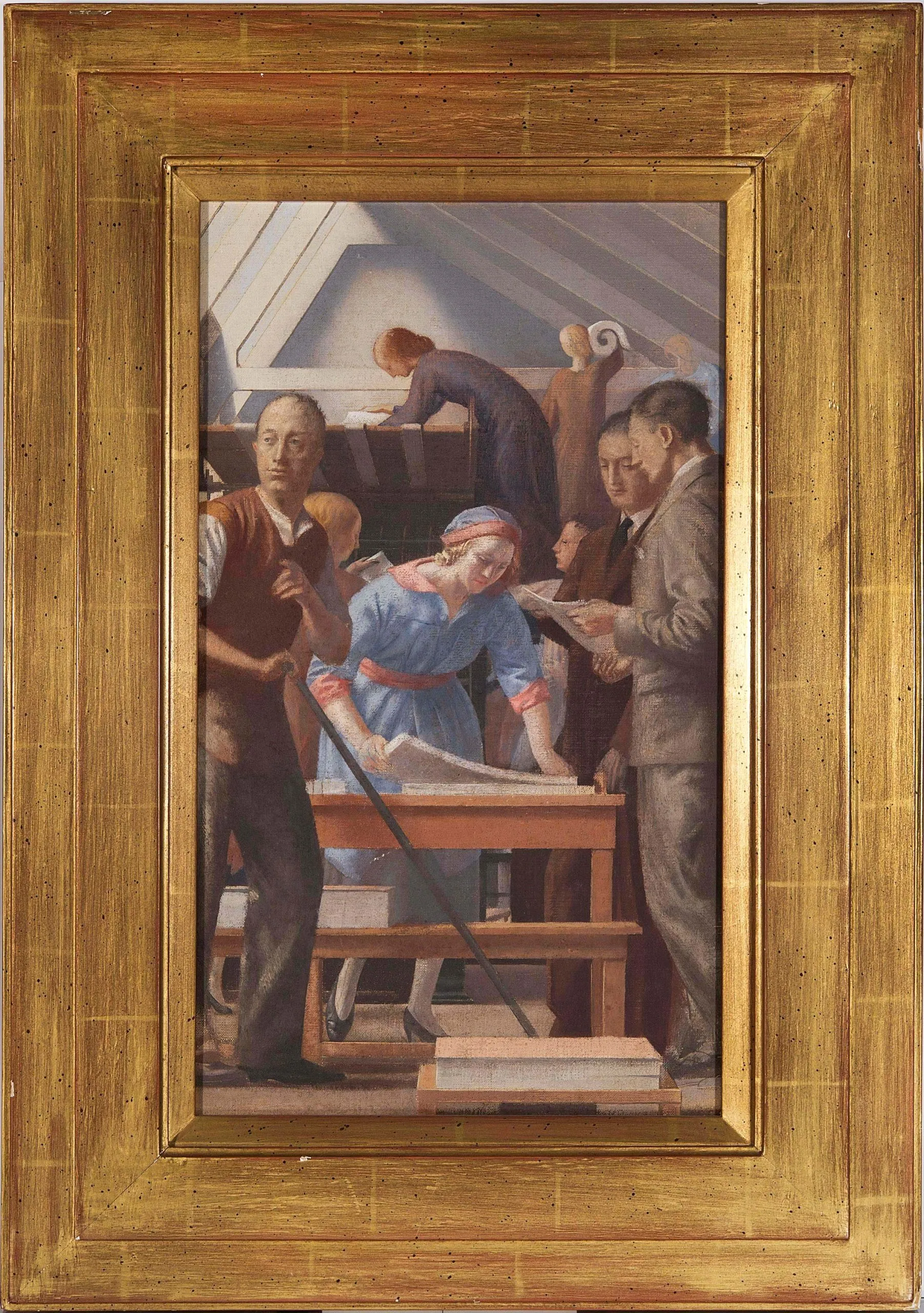
Study of the mural painting, St Luke’s Printing Works, by Thomas Monnington, 1930. Photo: Bank of England Museum
Exhumed from the rebuilding are an array of archaeological artefacts – a Roman comb, a Medusa head brooch, fragments of a Greek amphora – tangible reminders that the City is the most ancient, enigmatic and historically overlaid part of London, where corporate headquarters sit astride Roman temples. Also on display are a handful of Soane’s distinctive cylindrical bricks (imagine a Swiss roll in brick form) salvaged from the wreckage of his original rotunda.
Baker died in 1946 and is interred in Westminster Abbey, largely due to the lobbying of Charles Wheeler, who became president of the Royal Academy and the dean of Westminster. He considered Baker to be the ‘architect of the Commonwealth’. Now, for better or worse, he sits in the national pantheon.
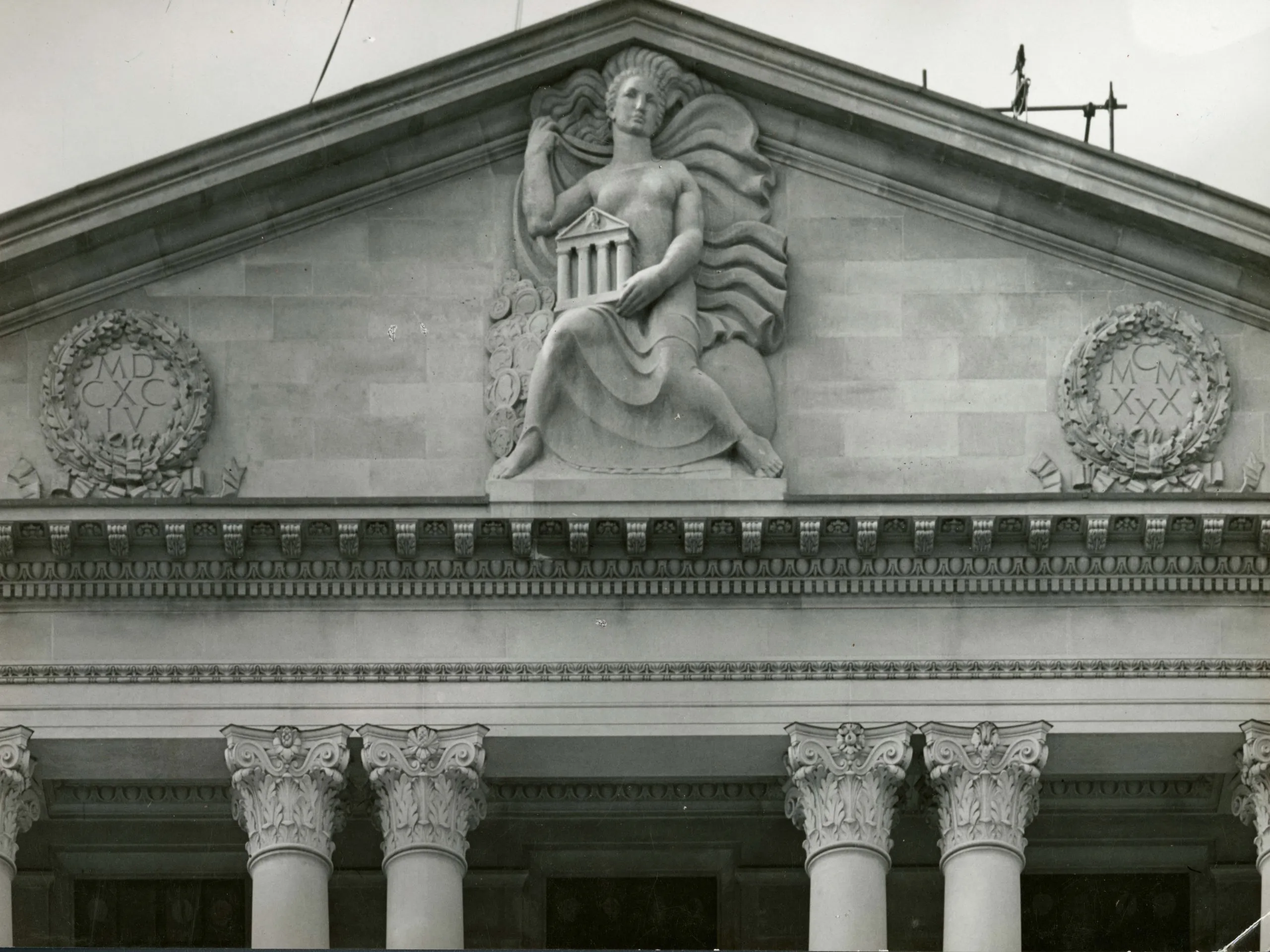
Charles Wheeler’s sculpture of Britannia on the Threadneedle Street pediment, c 1930. Photo: Bank of England Museum
Yet a century on, it is still excruciating to witness Soane in ruins, albeit evocatively captured in drawings, photographs and even an impromptu film of the rebuilding, featuring legions of construction workers in flat caps navigating vertiginous scaffolding and tottering piles of rubble.
An especially mesmerising image by the great architectural photographer Frank Yerbury shows one of Soane’s original Coade stone caryatids being lowered from the rotunda into a sepulchral void, to be swallowed up in darkness; in some ways, the perfect metaphor (if you were seeking it) for Baker and his Bank.
Building the Bank is at the Bank of England Museum, Bartholomew Lane, London, EC2R until spring 2027. Admission is free