
The extra funding—which will allow health boards to run more outpatient appointments and increase inpatient and day-case procedures in areas such as orthopaedics, dermatology, paediatrics and cardiology—takes the total additional support for tackling long waits to £135.5m this year.
Ministers have pledged to eliminate waits of more than a year for treatment by March.
“Under my leadership, the people of Scotland can expect a strong National Health Service delivering patient care of the highest possible quality,” Mr Swinney said during a visit to Glasgow’s Queen Elizabeth University Hospital.
“The latest figures show our plan to support Scotland’s NHS is working, delivering real benefits for patients. Not only are the total list size and longest waits coming down, but we are treating more people than last year.”
While the First Minister conceded there remained “work to be done”, he said there were “very welcome improvements” as pressures on the health service continue to ease from pandemic backlogs.
However, the announcement comes with waiting lists still at record levels. As of September 30, more than 56,000 people had waited more than a year for an outpatient appointment, while more than 29,000 were facing the same delays for inpatient or day-case procedures.
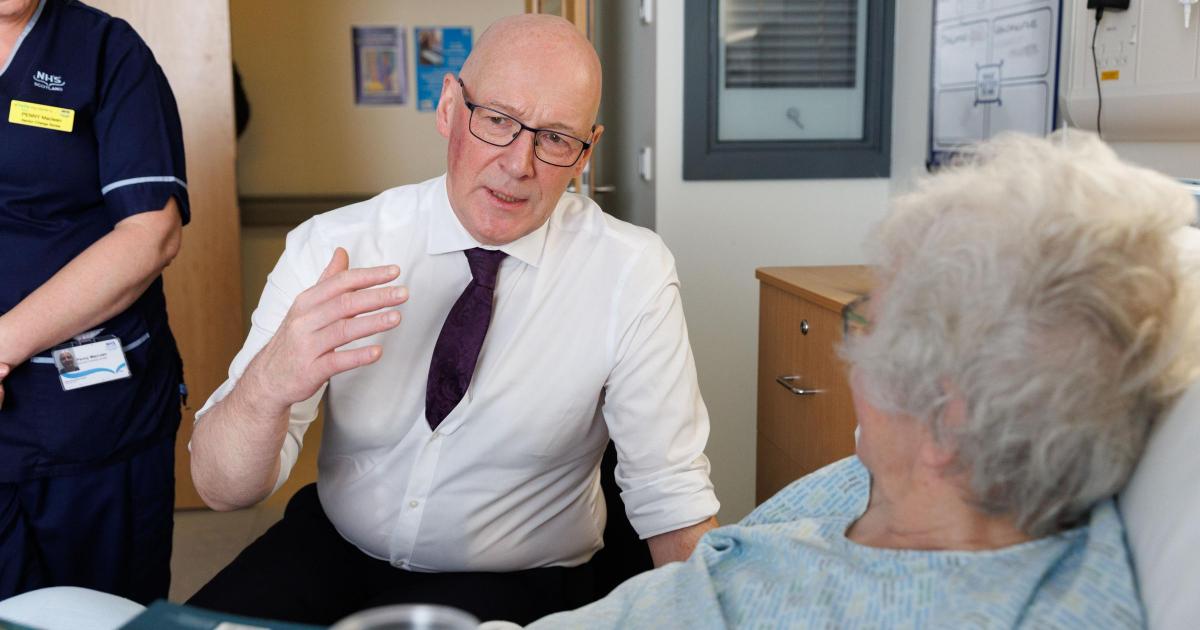
John Swinney meets patient Sandy Campbell during a visit to Queen Elizabeth University Hospital (Image: Robert Perry/Getty)
The Royal College of Surgeons of Edinburgh welcomed the funding but urged ministers to make greater and more consistent use of national treatment centres.
Professor Rowan Parks, the college’s president, said waits remain a “major issue”, with “approximately one in nine of the Scottish population” currently on some form of NHS waiting list.
“In the long term there needs to be redesign and renewal of the way in which services are delivered,” Prof Parks said, adding that national treatment centres could help tackle “high-volume, lower-complexity” procedures more efficiently.
Five national treatment centres are currently operating, but further planned sites were paused by the government last year due to financial pressures. Prof Parks said he would “love” to see those plans restarted.
Opposition parties said the new money was too little to address what they described as a sustained failure in the management of Scotland’s health service.
Scottish Conservative health spokesperson Dr Sandesh Gulhane said the funding was “a drop in the ocean when our health service is in permanent crisis mode”.
“Frontline staff are at breaking point and thousands of Scots are waiting over two years for treatment,” he said. “Instead of tinkering round the edges, John Swinney needs to back our plans to cut red tape, reduce the number of middle managers and surge resources to the frontline.”
Scottish Labour also increased pressure on the government after it emerged a Queen’s Park footballer endured a 10-hour wait for an ambulance after suffering a serious knee injury during Saturday’s Championship match against Partick Thistle.
Defender Charlie Fox collapsed in agony 24 minutes into the game.
Medics treated him on the pitch and stretchered him off, but the ambulance reportedly did not arrive until 1am.
The club confirmed he has since been discharged from hospital.
“This is the second footballer left waiting for an ambulance in recent months,” said Scottish Labour health spokesperson Jackie Baillie. “It is absolutely clear this SNP government is failing the people of Scotland. John Swinney must come clean and explain why people are still being forced to wait in agony.”
In September, the First Minister apologised to 19-year-old player Brooke Paterson, who waited for five hours on the pitch with a double leg break in North Lanarkshire.
The debate comes after former health secretary Jeane Freeman said the current state of the NHS was the result of failures by successive governments—including her own.
Speaking to BBC Scotland’s The Sunday Show, Ms Freeman said ministers had too often prioritised electoral politics over long-term planning and had not listened enough to frontline workers.
“Successive governments—my own included—do not take a long-term, beyond-the-electoral-cycle view of our health service,” she said. “They do not take a view that says some of the people who best know what we need to do are actually our clinical and frontline teams.”
She argued that improving the NHS required “widespread” input from staff at every level, from housekeeping and maintenance to consultants, doctors, nurses and physiotherapists.
Jeane Freeman said government’s had failed to properly tackle NHS reform
The Scottish Government has made reducing NHS waits a central priority of its programme for government. Mr Swinney pledged to improve access to GPs earlier this year but also warned there was no “shortcut” to faster diagnosis and treatment.
The health service continues to work through the legacy of the pandemic, during which elective care was largely halted. Rising demand linked to Scotland’s ageing population, persistent staffing shortages and ongoing financial pressures have compounded the challenge.
Recently, the Scottish Social Attitudes Survey reported that almost 70% of Scots believe NHS performance is worsening.