

This is a perilous time for the BBC, its director general and head of news forced to resign in the midst of an explosive row about a lack of news impartiality that has even drawn in the White House. Some at the corporation may want to lay the blame wholly at the door of dark forces running an organised campaign to bring the BBC down. But the BBC is also very much a co-author of this story, and it is only by properly confronting evidence of its serious failures that it can successfully take on its critics.
The BBC is funded by the public, for the public. The first of five missions set out by its charter is the provision of accurate and impartial news, current affairs and factual programming that offers analysis and content not widely available elsewhere.
That mission is critical in the context of an increasingly polarised online world beset with misinformation. But a leaked 19-page memo by a former independent adviser to the BBC’s editorial standards committee sets out grave allegations of failures of impartiality, in relation to reporting on President Trump, the Gaza conflict, and on sex and gender.
• BBC to apologise for doctoring Trump speech
As a journalist who has closely followed the coverage of this last area it is clear to me that the memo is right to raise it as evidence that BBC News is not always impartial.
Gender ideology is the minority unscientific belief system that men should be able to self-identify their way into female-only spaces and sports, that men can be lesbians, and that gender-questioning children should be put on affirmative medical pathways that can include taking hormones to block healthy development. It is highly controversial because of the risks it poses to women and children.
But the BBC’s coverage of gender ideology too often takes as fact the quasi-religious belief everyone has a gendered soul called a “gender identity” and that to dissent is bigoted.
• BBC accused of suppressing negative transgender stories
This has led the BBC to ignore altogether important national stories about children’s healthcare, such as the young people who have detransitioned after irreversible hormone treatment. Other stories are grossly one-sided: for example, congratulatory tales of male athletes self-identifying into women’s competitions that don’t include any voices on legal issues raised, or mention the risks to fairness and safety in women’s sport.
Decisions of the BBC’s editorial complaints unit appear racked with bias. It has dismissed complaints from the public about the corporation obscuring the fact that male killers who identify as female are male, by referring to them as women and using female pronouns for them: partisan and misleading language.
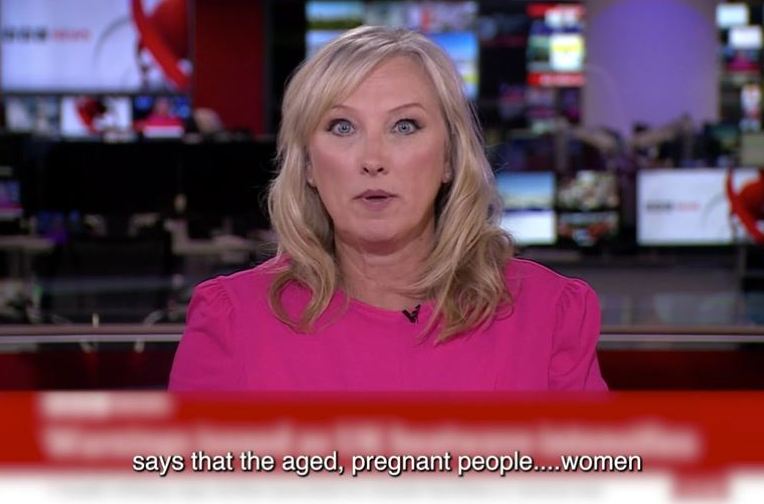
But it found the presenters Justin Webb and Martine Croxall had broken impartiality guidelines, the former for clarifying that trans women are male, a critical fact to help listeners understand the story, and the latter for a facial expression it claimed gave the impression of personal opinion, as she corrected the ideological “pregnant people” in her script to the more neutral “pregnant women”.
BBC executives might argue this is just one issue, that feminist supporters of public service broadcasting like me should drop our obsession and rally behind a Beeb under bad-faith fire. This is to spectacularly miss the point.
There is an intellectually respectable argument against public service broadcasting that I do not support, and impartiality is key to countering it. If the publicly funded BBC proves as easily captured by partisan ideology as the next institution, the argument for it disintegrates.
It was right that Tim Davie and Deborah Turness stepped down, given their failure to grip the issue on impartiality. But their resignations are not in themselves a fix. Reading the BBC’s own news reports, you would be forgiven for thinking these scalps were claimed as a result of just one egregious error: the editing together of two parts of a Trump speech for a Panorama documentary in a way that made him appear to explicitly encourage the 2021 Capitol Hill riots.
As she resigned Turness asserted “recent allegations that BBC News is institutionally biased are wrong.” This complacency is misplaced: the BBC’s output bias on a contested subject like sex and gender is not just the product of “mistakes” as she claimed, but of cultural and institutional capture. The BBC needs new leadership that toughens up its impartiality guidelines and makes clear that there is no place at the corporation for staff who try to undermine them, and therefore public trust in the whole BBC.
In assuming a bit part in the culture wars instead of rising above them, the BBC is risking its own demise. It is solely by ruthlessly examining what governance and editorial failures made it so vulnerable to unrepresentative groupthink that it can defeat its critics. Only the BBC can save itself.