
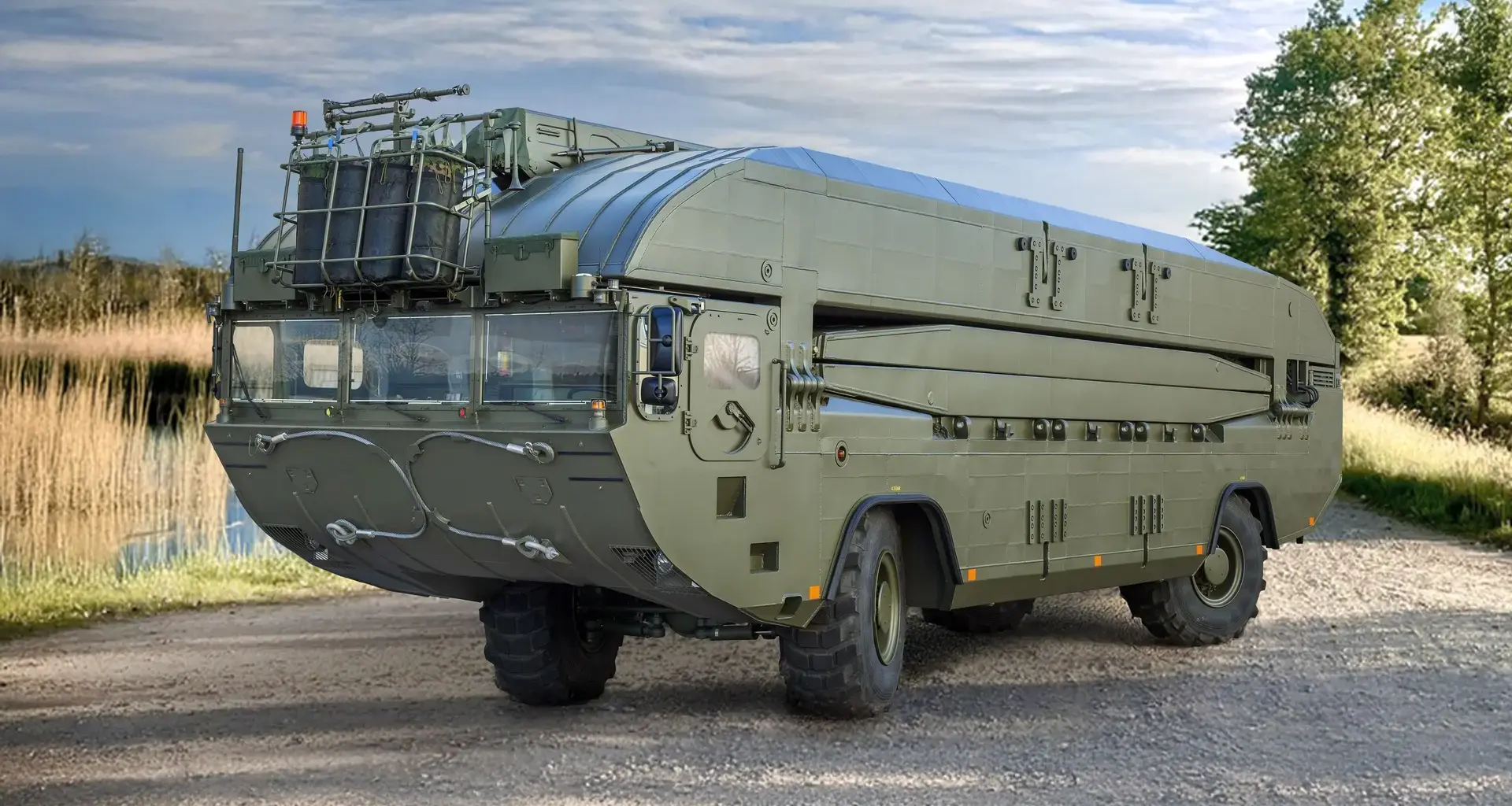
The United Kingdom and Germany have signed a joint €450 million contract to acquire the latest generation of M3 amphibious bridging and ferry systems from General Dynamics European Land Systems (GDELS).
The deal was arranged through the Organisation for Joint Armament Cooperation (OCCAR).
The “Wide Wet Gap Crossing Programme” will replace equipment first introduced in the late 1990s and expand NATO’s capacity to deploy and manoeuvre heavy vehicles across rivers and other obstacles in both combat and disaster relief operations.
The upgraded systems, based on the latest M3S model developed for Sweden, will feature enhanced reliability, improved safety, and a modernised human-machine interface. They will also be fully interoperable with existing NATO bridging systems, including the SRB, FSB and IRB pontoon bridge families.
According to GDELS, the M3 remains the fastest amphibious bridging system in NATO service and can be deployed within minutes to transport main battle tanks and other heavy vehicles across wide rivers. The company said the new configuration offers greater flexibility and reduced through-life support costs, while enabling full interchangeability between the UK and German fleets.
Dr Thomas Kauffmann, Vice President and Chief Sales Officer of GDELS, said “the new M3 will provide Germany and the UK with state-of-the-art floating-bridge capabilities enabling unhindered manoeuvrability for all NATO vehicles.”
Dr Christian Kauth, Vice President and Managing Director of GDELS Bridge Systems, added that production at the firm’s Kaiserslautern site is being expanded to meet growing demand. “We are proud to continue delivering the M3 from Kaiserslautern, where we are investing heavily in new production capabilities,” he said.
The M3 system has been used extensively across NATO for decades and is capable of operating in a range of conditions, from arctic to tropical environments.