

Orthopaedic Product Market Overview
Orthopaedics is the branch of medicine focused on the MSK system
(the bones, joints, ligaments, tendons and muscles) and addresses
conditions ranging from fractures and arthritis to spinal
deformities and sports injuries. Orthopaedic products refer to the
devices that restore stability, alignment and function of the MSK
system. These can include: joint replacement implants, plates and
screws for trauma fixation, spinal cages and rods, arthroscopy
tools, orthobiologics, braces, and custom orthotics.
Once a narrow surgical-device niche, the orthopaedic products
sector has evolved into a global, technological market, which is
driven by an ageing population with higher chronic joint disease
and innovation with breakthroughs in materials, robotics, 3D
printing and patient-specific design.
The orthopaedics market can be broken down into sub-sectors as
shown in Figure 1, with each of the segments defined below:
Arthroplasty – a dominant subsector
involving procedures for the replacement or remodelling of damaged
joints to restore function or reduce pain.
Spine – focuses on the diagnosis,
treatment, and prevention of disorders and structural abnormalities
affecting the spine, including deformities, traumatic injuries, and
degenerative conditions.
Trauma – the treatment and surgical
management of severe injuries to the MSK system arising from
accidents, high-impact events, or other acute physical trauma.
Sports Medicine – the treatment of MSK
structures affected by sports or training.
Orthobiologics – the development of
treatments made from biological substances that can promote faster
healing, a key example of this being regenerative tissue
treatment.
Other – includes enabling technology or
digital orthopaedics that provide pre-op and intra-op guidance,
through personalised, simulation-driven treatment planned in
conjunction with artificial intelligence and the bespoke 3D
printing of implants.
Figure 1 – Current Global Orthopaedic Product
Sector Breakdown1

Source:
1. Mike Evers,
“State of the Orthopedic Industry” Bonezone,
May 30, 2025.
Orthopaedic Products Market Growth
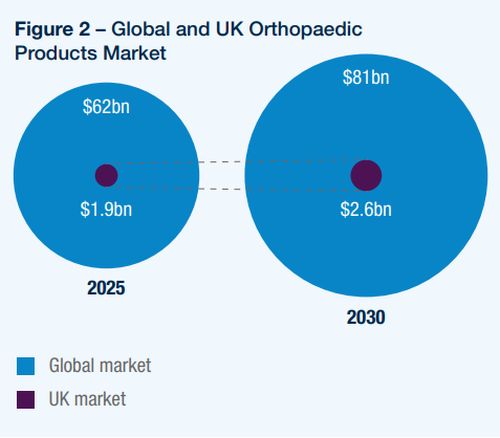
The orthopaedics market is substantial, valued at $62
billion globally and projected to grow to $80.8 billion by 2030, at
a 4.3% CAGR.1 The UK market is anticipated to grow faster than the
global market, currently estimated at $1.9 billion and growing to
$2.6 billion by 2030, a 6.5% CAGR as illustrated by Figure
2.2
Market growth is driven primarily by two factors:
Aging and obesity: An ageing population and
rising obesity rates are fuelling the demand for joint
replacements. By 2030, over 20% of the UK population will be 65 or
older,3 and obesity is expected to affect 36% of men and
33% of women.4
Key areas to watch include:
Robotics: Surgical robotics are supporting enhanced surgical
precision and have been conditionally approved by the National
Institute for Health and Care Excellence (NICE). Eleven
robot-assisted surgical systems are listed, including six for
orthopaedics, marking a path toward wider clinical
adoption.5
3D Printing: Advances in additive manufacturing enable
patient-specific implants designed to support better anatomical fit
and individualised motion. For example, the Paragon
28 3D-printed porous ankle implants are developed to mimic
natural movement and enhance mobility.6
Orthobiologics: These innovations are driving the development
of treatments that support faster healing, reduce the extent of
invasive surgery, and advance regenerative treatment options. For
example, the CartiHeal cartilage-regeneration implant (acquired by
Smith & Nephew in early 2024) is designed to
attract stem cells and support new tissue growth.7
Product digitalisation: Smart, tech-enabled tools are improving
surgical precision by providing real-time assistance.
Eventum Orthopaedic’s QuadSense surgical
device provides real-time data on joint force, helping surgeons
optimise their procedures.
In the UK, there is a substantial backlog for orthopaedic care:
the NHS waiting list in England for orthopaedic surgery totals
around 858,000 people, of whom only 58.9%8 have been
waiting less than 18 weeks (versus the 92% target).9
This backlog has fuelled record levels of private healthcare
admissions as patients seek faster treatment. Meanwhile,
innovations in MIS are enabling more complex procedures to be
performed in ambulatory centres, improving outcomes, freeing up
capacity, and boosting demand for advanced devices.
Technological advancement: Rapid advances in
orthopaedic technology are improving patient outcomes and
experiences, expanding patient eligibility and encouraging greater
adoption of surgical interventions.
Sources:
1.
“Orthopedic Devices Market (2024-2030)”, Grand View
Research, October 10, 2025.
2.
“Orthopedic Devices – United Kingdom”,
Statista, October 9, 2025.
3. Age UK,
Later life in the United Kingdom (Age UK, 2019) 3.
4. James Meikle, “WHO report: 74% of men and 64% of
women in UK to be overweight by 2030” The Guardian, May 6,
2015.
5. NICE,
“Cutting-edge robotic surgery gets greenlight as 11 systems
are recommended” National Institute for Health and Care
Excellence, April 17, 2025
6.
“Paragon 28 announces FDA clears APEX 3D system”,
July 15, 2020.
7.
“Smith+Nephew swoops in with $330M offer for CartiHeal after
Bioventus bows out”, Fierce Biotech, November 22,
2024.
8. Debbie Moon,
“NHS referral to treatment (RTT) waiting times data July
2025”, (NHS England 2025), 7.
9. Moon, “NHS referral to treatment (RTT) waiting
times data July 2025”, 8.
Orthopaedic Products M&A Summary
High-growth segments of the orthopaedics market,
particularly those leading in technological innovation, continue to
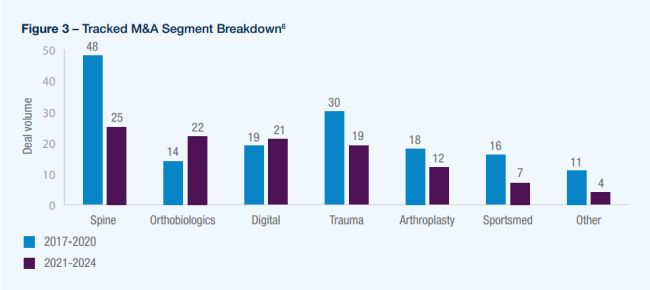
be most attractive in terms of M&A. Historically, spine-focused
companies have dominated, but over the past four years
orthobiologics and digital orthopaedics have considerably narrowed
the gap (see Figure 3).
This focused M&A activity reflects the strategic priorities
of major original equipment manufacturers (OEMs) – including
Zimmer Biomet, Stryker, DePuy Synthes, Smith+Nephew and
Medtronic – which are increasingly focussing on
acquiring high-growth, technology-driven assets to build and lead
specialised sub-sector platforms offering end-to-end services
through the care continuum. For example, Medtronic
is focused on dominating the spine vertical.
Considering these dynamics, and the sustained demand for
highquality manufacturing assets that improve patient outcomes, the
following UK and Ireland-based businesses stand out as companies to
watch in the space:
Blatchford (backed by CBPE Capital) – A
leading provider of prosthetics, custom-made braces, and
rehabilitation services to the NHS. Operating as a scaled O&P
original equipment manufacturer (OEM) and service provider,
Blatchford announced a £15m investment in a new centre of
excellence for operations in May 2025.1
Corin Group – An orthopaedic implant OEM
specialising in hip, knee, and shoulder reconstruction systems. Its
flagship innovation, ApolloKnee, a robotic platform focused on
efficient bone resection,2 positions Corin as an
attractive acquisition for buyers seeking portfolio depth or PE
platform opportunities.
Croom Precision Medical (backed by BGF)
– An orthopaedic CDMO partnering with both established and
emerging companies in the sector to drive innovation and
manufacturing efficiency,3 making it a notable company
to watch.
4D Medicine – A developer of a
resorbable biomaterial for orthopaedic implants. The company
recently raised £3.4 million in funding to advance product
development.4
Eventum Orthopaedics – Targeting the
400,000 people dissatisfied with knee replacements, the company
recently raised £3.8 million in further funding (led by
Mercia Ventures) to support its QuadSense product launch in UK, US,
and New Zealand and invest in new product lines.5
Source:
1.
“Blatchford invests £15m in new Basingstoke operations
centre” May 9, 2025.
2.
“Corin Announces Worldwide Launch of ApolloKnee” June
27, 2024.
3.
“State-backed BGF invests in Croom Precision Medical”
October 7 ,2020.
4.
“4D Medicine raises £3.4m for biomaterial platform,
July 26, 2024.
5.
“Eventum Orthopaedics secures £3.8M to improve knee
replacement surgery success” March 18,2025.
6. Mike Evers
Takeaways from the 2025 Orthopaedic Industry Annual Report
(BoneZone, 2025)
To read this article in full, please click
here.
Originally published 31 October 2025.
The content of this article is intended to provide a general
guide to the subject matter. Specialist advice should be sought
about your specific circumstances.