
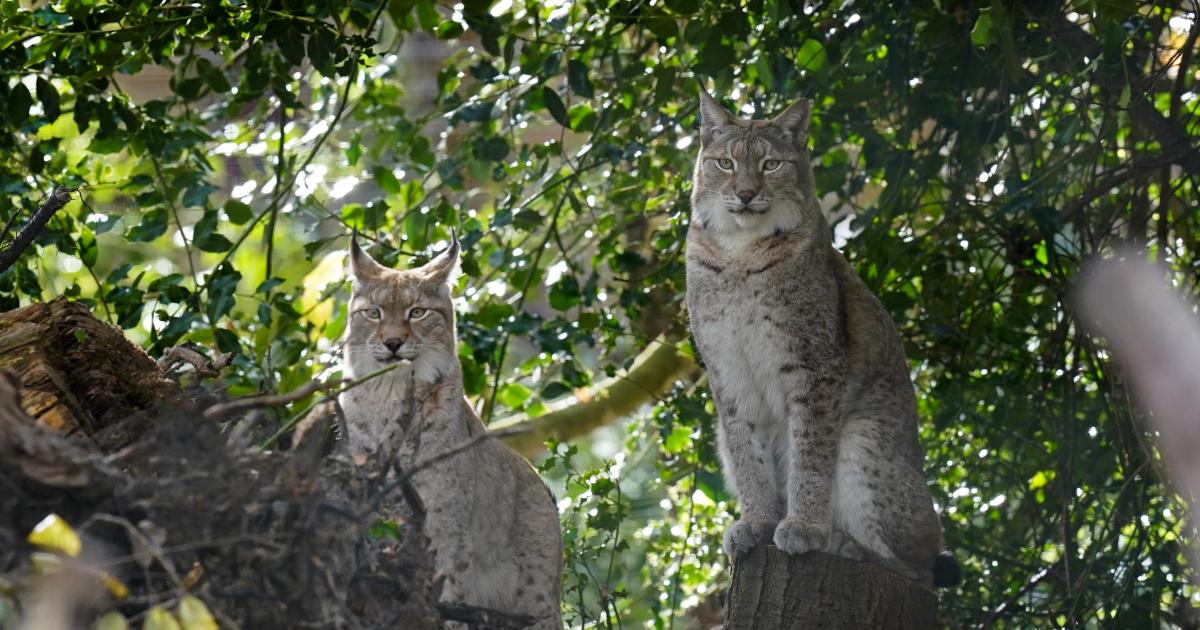
The Missing Lynx Project is exploring whether the wild cat could make a comeback in the UK after a new enclosure was unveiled in Kent in October.
Eurasian Lynx were a British predator in antiquity but the population died out in medieval times due to loss of woodland.
Eurasian Lynxes Flossie and Torridon explore their new state-of-the-art lynx enclosure at the Wildwood Trust near Canterbury in Kent (Image: Gareth Fuller)
The Missing Lynx Project, led by the Lifescape Project Partnership, is touring an exhibition about the once native species to start a conversation about its reduction.
Research by ecologists involved in the project has revealed that “if lynx were to be released in Northumberland, they could grow into a healthy population covering north-west Northumberland, the edge of Cumbria and the bordering areas of southern Scotland.”
The study found that Kielder Forest would be a viable location for the release of 20 lynx over several years.
If ecologists can secure a license for the reintroduction of lynx in Northumberland, wildcats could roam into the Scottish borders and parts of Cumbria in the proceeding five years.
Flossie, Eurasian Lynx explorin her new state-of-the-art lynx enclosure. (Image: Gareth Fuller)
A map supplied by the Missing Lynx Project appears to show that the habitat of potentially reintroduced lynx would extend into the outskirts of Carlisle.
Cumbria, Scotland and Northumberland are the only regions with enough woodland to accommodate a lynx population.
A habitat map showing where the Eurasian lynx could roam. (Image: Supplied)
Doctor Deborah Brady, lead ecologist at The Lifescape Project said: “We’ve done an in-depth consultation and it shows local people broadly accept the idea – and we also know that lynx could thrive in the area.”
A year-long consultation, which included a visit to the University of Cumbria Campus in Carlisle, found that 72 per cent of people in the project area would support the potential reintroduction of the lynx.
Dr Brady said: “We’ll continue to discuss it with local people to consider how a reintroduction project could work to maximise benefits and reduce risks. We hope to apply for a licence but only once we have a plan that’s designed together with local people which sets out measures that are feasible and can actually work.”
Eurasian Lynx are described as a medium-sized cat which eat deer and some carnivores such as foxes.