
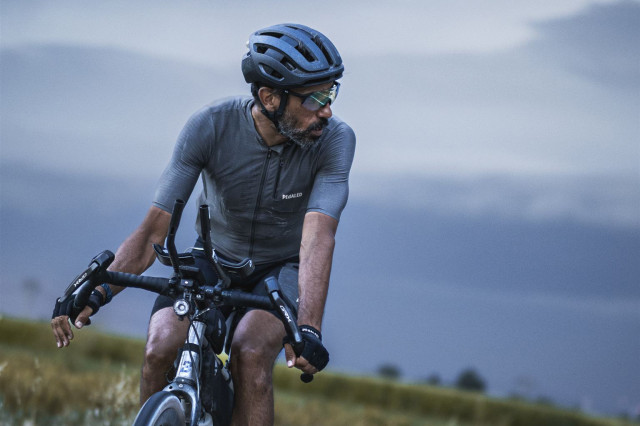
[Images provided by Edoardo Frezet]
French ultra cycling supremo Sofiane Sehili has made mainstream news headlines around the world in the past weeks. This followed his attempted illegal border crossing from China into Russia on the final leg of his trans-Eurasia record attempt, which landed him in a Russian jail for almost two months.
After a couple of epic months of riding eastwards from Portugal, he was within 200 kilometres of his finish line in Vladivostok, and on course to break the record. Unfortunately, there was a tense international border crossing in the way. Despite having an electronic visa for Russia, he was informed by Chinese border authorities that he would not be able to cross using it. There was also an obligatory public transport transfer to the border, which would have voided the record had he even been able to cross legally.
After trying other feasible options to stay on track, Sofiane decided to at least try and cross illegally, hoping for a favourable outcome if things went wrong. As we all know, things went a little sideways after that, to say the least. We caught up with him to learn more.
ORCC: You had border issues earlier in the ride and seemed to lose hope of breaking the record through these at times. Were there times you thought of quitting?
Sofiane Sehili: The moment that I actually quit and gave up, and said there’s not going to be a record, it was just the moment where I surrendered to Russian authorities.
I was ready to quit after spending five to six hours hiking in the woods to get to Russia. This was exhausting, and I was aware it was very dangerous and stupid. Unfortunately, when I was ready to quit, it was too late to get back to China; I’d already hiked for five to six hours and was not willing to go back into the forest and do it again in the dark, and I had to find a solution and a way to give up.
The option I went for was to just surrender to the authorities, which was probably ill-advised, when you look at what happened. It would have been a much better option to go back to China straight away, even if it was dark and meant hiking with a headlight through a dense forest. That would have been much better than spending 51 days in a Russian prison. But, at the time I surrendered, I had no idea things would turn that bad.
ORCC: What state of mind were you in at the time?
SS: I think I was just not willing to believe that this was the way it would end, and was not willing to accept that I was going to fail. I waited a couple of hours between the time I realised I was not going to cross the border legally and deciding to try and cross illegally, because obviously I knew doing such a thing in Russia was potentially dangerous, and potentially going to end in a bad way.

I sat down in front of a shop; it was quite a warm day, and I was rehydrating with an iced tea. I posted an Instagram story saying that I had no solution, so it was the end, and that I wouldn’t be able to get to Vladivostok on time. I was getting a few messages saying I couldn’t give up, that there had to be a way and a solution. I knew there was still time to find a solution, but even though I’d posted that first, I wasn’t willing to believe it was over. I still wanted to believe there was going to be a solution at some point, so I wasn’t desperate that it was over; I still believed there was a solution.
As long as there was time, there was hope. In my head, I was just trying to find a legal solution, and in the back of my mind was still the possibility of crossing illegally – but I thought that was not going to work.
ORCC: Were there not barbed wire fences and armed border guards around? How did you know what lay between where you were and Russia?
SS: I had no idea what I was going to run into. I honestly thought at some point the Chinese would stop me; it was my fourth time riding in China, and it’s a very controlled place, and riding a bike there or just being on the road in a sensitive area means that you’re going to get stopped and turned back by police or military. That’s what I thought would happen, then I’d just go back to town and say okay.
But what happened was that I started riding south, and there was this fence between the road and the forest. I thought, okay, this makes sense, it’s a border. But at some point, there was no fence, just an alleyway and a building, and then the forest, so I started hiking in the forest.
After a few hours, there was a barbed wire fence, but there was a stream, and it was really easy to just go under it. Right after that was an open area for about 100 meters, which I guess is the actual border. As I was following the stream, I was at the lowest point in the area. There was a hill with a military tent on top, and I figured that was where they would spot me and ask what I was doing there. I was going to tell them I got lost, and thought they’d send me back to China.
For some reason, they didn’t spot me, unfortunately, and the next day I went back to this point with the Russian military, and a Chinese soldier came out of the tent and kicked us out. They should have spotted me, but as they didn’t, I was free to keep going until I reached the train track on the Russian side.
ORCC: Did the authorities understand why you had done it, or were they even interested?
SS: No, because to be honest, I wasn’t truthful when I first showed up there. If I’d told them that I crossed on purpose (I figured), they’d get pissed off, and if I told them I got lost in Russian territory by accident that they’d just buy it and wouldn’t look further than this.
That was where I was naive; they seized all of my electronics, looked at my GPS and GoPro, and as I’d documented my whole record attempt on it, including crossing the border illegally, they looked at this, and I realised I couldn’t keep lying to them.
The next day, I was interrogated again, and understood that they’d figured it all out and so I told them the truth. They told me it was better that I tell the whole truth. I don’t know if that’s true or not. In the end, I was only sentenced to a fine, so it was probably better to tell the truth; maybe I wasn’t sentenced to prison because I’d been truthful, not right off the bat, but just 24 hours after that.
ORCC: From then on, did you have any contact with the outside world, and how did people get to know you were in trouble?
SS: Just letters; I could give letters to my lawyer, who could also give me letters, so I wrote pretty much every day. At best, I would see my lawyer once a week and give her my letters, and she would give me letters from Fanny (my partner).
ORCC: What was the jail situation like?
SS: It’s only the country I’ve been incarcerated in, but I can tell you it does not look like the prisons you see in American movies and TV shows. It’s a big building in the city, quite old, everything looks like it’s been broken and fixed several times, not a nice place for sure.
But it’s decent – every cell had a TV and fridge. We had about four square meters per inmate, so two-person cells had around eight square meters, then there were four, six, eight, and 10-person cells.

We showered once a week. It wasn’t a pleasant place and was very old, but every cell had a window, which is important. I’m guessing it’s not the best prison, but definitely not the worst.
ORCC: Were there communal areas and outside exercise breaks?
SS: No, not at all. We were 24-hours a day in the cell. The only time we were allowed out was for the weekly shower, to see your lawyer, or to go to court; there was no communal area, and all of the meals were served in the cell.
What I really missed was not being able to go outside and walk. For 50 days, we were not allowed outside, just seeing the sky and feeling the sun; I missed that.
ORCC: Looking back, what’s your self-assessment of what happened?
SS: I obviously regret crossing this border illegally, but I don’t think that, given my state of mind at the time, I’d have been able to make a different decision.
I’m just happy this is over, and I know a lot of people were worried that there was going to be a before and after me, that this would change me in a way. It’s only been a couple of weeks, but I feel like I’m fine and that there’s no trauma linked to the 51 days in prison. I don’t have nightmares or flashbacks. I’m still in a phase where I won’t just watch the first season of Prison Break and think “oh cool”, but I’m also not in a phase where I’d want to go back to Russia right now.
Honestly, I don’t feel I’m traumatised and like it will never go back to Russia, obviously it won’t be a big deal to go back, not impossible, but at some point, I will probably go back – just to make sure I’m completely over it. I just feel happy and relieved to be out and am enjoying the small things you normally take for granted.
ORCC: What comes next, more races, record attempts?
SS: I won’t be attempting this record again. I did a similar trip in 2017, and I realised that roads are busier, and the world is different now. I’ve also changed and am more inclined to ride MTB and gravel, and less inclined to spend long hours in the saddle with cars around, and with such a record, you end up riding busy roads.

Races are definitely on the calendar, not this year – I need to get back training and in shape. I definitely don’t want to spend time travelling to the opposite side of the world right now, so I’ll be back racing sometime next spring, somewhere in Europe.
I don’t have any exact plans, but racing, cycling, bike packing trips – it’s my life, my life is not going to change that much.
Footnote – We’d like to also make it clear that Sofiane was well treated by authorities throughout, and was never in any kind of hostage or other situation requiring government assistance or funding. He was eventually penalized with a fine, which was waived as he’d already spent long enough in jail.
You might also like: