
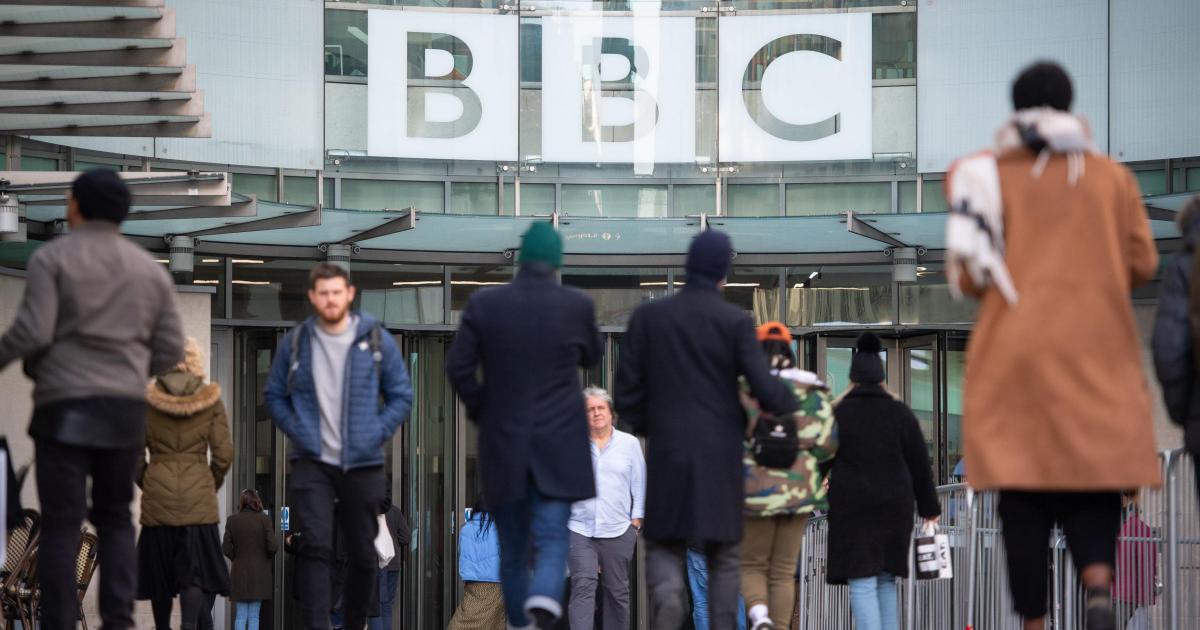
Some of the world’s greatest and most-loved dramas and literature in the English language have been made accessible, at the highest quality, to the Anglosphere. It is the only remaining great thing in Great Britain, in my opinion.
This has made it enemies in various places, notably among London-based news and broadcasting organisations which are privately owned and influenced, very often, by right-wing political parties, and illiberal governments in other countries, who seek to limit access of the British people to facts they don’t want to be heard.
The BBC is one of the last unifying elements of the United Kingdom, alongside the royal family, which is itself under pressure. I am neither a royalist nor a unionist, but perhaps those people who would destroy the BBC should beware of unintended consequences. Brexit was bad; destroying the last remaining pillar of the UK’s unity could be a lot worse.
John Jamieson, Ayr.
Don’t forget what Trump said
There has been a slew of articles on the crisis affecting the BBC as a result of its flawed editing of Donald Trump’s speech on January 6, 2021, including two today from Neil Mackay and Kevin McKenna (“Crisis-hit BBC is just another casualty of the collapse of the 20th century rulebook” and “This ‘insidious woke culture’ is putting the future of the BBC at risk”, both The Herald, November 11). Both offer interesting insights into the crisis, the reasons behind it and the serious implications arising from it.
Yes the BBC got it wrong but in the analysis around the editing, are we in danger of forgetting that ex-President Trump (as he was to become that day) actually said: “If we don’t fight like hell, you’re not going to have a country any more”? This is not the tone to encourage his supporters to accept the election result in a civilised manner over a cup of tea. Indeed amidst the recent noise, it can also be forgotten that Donald Trump didn’t accept the 2020 election result nor the democratic process by which Joe Biden beat him.
We forget what the current President of the US actually did and said on January 6, 2021 at our peril.
Willie Towers, Alford.
Read more letters
Stop the bashing
Brian Watt (Letters, November 11) accuses the BBC of being “institutionally biased” and then goes on to cite its News website in his support. You couldn’t make it up.
Sadly, the BBC is being bashed by loads of folk from all sides these days: left-wing, right-wing, nationalist, unionist, feminist, trans, etc. It has to stop.
We live in a pluralistic society where many voices compete for media attention. Many have an axe to grind against the BBC – Mr Watt is obviously one of them.
But they’re playing a dangerous game. In fact, they’re playing Donald Trump’s game.
It’s not a good look.
We need to realise the huge amount of good that we’ve got with the BBC before we lose it. Sure, the BBC isn’t perfect – but those who strive for perfection (in their view) in this world are often the enemy of what is good.
Lawrence Marshall, Edinburgh.
Keep a sense of proportion
It is true that the BBC’s editing of President Trump’s speeches was a colossal error of judgment, but the trite accusations that the problem is “systemic” and “institutional”, two over-used and lazy epithets, show just how deep prejudice against our precious public broadcaster is in the British press.
Do we really understand the meaning of these words? What is the evidence that suggests that prejudice and bias pervade the entire BBC service? Is it because prejudice and bias are merely expressions of what you don’t want to see, hear or believe? Or what you oppose?
All media organisations occasionally make mistakes. So why the storm of public and political outrage at the Beeb when others fail to meet proper standards? Speck and mote come to mind.
The Beeb’s standards must remain high, of course. It is publicly funded after all, but let’s keep a sense of proportion.
Trevor Rigg, Edinburgh.
Run by the left wing
Most of the things complained of about the BBC are really only symptoms of the fundamental problem that the BBC is totally unrepresentative of the British population.
For example, while 52% voted to leave the EU, nobody at the BBC did. Similarly, while opinion polls put Reform UK’s support at about a third of the electorate, nobody at the BBC is sympathetic.
The reason for this is that the BBC has long been run by left-wing university arts graduates, who consistently recruit like-minded people, while filtering out any applicant who thinks differently.
The BBC has long made strenuous efforts to ensure that ethnic minorities and members of the LGBT community are well represented among its employees. Indeed, certain minorities appear to be heavily overrepresented in relation to their share of the population.
The people who are consistently cheated by this set-up are the white working class, social conservatives and anyone else whom the left consider to be their opponents.
It would be impossible to replace sufficient BBC employees so that it became representative of the British people. Really, the only way forward is phase out the licence fee and let those who actually like it pay for it, same as with newspapers and streaming services.
Otto Inglis, Crossgates, Fife.
No friend of working people
The BBC is backed into a corner, not for anything as abhorrent as parroting Israeli defence of its war crimes including genocide in Gaza but for its rather clumsy précis of Donald Trump’s support for the popular attack on democracy following Joe Biden’s election victory.
It is not too surprising to see the Tory Party and Reform UK wading in to kick it while it is down, but what is beyond belief hearing it described as having a “left-leaning bias” by Shadow Secretary for Culture Media and Sport, Nigel Huddleston.
Let’s be very clear that while the BBC may be to the left of the Tory Party and Reform UK it is most certainly not left-wing. The BBC has always been an organ of state propaganda and remember how it presented Boris Johnson on shows such as Have I Got News For You as a friendly buffoon that made him electable and more recently provided a platform for Nigel Farage to promote his agenda as something palatable.
No matter how much the propaganda of the war years was eagerly consumed, the BBC has always sat well to the right of centre and has never been on the side of working people. Framing the BBC as having “a left-leaning bias” demonstrates how far to the right both the Tory Party and Reform UK actually are. Neither of those parties nor the state broadcaster should be trusted with the best interests of the working class.
Ni Holmes, St Andrews.
Fiona Bruce, presenter of the BBC’s Question Time debate show (Image: PA)
Advice for Fiona Bruce
I agree wholeheartedly with the views of Christopher H Jones (Letters, November 11) regarding Fiona Bruce. I was always led to believe that a good listener who didn’t interrupt received the desired response, rather than the aggressive tactics favoured by Fiona Bruce. She’s more akin to a panellist than a chairperson. Sadly this stretches to Antiques Roadshow, where again she has been given full rein to basically take over what has become the Fiona Bruce Show. She can’t hold a candle to the following, who were leaders in the field: David Dimbleby, David Frost, Michael Parkinson and Terry Wogan, who listened rather than badgered their guests into submission, and it made for first-class debate and first-class viewing. Ms Bruce would do well to watch some archive footage in an effort to become a competent chairperson.
Neil Stewart, Balfron.