
Critical national infrastructure (CNI) managers around the world are bracing for the worst solar storm in two decades, which could affect the electricity grid.
In the UK, the Met Office and British Geological Society (BGS) issued warnings on 11 and 12 November 2025 about solar weather, which was on its way from the sun to Earth, and the worst effects were expected to hit on the evening and night of 12 November.
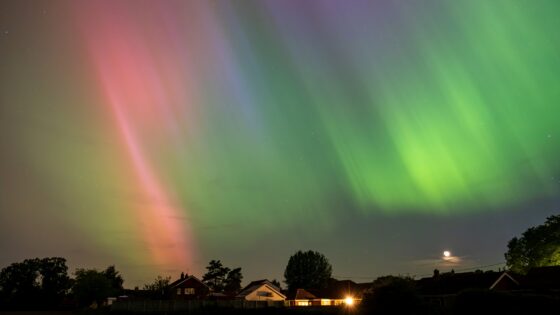
Some of the material from the sun had already arrived on 11 November, prompting visible auroras across the UK. The Met Office said: “Two CMEs (coronal mass ejections) arrived late on 11 November with a further CME expected on 12 November.”
Threat posed by extreme space weather to CNI
The Met Office Space Weather Operations Centre (Moswoc) says extreme space weather “can have potentially significant impacts on the UK’s critical national infrastructure”.
Space weather is a normal occurrence because the sun is in constant flux, but elevated solar activity is made more visible now than it would have been in previous decades and centuries due to the increased reliance we have on technology and satellite such as global navigation satellite system (GNSS), like the US military’s Global Positioning System (GPS).
“Solar flares can cause high-frequency radio and GNSS to perform erratically, extreme CMEs (coronal mass ejections) can put power grids at risk. Therefore, space weather prediction is of crucial importance to power companies, satellite operators and the aviation industry,” Moswoc says.
The 2025 National Risk Register from the UK Government listed severe space weather as a specific risk, rated as having a 5-25% likelihood in a 10-year period, and predicted to have “significant” impacts, which the register defines as causing 201-1,000 deaths and billions of pounds in economic costs.
‘Cannibal storm’ will create worst disruption in two decades, potentially affecting power
The BGS said in a statement that “current predictions suggest that a second storm, feeding off the first, will result in potentially the largest solar storm to hit our planet in over two decades”.
“Scientists believe that it has the potential to achieve the maximum level of G5 on the NOAA (National Oceanic and Atmospheric Administration) storm scale,” it continued.
“Dubbed a ‘cannibal storm’, the first event has already disrupted communications and global positioning system (GPS) satellite accuracy. At ground level, it created the biggest measured geoelectric field since BGS records began in 2012.”
BGS geomagnetic hazard specialist Gemma Richardson said: “Space weather can have a real impact on the lives of people across the planet.
“BGS records real-time data of geomagnetic conditions, underpinning the national forecast service. Our data suggests that this event could be one of the biggest storms we’ve seen in 20 years.”
Met Office space weather manager Krista Hammond said: “Multiple coronal mass ejections have reached Earth in recent days, with another one likely to arrive later today.
“This event is likely to be of a similar magnitude to the one in May 2024, which brought auroras across much of England and Wales.”
Hammond also told NCE: “Further coronal mass ejections are expected to reach Earth in the coming hours, enhancing aurora visibility, possibly as far south as England and Wales; though terrestrial weather (cloud and rain) will spoil visibility for many.
“We have witnessed both a solar radiation storm and a geomagnetic storm in the last few days. A further coronal mass ejection will reach Earth later today.
“With a G4/G5 event, potential impacts include: temporary loss in high frequency communications – these will be particularly disrupted over polar regions during the event, the possible dilution of precision for position and navigation, resulting in larger possible errors for positioning systems, and satellite communications and orbits could also be affected over the next couple of days.”
The Met Office website says that if a G5 geomagnetic storm hits, which are caused by CMEs, power systems may be affected.
“Localised voltage control and protective system problems may occur, leading to the potential for localised loss of power. Transformers may experience damage,” it says.
The National Energy System Operator (Neso) is responsible for balancing supply and demand on the electricity grid.
A Neso spokesperson said: “Neso works closely with the Met Office and other partners to forecast space weather and to take reasonable steps to prepare the electricity industry.
“Based on current forecasts, the current storm is not anticipated to require additional actions by energy networks, but we will continue to monitor the current storm as it progresses.”
Storm expected to be ‘well below’ level of Carrington Event
A wide range of solar weather events have impacted Earth since humans have been able to record them, most notably the Carrington Event of 1859 which had a direct impact on telegraph stations including in Boston, Massachusetts and Portland, Maine, in the USA.
If an event of the scale of Carrington happened today, the impacts on networks and infrastructure would likely be greater, but the specifics are difficult to predict because of the low frequency of powerful solar storms – and because our understanding of them has only started to mature relatively recently.
Hammond told NCE: “The level of event seen last night was significantly less than a Carrington Event. While further coronal mass ejections are forecast to arrive in the coming hours, it will remain well below that of a Carrington Event.
“It’s expected to be a G4/G5 event, but it’s important to note that G5 events are open ended in scale. So while we may tip into a lower level G5 event, it is still significantly below the levels that would have been seen as part of the Carrington Event.”
Lancaster University hosts AuroraWatch which is a website and app where members of the public can see when the aurora might be visible from the UK.
Lancaster University professor of space physics Jim Wild told NCE: “The intensity of the Carrington (-1750nT) is based on reconstructions of what the magnetic disturbance measured at the equator would have been. That is a parameter known as the ‘Disturbance: storm time’ (Dst) index.
“The modern version of the Dst index (measured in nano Tesla [nT]) is based on multiple equatorial magnetic observatories around the world, which didn’t exist at the time of the Carrington Event, but modern studies have tried to recreate what it would have been.
“The current event has so far peaked at -230 nT, but obviously, we are all keeping our eye on that. Nothing like a Carrington-level event so far. For context, the May 2024 event peaked at about -400nT.”
A government spokesperson said: “Space weather is an everyday phenomenon that, in the vast majority of cases, causes no effects on Earth.
“The UK has a secure and diverse energy system. We are confident in our plans to protect households and businesses during all space weather events, including through our dedicated Severe Space Weather Preparedness Strategy.”
Grid left unscathed by May 2024 solar storm
The solar storm which hit Earth in May 2024 left Great Britain’s electricity grid unscathed, according to an Ordnance Survey assessment published in August 2025.
When the country was hit by “notable period of space weather” in May 2024, the geomagnetic storm which was caused by the interaction of the space weather with the Earth’s atmosphere, “was declared by the Met Office as the strongest of its type in two decades,” according to OS, GB’s national mapping service.
The storm “caused temporary disruption to satellite communications, GPS signals and radio communications, but stopped short of affecting the National Grid,” OS said.
2025 set to be record year for extreme space weather
Also in August 2025, NCE reported that severe space weather notifications issued by the Met Office to critical national infrastructure (CNI) indicated that 2025 would break records.
NCE previously reported that Moswoc had issued nearly 4,000 severe space weather notifications to CNI managers in the first 10 years after it was set up in 2014.
Via data released in a Freedom of Information Act response to NCE, Moswoc said it had issued 4,294 severe space weather notifications between October 2014 and December 2024.
In total, across all notification classes, 2017 was the most active year with 631 notifications issued.
However, at 420 notifications at the time of the FOI response, 2025 appeared to be on track to be a record-breaking year for Moswoc severe space weather notices.
Like what you’ve read? To receive New Civil Engineer’s daily and weekly newsletters click here.