

The UK’s unemployment rate has hit its highest level outside the COVID pandemic era for nearly a decade.
Official figures showed the rate of unemployment rose to 5% in the three months to September, up from 4.8% in the three months to August.
The Office for National Statistics (ONS) said that, outside of skewed levels seen during the COVID pandemic years, this was the highest seen since August 2016.
It said average regular wage growth was also affected, dropping from 4.7% in the previous three months to 4.6% in the three months to September, and also estimated that the number of workers on UK payrolls fell by 32,000 during October to 30.3 million, following an upwardly revised 32,000 drop the previous month, though the numbers are subject to further revisions. This was the largest two-month drop since late 2020.
One expert has said multiple factors could be at play, including that the fall in the number of information and communication roles – as well as professional, scientific and technical jobs – would heighten fears in workers that AI is “coming for their jobs”.
Another told Yahoo News the new figures make for “sobering reading” with young people in particular.
Which jobs are most likely to be affected?
In a survey during Q3 (July, August and September), the Federation of Small Businesses found that the largest proportion of small businesses reporting a decline in employment by sector were the accommodation and food sector (with 42% saying they were cutting employment), and wholesale and retail trade (with 25% reporting a decline).
Those surveyed also revealed their intentions for the coming three months of October, November and December, with the sectors where most small businesses were expecting a decline in employment were revealed as the accommodation and food sector again (43%) and construction, where 32% of businesses said they were looking to reduce the number of staff they employ.
Sarah Coles, head of personal finance at Hargreaves Lansdown, said unemployment had risen particularly among men, with jobs falling in sectors including retail, real estate, construction, and across the services industry, as opposed to rises in employment in health and social work.
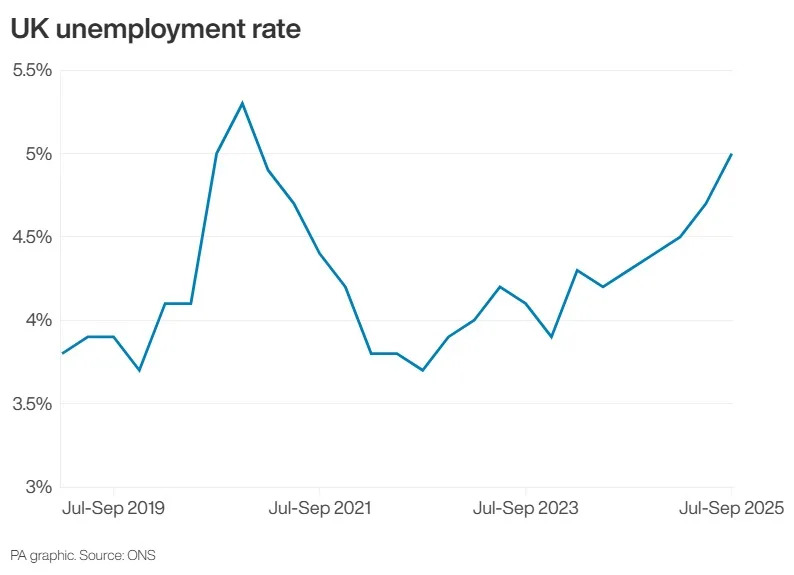
UK unemployment rate. Infographic from PA Graphics. See story ECONOMY Unemployment. An editable version is available: please contact graphics@pamediagroup.com. Embed code for interactive version:
A spokesperson for employment charity Shaw Trust told Yahoo News UK: “Today’s figures make for sobering reading – we’re seeing fewer jobs across key industries such as retail, hospitality, and manufacturing. And this is particularly bad news for young people, as these industries are key for entry level jobs. As a result, youth unemployment is substantially higher than the national average, and almost a million young people are not earning or learning.
“Young people have had a really raw deal – our teens and early twenties are the time we lay the foundation for the rest of our lives. But this generation have had to contend with a global pandemic disrupting their education, a cooling economy with less entry level jobs, and increasing competition from AI.
“Meanwhile, sectors such as health and social care continue to face chronic shortages, and there’s also high demand for people in logistics and transport, skilled trades and construction, education, and technology related roles.”
The charity said there is a “growing mismatch between skills and job market needs” and said more needs to be done to ensure that young people are ready for work, and have good jobs to go to.
What has caused unemployment rates to rise?
One reason for the rise in unemployment is uncertainty around the budget on 26 November, experts have suggested.
Martin Beck, chief economist at WPI Strategy chief economist, said the drop in payrolls data pointed to caution among businesses ahead of the budget.
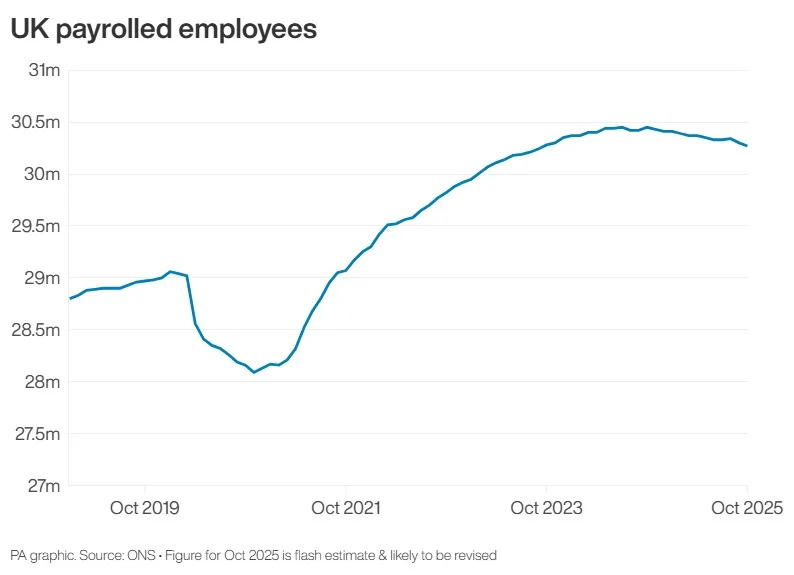
UK payrolled employees. Infographic from PA Graphics. See story ECONOMY Unemployment. An editable version is available: please contact graphics@pamediagroup.com. Embed code for interactive version:
“Signs of renewed weakness in the UK labour market suggest the real economy is starting to feel the chill of Budget tax uncertainty,” he said, warning that the “prospect of new tax rises in the upcoming budget poses further risks to employment, particularly if the Chancellor again looks to raise taxes on businesses”.
However, one silver lining in the data was that job vacancies rose for the first time in more than three years – estimated to be up by 2,000, or 0.2%, to 723,000 in the three months to October.
Coles, who is a columnist at Yahoo Finance, said there were “lots of forces at work, from slower economic growth to the rise in employers’ National Insurance making it more expensive to employ people”.
She said: “The fact that we’ve seen jobs fall among retail, real estate, construction, and across the services industry, indicate there’s likely to be a cyclical element to jobs.
“This is also reflected in the fact that the biggest rises in employment are in health and social work, which are less affected by the bigger economic picture.
“AI will be playing its part. The fall in the number of information and communication roles, as well as professional, scientific and technical jobs will do nothing to alleviate concerns among higher earners that AI could be coming for their jobs.
“The drop in the number of administrative and support staff could be a sign that finding an entry level job into some professions is getting harder as technology steps in.”
Tina McKenzie, policy chair of the Federation of Small Businesses, blamed the unemployment increase and drop in number of people on payroll on the “government’s complacent attitude to jobs and businesses”.
She said: “Pushing small businesses out of employing staff with ever increasing regulation, litigation and tax will scar present and future generations who will keep finding the search for work incredibly painful.
“We need a government that sides with the private sector – including people starting out on their own – not one that sides against it.
“At the upcoming budget, Rachel Reeves must take action that backs jobs and growth – increasing the employment allowance in line with the living wage, restoring the sick pay rebate, and making sure those who are sick can access the Chancellor’s new ‘job guarantee’ scheme would all help.”
Read more