
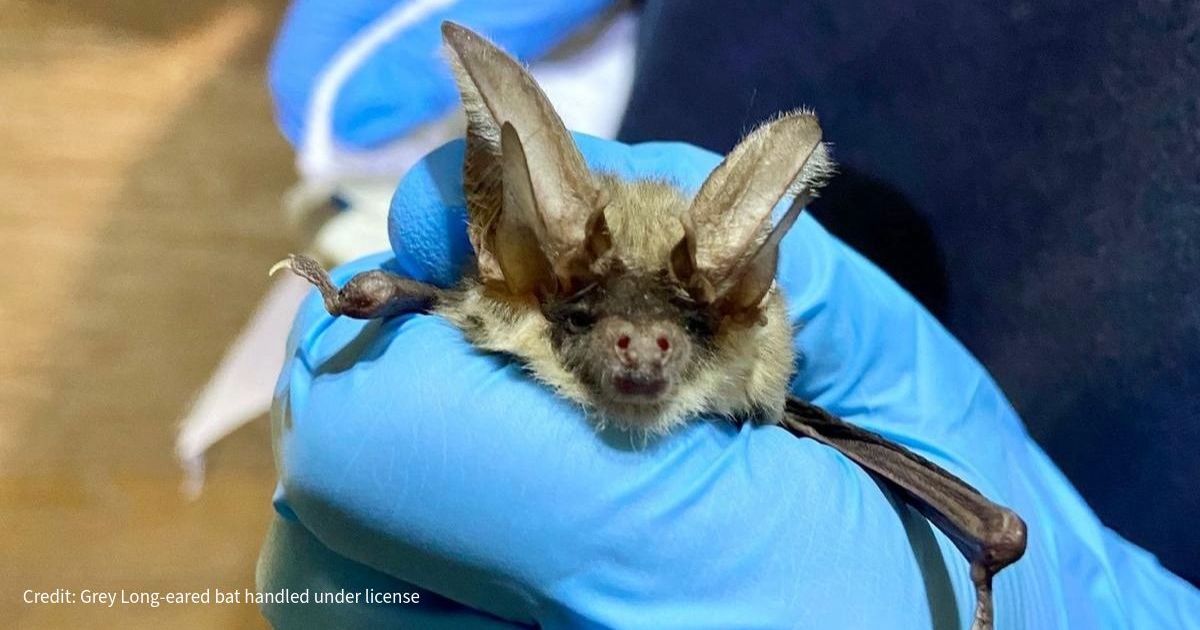
They are thriving! A grey long-eared bat being safely handled during licensed monitoring work at Seaton Wetlands.
(Credit: Submitted)
A bat species so rare it numbers fewer than 1,000 across the UK has been found in record numbers at a Devon nature reserve – with conservationists hailing the discovery as a “fantastic” breakthrough.
Surveys carried out at Seaton Wetlands, managed by East Devon District Council, have identified 13 grey long-eared bats this year – a significant proportion of the estimated national population.
The species, considered one of the UK’s most elusive mammals, was first detected at the site in May when Professor Fiona Mathews, former Chair of the UK Mammal Society, caught a single female grey long-eared bat during a trapping session focused on the migratory Nathusius’ pipistrelle.
Nature Reserves Ranger Ben Morgan-Brown, who was present during the find, later coordinated additional surveys with the Devon Bat Conservation and Research Group, of which he is a member. Across four licensed trapping sessions, the team recorded 118 bats from nine species, including a further twelve grey long-eared bats.
Each of the rare bats was ringed, allowing researchers to monitor their future activity and gain a better understanding of how the species uses the wetlands and surrounding habitats.
Sophie Duncan, Records Officer for the Devon Bat Conservation and Research Group, said: “To encounter so many grey long-eared bats was fantastic, and a great opportunity for our members. Seaton Wetlands is obviously an important site for this species, and the group is very grateful for the chance to conduct surveys and build on our research at other local sites.”
Councillor Richard Jefferies, portfolio holder for environment – nature and climate, said: “We were very excited about finding one grey long-eared bat in May, but an astonishing further twelve individuals over the summer is a huge tribute to the site and the work that the East Devon Countryside team do. This highlights the importance of working with other organisations. Together we are providing thriving habitats and discovering through monitoring wildlife that we have some of the rarest species in the UK here in East Devon.”
James Chubb, countryside manager, added: “Grey long-eared bats are one of the named priority species in our Countryside Stewardship Higher Tier scheme for Seaton Wetlands, so to have definitive proof the species is thriving on the nature reserve is hugely satisfying.”
The discovery is expected to contribute to broader conservation efforts for this priority species, whose survival is threatened by habitat loss across the UK.
Further information on Seaton Wetlands and other reserves can be found at www.wildeastdevon.co.uk. For resources on UK bats and conservation, visit www.bats.org.uk.